
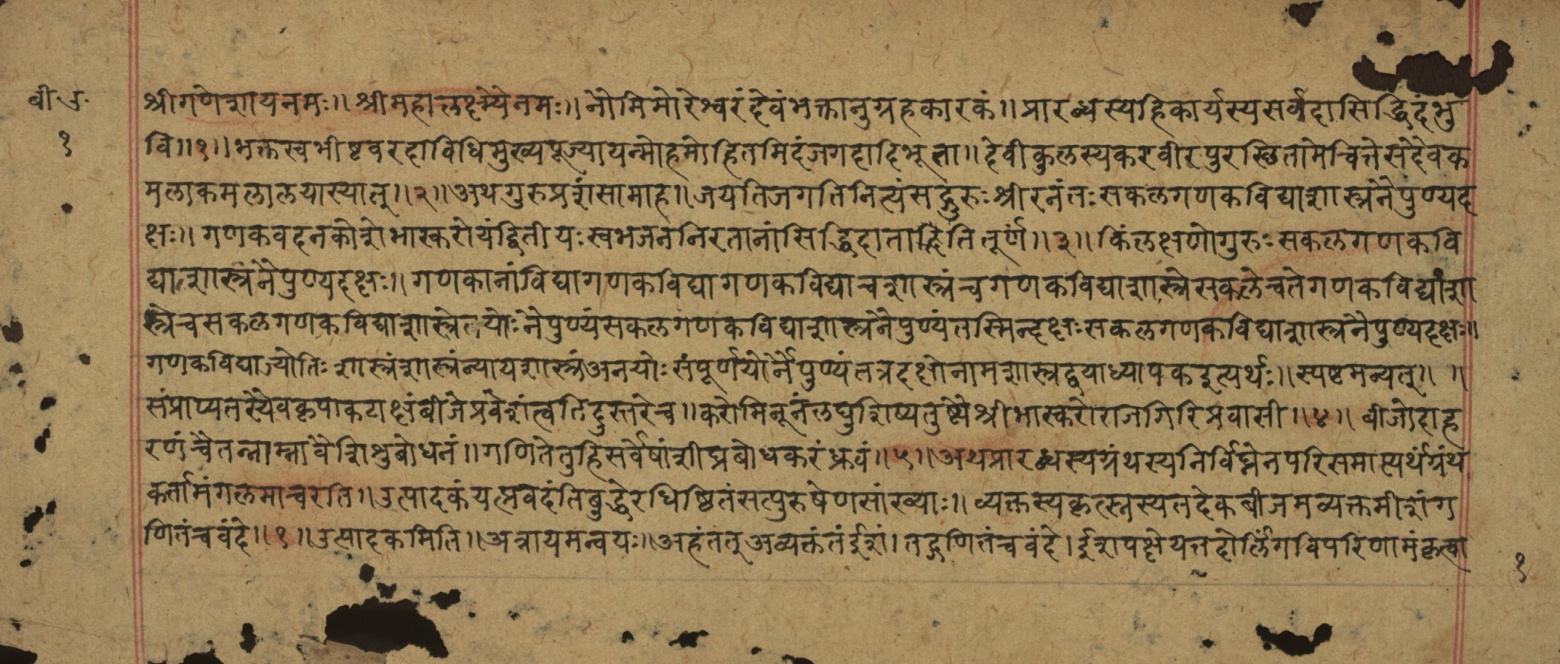
Most Sanskrit manuscripts are anonymous and ancient. This one is neither: it is an algebra textbook written in early twentieth-century Pune, and its donor's address is on the title page. The Bījodāharaṇam ('algebraic examples') composed by Rāmacandra Bālakṛṣṇa Jośī is a reminder that Sanskrit mathematics was not a dead language of a dead era — it was being taught, practiced, and donated to archives well into the twentieth century.
A Textbook With a Return Address
Rāmacandra Bālakṛṣṇa Jośī of Nārāyaṇa Peṭha composed the Bījodāharaṇam — "algebraic examples" — as a teaching collection, and the copy survives because he gave it to Pune's great history-research institute, the Bhāratīya Itihāsa Saṃśodhaka Maṇḍaḷa.
In memory of Bāḷakṛṣṇa [.........] Jośi. A donation to the Bhāratīya Itihāsa Saṃśodhaka Maṇḍaḷa by Rāmacandra Bāḷakṛṣṇa Jośi, 288 Nārāyaṇa Peṭha, Pune
The address is preserved in ink. This is not an anonymous compilation copied and recopied over centuries; it is a named author's personal copy, given as a memorial gift to an institution. The date is early twentieth century — an era when Sanskrit was being declared dead, when English was the language of education, when Indian mathematicians were learning calculus from Victorian textbooks. Yet here is Rāmacandra, composing algebra in Sanskrit verse, following the classical forms, teaching it to young students.
The Unknown as a Seed
The book opens like any orthodox treatise — salutations to Gaṇeśa and Mahālakṣmī — and then explains the philosophical name for the unknown: avyakta, the unmanifest.
Salutation to Śrī Gaṇeśa. Salutation to Śrī Mahālakṣmī. I bow to Mōreśvara, the god who bestows grace upon devotees, who always grants success in the world for the beginning of undertakings.
The Sāṃkhya framing is deliberate: as the unmanifest (avyakta) produces the manifest world, so the unknown (avyakta rāśi) produces the answer. The algebraic variable is not just a placeholder or a symbol — it is a philosophical principle, the potential that becomes actual when the equation is solved.
The unmanifest is pradhāna. Īśa is of the nature of sat-cit-ānanda. The calculation, however, is of the unmanifest alone in the pradhāna position.
This is Sāṃkhya cosmology applied to algebra. The unmanifest principle (pradhāna) is the source material; the conscious principle (Īśa, the Lord of sat-chit-ānanda — being, consciousness, bliss) organizes it. In calculation, we work with the unmanifest — the unknown quantity — and through the operation, it becomes manifest as the solution. The equation is a cosmological act in miniature.
Two Friends and One Hundred Rupees
Then comes the arithmetic, dressed as an argument between merchants — the kind of word problem that makes a classroom come alive.
One says: "Friend, give me a hundred in wealth, then I become double of you." Another says: "If you give me ten, then I become sixfold of that." Tell then what is the measure of wealth for me in that...
The setup is concrete and social. Two merchants are haggling. The problem is to find their initial wealth. Set up two equations: if x is the first person's wealth and y the second's, then x + 100 = 2(y - 100) and y + 10 = 6(x - 10). Solve by elimination or substitution. The algebra that seems abstract in a modern textbook emerges here from real negotiation, real currency, real stakes.
The Rules, Sung in Order
The textbook moves methodically through the operations — wealth times wealth is wealth, debt times debt is wealth, wealth times debt is debt — then squares, roots, and the khahara, the quantity that swallows everything and changes nothing.
The product of two wealths is wealth, thus produced 6. ... The product of two debts is wealth, thus produced 6.
These operations correspond to our modern understanding of positive and negative numbers and their arithmetic. Wealth (dhana) is positive, debt (rṇa) is negative. Positive times positive is positive; negative times negative is positive (the debts of two merchants combine into wealth in shared liability). Positive times negative is negative (wealth mixed with debt becomes debt). The terminology is commercial, but the algebra is rigorous.
The khahara — the "void-absorber" or "zero-eater" — is the additive identity, the quantity that vanishes in any sum. It is not nothing in the sense of absence; it is nothing in the sense of neutrality. When you see it, you can eliminate it because it contributes nothing to the result.
The Guru of Algebra and His Student
Rāmacandra frames his work with praise for his teacher, Śrī Ananta, described as "a second Bhāskara to the multitude of mathematicians."
Victorious forever in the world is the true guru Śrī Ananta, skilled in proficiency in all the sciences of mathematics. He is a second Bhāskara to the multitude of mathematicians, the remover of distress who grants success to those devoted to his worship.
The comparison to Bhāskara II (the twelfth-century mathematician whose Bījagaṇita was the standard) is high praise. But Rāmacandra is not just repeating ancient work. He is adapting it, translating it, making it accessible to early twentieth-century Pune students who needed to understand algebra through Sanskrit, not English, because Sanskrit carried the cultural inheritance and the philosophical framing that made mathematics meaningful.
The Bījodāharaṇam is a window into a transitional moment: Sanskrit mathematics still alive, still taught, still composed in verse. The donations to archives, the careful preservation, suggest that Rāmacandra and his contemporaries were deliberately saving this knowledge, knowing that the world was changing, that English and print would soon displace manuscript and Sanskrit, but that the work was too valuable to let disappear. It did disappear — but not completely. This manuscript in Pune's archive is a trace of an entire educational world that operated in Sanskrit, in verse, in the early twentieth century, teaching algebra the way Bhāskara had taught it eight hundred years before.