
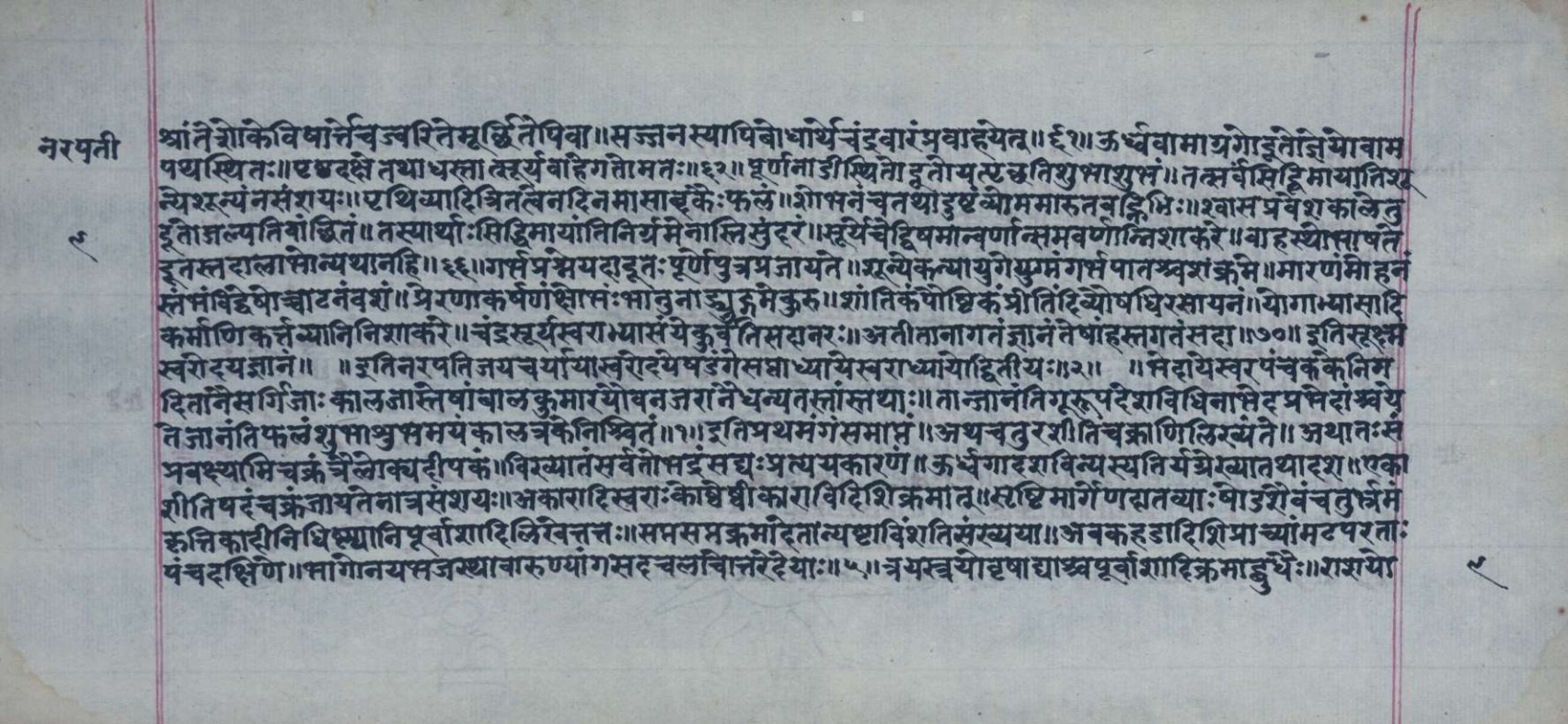
In the science of svarodaya, the breath is an oracle. The Śakunaśabdapraśasti — a compendium that shares the Narapati lineage of vowel divination — reads which nostril the breath is flowing through, and which syllable is rising, to answer the questions people actually brought: Will the sick recover? Which army wins? Is it safe to travel? Will a child be born? The breath, constant and uncontrolled, becomes a clock that never stops ticking.
The two currents: lunar and solar
The Śakunaśabdapraśasti names the two channels of breath — the lunar current flowing through the left nostril, and the solar current flowing through the right — and assigns each its domain of knowledge and power. They are not equal in strength; they rise and fall on schedules the text teaches.
In exhaustion, grief, fasting, fever, or even fainting, one should flow the lunar current for the purpose of restoring consciousness to one who has lost it. The messenger stationed in the left upward path should be known; this is the left. The right is considered to be located in the solar current.
The lunar current heals. Flow it when a person has lost consciousness, when grief threatens to collapse the body. The solar current acts — it is the channel of power, command, and violence. Which breath is active when a messenger arrives tells you whether his news will succeed or fail. A messenger arriving in the solar current, the text implies, carries force; arriving in the lunar, they carry mercy or caution.
Every act has its syllable
But breath is not uniform. Within each nostril flows a syllable — a vowel sound, a-kara, i-kara, u-kara, and so on. Each syllable is its own oracle. The Śakunaśabdapraśasti teaches which syllables demand which actions.
All auspicious and inauspicious acts should be performed according to the strength of vowels and colors. Killing, delusion, paralysis, enmity, expulsion, and subjugation — one should perform these at the rise of Guhasvara (hidden sound). Bathing, drinking, and all such acts, as well as clothes, ornaments, and decorations — the commencement of learning and marriage should be performed at the rise of Jivasvara (vital sound).
The fierce syllables carry fierce acts. Hidden sound (Guhasvara) governs killing, paralysis, subjugation. Vital sound (Jivasvara) governs gentleness: bathing, learning, marriage, ornament. Temples and royal coronations wait for the rāshi-svara — the sound that moves in the zodiac. The text teaches that timing and action are not separate; they are read together from the breath.
The five states of every vowel
Each vowel passes through five life-stages: child (bāla), youth (kumāra), full strength (yuva), old age (vṛddha), and death (mṛta). A vowel in childhood is weak, tentative — good for things requiring caution, bad for bold action. A vowel in youth brings gain and victory. In full strength it succeeds at everything. In old age it brings loss. At death it brings destruction.
The implications are vast. When you ask a question, your question is answered not by the vowel alone but by the stage the vowel is in. The same syllable behaves differently at different hours of its cycle. The Śakunaśabdapraśasti teaches how to calculate which stage a vowel is in at any moment — using measurements in ghati (time units), the phases of the moon, the day of the month, the season.
The Bala causes some fatigue, the Kumara gives gain of wealth, the Yuva is said to give all success, the Vrddha causes loss, and the Mrta causes destruction. In travel, in battle, in dispute, in loss, in theft, and in disease, the Bala vowel becomes inauspicious; in marriage and other auspicious matters it is auspicious.
Knowledge written in the breath itself
The Śakunaśabdapraśasti describes an intricate system of cycles. The breath runs through larger cycles — yearly, seasonal, monthly, fortnightly, daily. Each cycle has its own rulers, its own syllables, its own meanings. A twelve-year cycle governs the great turning of years. Within that, the seasons run their syllables. Within that, the months. Within that, the days.
This is not superstition laid over nature; it is nature itself structured as knowledge. The text teaches that a skilled practitioner can read past, present, and future from the breath — not as magic, but as consequence. If you know the breath's position in its many cycles, you know what the present moment is ripe for. This moment is right for marriage, that moment for war, another for planting, another for rest.
The genius of svarodaya lies in its accessibility. The breath is always moving, always in one current or the other, always holding a syllable. The oracle is never closed — a question at any moment can be read from the breath that flows at that moment. That, more than any particular prediction, is why this science endured: it made divination continuous with life, written into the ordinary act of breathing, available to anyone who learned to feel the difference between left nostril and right.