
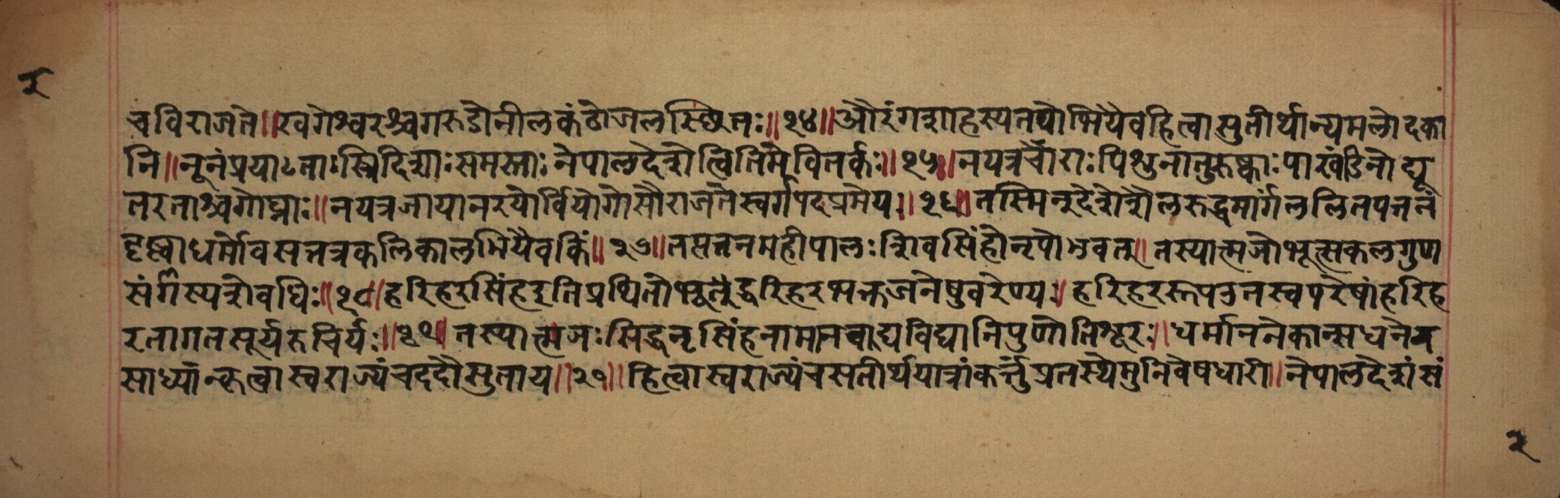
Not every Sanskrit court text praises a dynasty. Sabhāvinoda — 'the delight of the assembly' — spends some of its most beautiful verses praising a place: Nepal, described as a land so virtuous that heaven itself might be mistaken for it.
A royal poem's opening
The text begins conventionally enough — invocations to Ganesha and Dhanvantari, then the Sūryavaṃśa lineage. It is a court poem, and court poems have formulas. But the poet works within them with craft. The opening invocation to Ganesha, remover of obstacles, sets the stage for a journey: the poet bows before the god of beginnings, then summons the solar dynasty, the most noble lineage in Sanskrit literature.
I bow to Śrī Ḍhuṇḍhirāja, who destroys all sins, who is the joy of Pārvatī's heart, and who was given a modaka by Kamalā. The Sūryavaṃśa flourishes on this earth, in which mighty kings arose; in which were Māndhātṛ and others, devoted to dharma; in which was Rāma, the giver of all objects.
The solar dynasty is invoked — Māndhātṛ, Rāma — as the pedigree of the kings the poem will celebrate. These are not generic ancestors but archetypal figures: Māndhātṛ, the king who ruled the entire earth; Rāma, the embodiment of dharma. The poem situates its own king within a lineage of cosmic proportions.
The land without faults
Then comes the praise of Nepal, and the poem rises to its best lines. The praise is not of the king's deeds but of the land itself — its virtue, its geography, its isolation from vice.
Where there are no thieves, no slanderers, no cruel men, no hypocrites, no deceitful people, nor cow-killers; where there is no separation of husband and wife — there, O king, one should consider heaven itself to be present. In that land where the path is blocked by mountains, in Lalitapattana, having seen Dharma himself, what fear of the Kali age is there?
The praise is built on negatives — what the land lacks — and the absence of fault is its glory. There are no thieves because there is no theft; no slanderers because virtue silences the tongue; no cruel men because compassion is the law of the land. The mountain walls are not defenses but sanctuaries. They keep out the degradation of the Kali age — the age of conflict, confusion, and decline — and preserve within them a pocket of the earlier, better ages.
Lalitapattana (the beautiful city, modern Kathmandu) is where Dharma himself has been seen. This is the highest praise in Sanskrit court poetry: a place where the abstract principle of righteousness takes visible form, dwells in the valley, and governs the land. The mountains, in this reading, are not geographical features but cosmic boundaries, preserving a fragment of heaven on earth.
A poem as a place's portrait
Sabhāvinoda is a reminder that Sanskrit kāvya was not only romance and epic — it was also place-writing, praise of kings, and the celebration of particular lands. Its portrait of Nepal, sheltered by mountains and free of the Kali age's vices, is the kind of passage a court would remember and quote: a kingdom described as heaven, in verse. The text preserves not just a political moment but a vision of what a land could be — what it meant, in the 12th century, to imagine a realm where virtue and geography aligned, where a mountain range was also a moral boundary, and where one could point to a place on earth and say: heaven is here.