
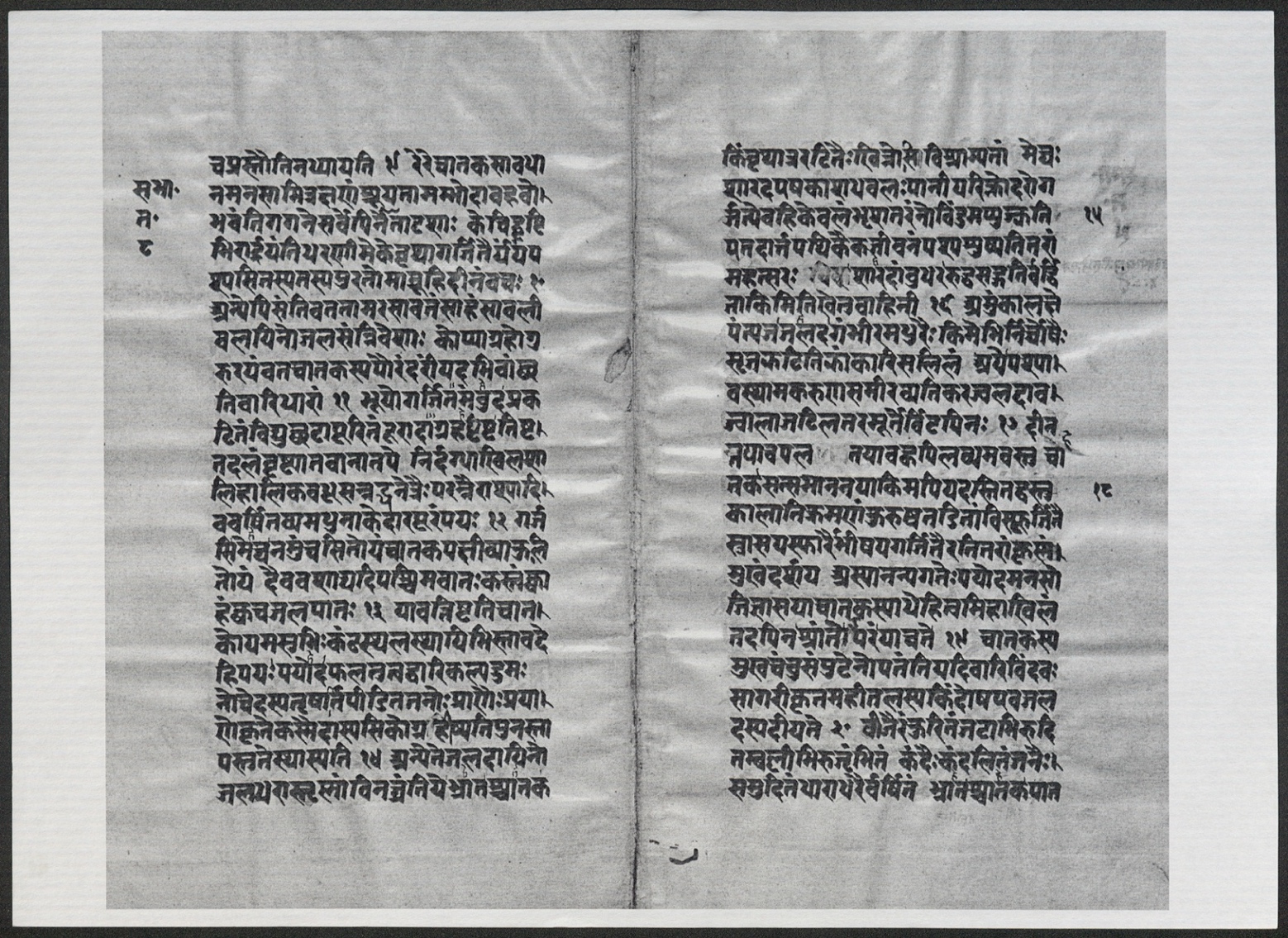
The Sanskrit subhāṣita is a poem built to be quoted — a verse of two or four lines that lands like a proverb with better manners. Sabhātaraṅga, 'the wave of the assembly,' is a collection of such verses, gathered from the court and the forest, the wise and the wicked, and arranged so that a single stanza can be pulled out and used. The collection opens with praise of the virtuous, then turns to skewer the wicked with precision.
The nature of good people
The manuscript opens with verses on virtuous character, developed through extended metaphors from nature. A good person's qualities are not abstract but visible, like the qualities of gold or sandalwood.
A good person neither feels delight nor speaks of it; he simply acts. Even when misfortune befalls, the wise remain steadfast in courage. The virtuous do not seek water that is extremely cool for bathing, nor a pearl necklace, nor sandalwood paste for anointing. But with affection they approach him who speaks kindly to good people, by whom the elevation of the mind is achieved and who is honored by the good.
Notice the paradox: good people do not pursue comfort or pleasure, yet they are not ascetics. They seek the company of others who honor virtue. Their wealth is not in possessions but in recognition of what is good — and in that recognition, genuine elevation of mind occurs.
The wicked, decorated but dangerous
The manuscript's moral verses are sharpest when directed at the wicked. They are spare, practical, aimed at the reader who has to deal with difficult people.
A wicked person should be avoided, even if adorned with learning. Is a snake, though decorated with jewels, not terrifying? Flies desire a wound, kings desire wealth; base persons desire quarrel, good persons desire peace. An elephant by a thousand hands, a horse by a hundred hands, a horned animal by ten hands, wicked persons by leaving the country.
Learning does not sweeten a bad character — the verse compares a wicked scholar to a jeweled snake. And it ends with practical arithmetic of distance: keep farther from the wicked than from an elephant. The bad person's nature is fixed and will pursue corruption as surely as flies seek a wound. The only remedy is separation.
The Cātaka bird's prayer
The collection's most famous piece is the address of the Cātaka bird — a creature of legend who drinks only rain, and begs it from the cloud.
Listen to the prayer of the Cātaka bird, O cloud: 'There are indeed many clouds in the sky, but not all are like you. Some merely thunder in vain without raining.' The wind drinks up the ocean, the fire consumes the forest, the sun dries up the waters of three regions — yet some obstacle or other always protects the Cātaka's life.
It is a poem about dependence and hope — the Cātaka trusting that this cloud, unlike the others, will actually rain. It works as a love poem (the supplicant trusting the beloved), a political allegory (the subject trusting the king), and a meditation on faith all at once. The bird's vulnerability — unable to drink from ocean, river, or well, living only by the cloud's gift — mirrors the human condition: we survive by what we do not control and cannot compel.
Gold tested by four means
The manuscript's deepest verses are those that use natural processes as windows into character. How do you test whether something is truly gold? The text offers a method that becomes a metaphor for testing persons.
Just as gold is tested by four means — rubbing, cutting, heating, and beating — so a person is tested by four: family, conduct, qualities, and actions.
This is more than analogy. It suggests that virtue and gold are tested by the same kinds of friction — pressure applied repeatedly, heat, separation from false elements. A person's character, like metal, reveals itself only under specific kinds of stress. No amount of rhetoric can substitute for this testing. You know what someone is made of only by watching them under pressure.
A portable library of wit
The Sabhātaraṅga preserves something now almost lost: the practice of building a library of sayings, each one complete enough to stand alone, sharp enough to change how the hearer thinks.
The eater of the long-beneficial Udumbara water and milk of the cow—Those whose souls are stained by poison-fire, who are double-tongued, crooked, who always take away the life of the world — who indeed are those Death-like wicked ones? What physician is there, what wicked one? Who is endowed with another form? Who is not satisfied with wealth? Who is there, who is not a scholar?
Each verse fits in the mouth, travels easily in conversation, and lands with precision. The Sabhātaraṅga is a reminder of how Sanskrit wisdom traveled: not as long treatises, but as single perfect stanzas, memorized and quoted. The subhāṣita was the tweet of its era — and this manuscript is a collection of the best ones, preserved for the next assembly. To read it now is to recover that practice: wisdom not as a book to be finished but as a set of crystalline sayings, each one testing the reader who hears it.