
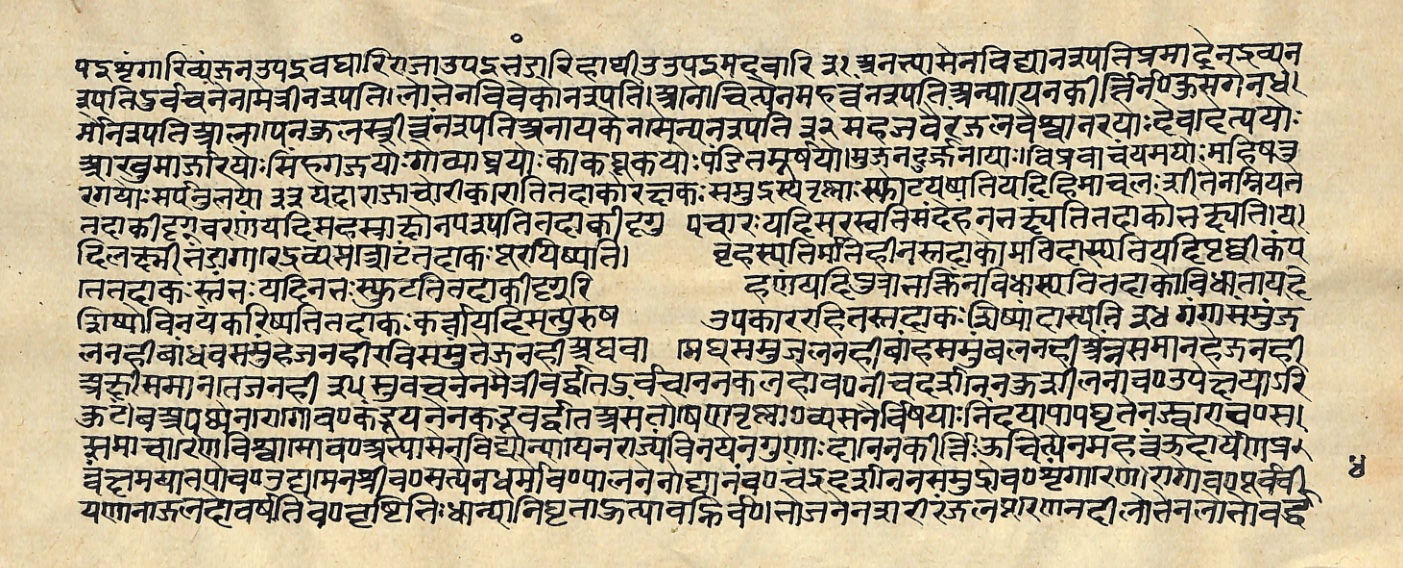
Every virtue has a weakness that quietly destroys it. That is the premise of a striking chain of aphorisms in the Sabhāśṛṅgāra, a Jain miscellany of proverb-verses that runs through the ways good things come to ruin, catalogs the enmities nothing can fix, and ends, unexpectedly, in a long meditation on how liberation actually works.
How good things perish
The text opens its ethical catalog with the economy of a proverb-list, pairing each virtue with the single flaw that undoes it.
Knowledge perishes through lack of practice, wealth perishes through negligence, a minister perishes through harsh speech, discrimination perishes through greed, counsel perishes through lack of deliberation, fame perishes through injustice, righteousness perishes through bad company, a woman perishes through excessive talk, an army perishes through lack of a leader.
Each pairing is precise: the virtue and its specific solvent. Nothing here is destroyed by an enemy from outside — everything decays from neglect within. The same page pushes the form further into rhetorical questions that verge on riddle: if a king himself commits theft, who is left to protect anyone? If the Himalaya releases no cold, what has the world come to? If Lakṣmī goes to a caṇḍāla's house, who is left to honor her? The device recurs throughout the manuscript — cosmic disorder used to sharpen a point about ordinary conduct.
Enmities that cannot be cured
From the ruin of virtues, the text turns to a catalogue of natural enmities — pairs that will never make peace, no matter what is tried.
Natural enmity arises between dog and cat, gods and demons, mouse and cat, eagle and serpent, cow and tiger, crow and owl, wise man and fool, good person and wicked person, Brahmin and barber, buffalo and horse, serpent and mongoose.
The list moves from the animal register to the social and lands on its real point: some conflicts are structural, built into the order of things, and wisdom lies in knowing which ones they are — so as not to waste effort trying to reconcile what cannot be reconciled. A later verse extends the logic with an even harder edge: doing a favor for a wicked man, it says, is like crossing a dry riverbed, chewing sand, or churning water — futile by nature, not by circumstance.
What gold endures, and what a good man endures
A gentler thread runs alongside the catalogue of ruin: verses on how good things suffer for the sake of others, and are better for it. Cotton endures scutching for another's cloth; the pearl endures piercing for another's ornament; gold endures heating and beating for another's decoration; sandalwood endures rubbing so it can cool someone else's body; the sun rises for another's sight, the cloud rains for another's benefit.
A good man acts for the benefit of others: cotton endures scutching for another's cloth; the pearl endures piercing for another's ornament; gold endures heating and beating for another's decoration... the sun rises for another's sight; the cloud comes only for another's benefit and rains for another's welfare.
It's the same aphoristic engine as the ruin-catalogue, run in reverse: instead of a virtue and its solvent, a substance and the suffering it accepts on someone else's behalf. The text later insists this is not incidental to virtue but definitional to it — 'good people do benefit to others, yet that is for their own self,' it notes, observing that the sun destroys darkness for others, not itself, and the moon cools with its nectar, not for its own body.
A closing turn toward liberation
What the surviving article never mentioned is where the manuscript actually goes: past the proverbs, into a sustained passage on mokṣa. It is emphatic that liberation has nothing to do with external austerity — not matted locks, not carrying a skull-bowl, not wandering the forest.
kintu rāga dveṣa parihāri śudhyīṃ mani mokṣa hoya i — But liberation comes only through a mind purified by giving up attachment and aversion.
The verse that follows makes the same point in classical form — rāgī badhyati karmeṇā, vītarāgo vimucyate: one who is attached is bound by karma, one free of attachment is released. It's a swerve that recontextualizes everything before it. The list of ruined virtues and fixed enmities isn't just court wisdom for getting by in the world; it's groundwork for a text that ultimately wants its reader to see the mind, not circumstance, as the real site of both bondage and freedom.
A mirror held to conduct
Sabhāśṛṅgāra is the kind of text that was read aloud in assemblies, each verse a small lesson meant to land in a single breath. Its genius is in the pairing — for every good thing, the flaw that undoes it; for every enmity, the reason it is fixed; for every substance that suffers, the larger good it serves. It is a practical ethics compressed into poetry, moving by its final pages from proverb to philosophy, and the manuscript preserves it the way it was meant to be used: verse by verse, one at a time, building toward a claim about the mind that the opening aphorisms only hint at.