
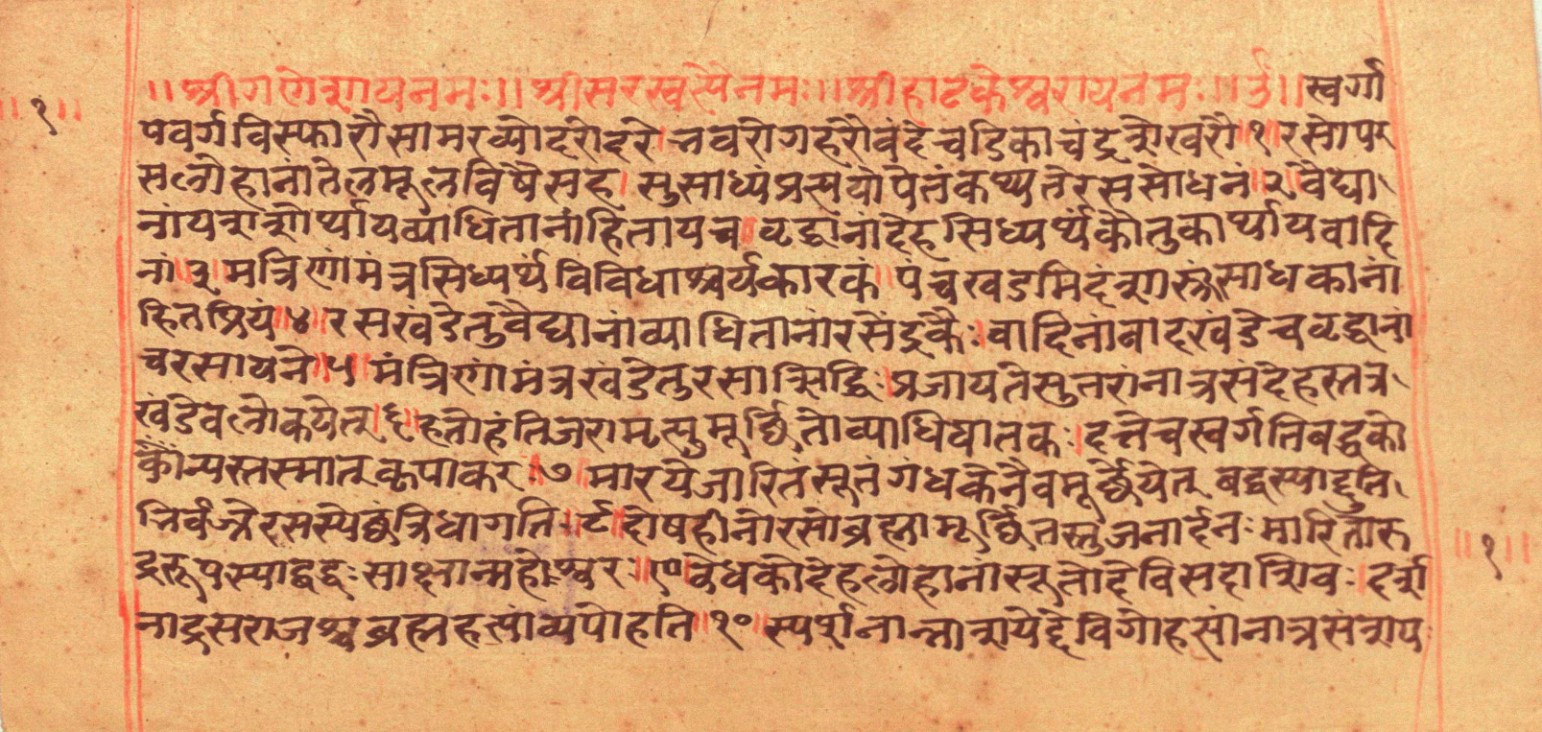
The Rasaratnākara—'the jewel-mine of rasa'—is a treatise with a strong opinion: mercury is the king of medicines. Attributed to the Siddha Nityanātha, it opens with invocations to Gaṇeśa, Sarasvatī, and Haṭakeśvara, then makes its case in a handful of verses. But the real work of the text is not argument; it is instruction—22 folios of precise procedures for purifying, processing, and combining mercury and its mineral companions into medicines that work quickly and in small doses.
Why rasa outranks everything
The argument is practical, not mystical: mercury works quickly, in small doses, and restores health fast. The text cites a long lineage of authority—from Śiva's Rasa-khaṇḍa through Nāgārjuna, Carpaṭa-siddha, Vāgbhaṭa, Caraka, and Suśruta—to show that mercury therapy sits at the summit of Indian medical tradition, not at the margins. And yet most texts left gaps: no procedure here, no enumeration of operations there, no proper dosage, no tradition. This compilation is built to fill those gaps.
Due to minimal usage and lack of interest in it, because of quick restoration of health, rasa (mercury/medicinal essence) is superior to other medicines. Rasa-vaidya (mercury/alchemical medicine) is not like ordinary vaidya (physician), it is divine, not human.
Mercury has defects—and they can be removed
But the text is not naïve about mercury's dangers. Raw mercury is sluggish, dull, contaminated with lead and tin—it has defects (doshas) that must be removed before it heals rather than harms. The treatise's first job is to describe how.
The purification of mercury (rasashodhana) is described as easily accomplished with confidence, using mercury, sulfur, metals, oils, ghee, and poisons. For the benefit of physicians and yantra-users, for the welfare of the diseased, for the bodily perfection of the elderly, and for the curiosity of disputants.
The purification involves washing mercury in sour gruel to remove the defect of lead. The defect of tin requires water from citra root. The king tree destroys impurity; citraka destroys the defect of fire; cowhage destroys unsteadiness. Each defect has a specific antidote, applied one by one using precise procedures—mortar work, precipitation apparatus, seven-night rubbings—until the mercury is pure.
Processing mercury through three states
Pure mercury is not yet medicinal mercury. The text describes three alchemical states: marana (killing/calcination), murchana (stupefaction/swooning), and bandha (binding/fixing). Each state gives the mercury different properties. Killed mercury destroys old age and death. Swooned mercury destroys disease. Bound mercury grants heaven. The three states are not separate drugs; they are the same mercury transformed through controlled heating and combination with sulfur and herbs.
Killed, it kills old age and death; stunned, it destroys diseases; bound, it grants heaven—what other is so merciful? One should kill calcined mercury, stun it with sulfur; with oblations to fire when bound—here mercury has threefold destiny.
The marana process alone—the killing—involves grinding mercury with equal parts sulfur and various herb powders, cooking in sealed crucibles in cow-dung fires, repeated cycles in different vessels (ratna-puta, vajra-musa, bhudhara-akhya puta). A single marana can take weeks of careful work: grinding for four yamas (periods), cooking with specific herbs, cooling, grinding again, repeating ten times until the mercury becomes ash. This is not alchemy in the fantasy sense; it is craft—exacting, repeatable, and based on observation of what works.
The mineral companions: sulfur, diamond, mica
Mercury does not work alone. The text devotes detailed sections to the purification and processing of uparasas—secondary minerals that work with mercury. Sulfur (gandhaka) is purified through washing, oil-extraction, and repeated burning. Diamond (vajra) is classified by color and shape: male diamonds are round and radiant; female diamonds are six-cornered; neuter diamonds are triangular. Each type serves different purposes, and each must be purified through its own process—some placed in tigress bellies and cooked, others treated with horse urine and decoctions of specific herbs.
Yellow, yellow one gives liberation and the eight siddhis; the red one is said to be a Kshatriya, a conqueror of death, powerful, a destroyer of gray hair and disease, and an aphrodisiac. The white one would be for a Vaishya, a maker of the body's firmness.
Mica (abhraka) has four types—pināka, dardura, nāga, and vajra—each with different properties for disease. The text covers the purification of each, the herbs to use, the apparatus required, the length of cooking, the signs that the process is complete.
A practical text for practitioners
What distinguishes the Rasaratnākara is that it is not a mystical claim dressed in medical language. It is a manual: here are the defects you will encounter, here is how to remove each one, here are the apparatus and timing you will need, here is what success looks like. The author, Nityanātha, claims to have extracted this knowledge from many earlier texts and from personal experience (anubhava). What emerges is a compendium dense with procedure—enough detail for a skilled practitioner to follow, enough restraint to avoid unnecessary elaboration. This is how knowledge transfers from one physician to another across generations.