
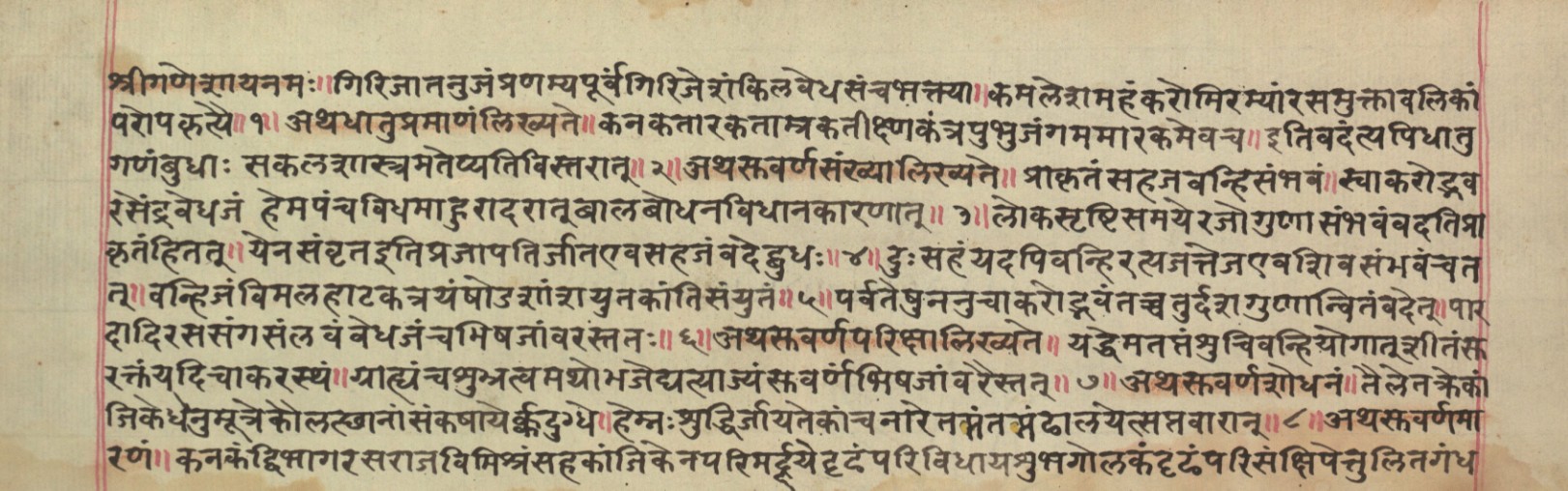
This 12-folio Rasamuktāvalī from the Poona University Collection at Bhandarkar Oriental Research Institute is a short course in turning precious metal into medicine. Composed by Kamaleśa, it walks through the full lifecycle of gold as a drug: classification, testing, purification, and incineration — and then the long list of diseases the resulting ash was trusted to cure.
Five kinds of gold, one that matters
The text begins with taxonomy. Gold is fivefold: natural, fire-born, mine-born, mercury-born, and piercing-born. The manuscript immediately launches into parīkṣā — how to test it — and the tone is that of a metallurgist, not a poet. The classification itself sets the frame: natural gold (prākṛta), born at the world's creation; fire-born (vahnisambhava), brilliant and pure; mine-born (ākara), endowed with fourteen qualities; mercury-born (rasendra), obtained from mercury processing; and piercing-born (vedha), the rarest and most potent.
Now the classification of gold is written. Natural, artificial, fire-born, mine-born, mercury-born, and piercing-born—gold is said to be of five kinds, for the purpose of instructing the young.
Once the types are named, the next step is crucial: testing. Gold that has heated pure but remained cool is true; mine-born gold that shows whiteness is acceptable; anything else is rejected. The text then moves to purification (śodhana): gold is cycled through oil, buttermilk, fermented rice water (kāñjika), cow's urine, and horse-gram decoction, heated repeatedly until its essence emerges. Only then does the actual work begin.
One should carefully enclose mercury and sulfur, thirty fire-stones daily, in the elephant-furnace. With fourteen good coverings, gold-ash becomes pleasantly and delightfully produced.
What dead gold cures
The therapeutic list for hema-bhasma (literally 'dead gold') is staggering in its scope: wounds, dyspnea, cough, consumption, disorders of pitta and vāta, diabetes, grahaṇī, severe diarrhea, leprosy, fever, impotence, and insanity — while "promoting youth, radiance, strength, semen, and speech." This is the rasāyana ideal: a metal reduced to ash so fine it behaves like a tonic rather than an ornament. The manuscript lists not just treatment of disease but restoration of what disease took away.
Dead gold produces divine radiance, cures wounds, dyspnea, cough, consumption, and disorders of pitta and vāta. It destroys diabetes, grahaṇī, severe diarrhea, leprosy, fever, and also impotence and pride.
What makes this remarkable is not the ambition of the list but its specificity. The text doesn't simply claim gold ash treats everything; it names conditions, pairs them with afflicted tissues (pitta bile disorders, vāta wind disorders), and distinguishes between the ash's action on the body's humors. The precision suggests actual experience—a tradition watching what worked and what failed, codifying successes.
Mercury, pearls, and the mṛgāṅka pair
Gold never works alone here. The Bālamṛgāṅka and Rājamṛgāṅka formulations combine it with purified mercury, orpiment, jasmine, pearls, and emblic myrobalan, triturated for seven days and processed in a sealed apparatus. The manuscript is equally careful with the other metals — silver must be mined, not tin-derived or transformation-derived; copper carries eight defects that must be removed; iron is threefold, and only kānta (magnetic iron) and tīkṣṇa pass the tests. Each metal gets its own māraṇa (killing/incineration), its own furnace, its own list of virtues and toxicities.
The genius here is that the Rasamuktāvalī doesn't present metals in isolation. It builds a complete materia medica of the periodic table, with each element assigned a therapeutic role and clear protocols for its preparation. Gold treats consumption and weakness; silver carries medicine across the ocean of disease; copper destroys leprosy and wound-born disorders; iron restores vigor and destroys anemia. They become a coordinated system.
The risks are in the text too
What I appreciate most is that the dangers are not hidden. The Rasamuktāvalī explicitly enumerates the doṣas (faults) of unripe preparations — vomiting, purgation causing burning, fainting, high fever, trembling — and warns that badly processed copper "destroys semen and strength, and causes diabetes." This is a tradition that knew its metallurgy could harm, and codified the signs so a physician could catch a failed batch before it reached a patient. Impure or incompletely processed metals are poisons; only the perfected ash heals.
Reading it, the line between pharmacy and laboratory disappears. The same folios that recite therapeutic verses specify fire-stones, coverings, and furnace times — a small, exact manual for a workshop that made medicine from the periodic table. The text is a gift to anyone trying to understand how Ayurveda thought about transformation: matter burned, cooled, ground to fineness, until it becomes medicine. The key is precision, timing, and knowing when the work is finished.