
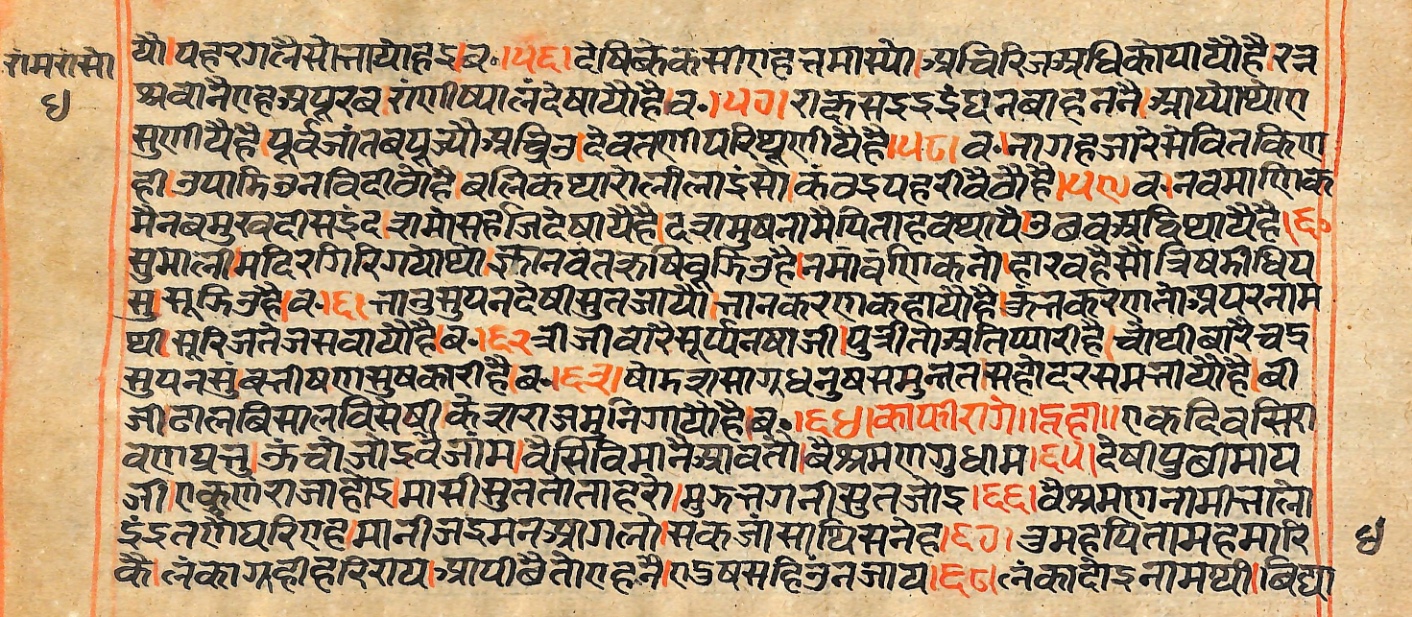
The Rāmayaśorasāyana — 'The Elixir of Rāma's Glory' — is a 243-page vernacular poem by Keśavarāja, written in a Rajasthani-Gujarati dialect with Devanagari script, and it opens somewhere unexpected: with salutations to Jain tīrthaṅkaras. This is the Rāma story told inside a Jain moral universe, where the same beloved characters carry a different message.
A Jain frame for a Hindu epic
The first folio sets the tone immediately. "Salutations to the revered Gurus. Salutations to Śrī Śāradā. The Lord Śrī Munisuvrata Swami, the deity who delivers the three worlds... I salute." The poet tells us the work is a rasāla — a narrative composition — and that in the Harivaṃśa lineage "the essence of the story of Hari Rāma is told." Then comes the moral: "Rāma's story is the head of all stories; listening, one's sins are washed away and the cycle of rebirth is averted — by it one attains the place of Śiva."
In the Harivaṃśa lineage, the essence of the story of Hari Rāma is told. This composition is called Rasālā, which always brings victory... Rāma's story is the head of all stories; by it one attains the place of Śiva.
Kishkindhā and Laṅkā, in the poet's own geography
The poem builds its own world from the familiar epic materials. There is King Bali, "there is none stronger than Bali, who always acts with might," ruling both Kishkindhā and Laṅkā with prosperity. There are the vānara lineages — from Śrīkaṇṭha was born Nandana Vajra Sukaṇṭha, "causing joy and happiness" — and the rākṣasa dynasties of Laṅkā. The genealogies are recounted with cataloging relish, the way a village audience would want them: who married whom, who ruled what, and how many sons each king had.
Rāvaṇa's family album
Rāvaṇa himself arrives with full biography. His mother Kaikesī bore four children: Kumbhakarṇa, Rāvaṇa (called Daśamukha, ten-faced), Śūrpaṇakhā, and Vibhīṣaṇa. He marries Mandodarī, daughter of the celestial architect Maya, on Mount Vaitāḍhya in a city of divine music — and the text notes the fourteen boons and the rites on the fifth day after the birth of a son. His son Indrajit is born "with eyes like clouds," riding a cloud vehicle, bearing weapons — "neither second nor third was born." The poem's Rāvaṇa is no cardboard villain; he is a king with a family tree, and the text spends real pages on it.
Daśador (ten-armed) king's son was born. Indrajit was his name, by which he was called, indeed. With eyes like clouds, neither second nor third was born. Megha (cloud) as vehicle, bearer of weapons, thus he was known.
The moral economy of the story
For all its epic cast, the poem keeps returning to dharma. The story of Lubdhaka, the greedy hunter, is told as a lesson in self-restraint: a sinful soul, a sage in Vārāṇasī, and the path to mokṣa through saṃyama. A page on pride warns that "the earth breaks where there is pride; greatness departs and the wealthy become poor, the living are counted as dead." And the demoness Trijaṭā shows compassion and devotion to Rāma even within Laṅkā. The Rāma story here is a machine for producing moral examples, and the poet never lets the audience forget it.
The manuscript itself carries its history in its margins: accession number 1657 of 1891–92–95, new number 8, stamped 'Microfilmed' in red. It is a cataloged survivor of a once-large vernacular tradition — and reading it, I felt the pull of a whole regional literature of Rāma that never made it into the printed canon.