
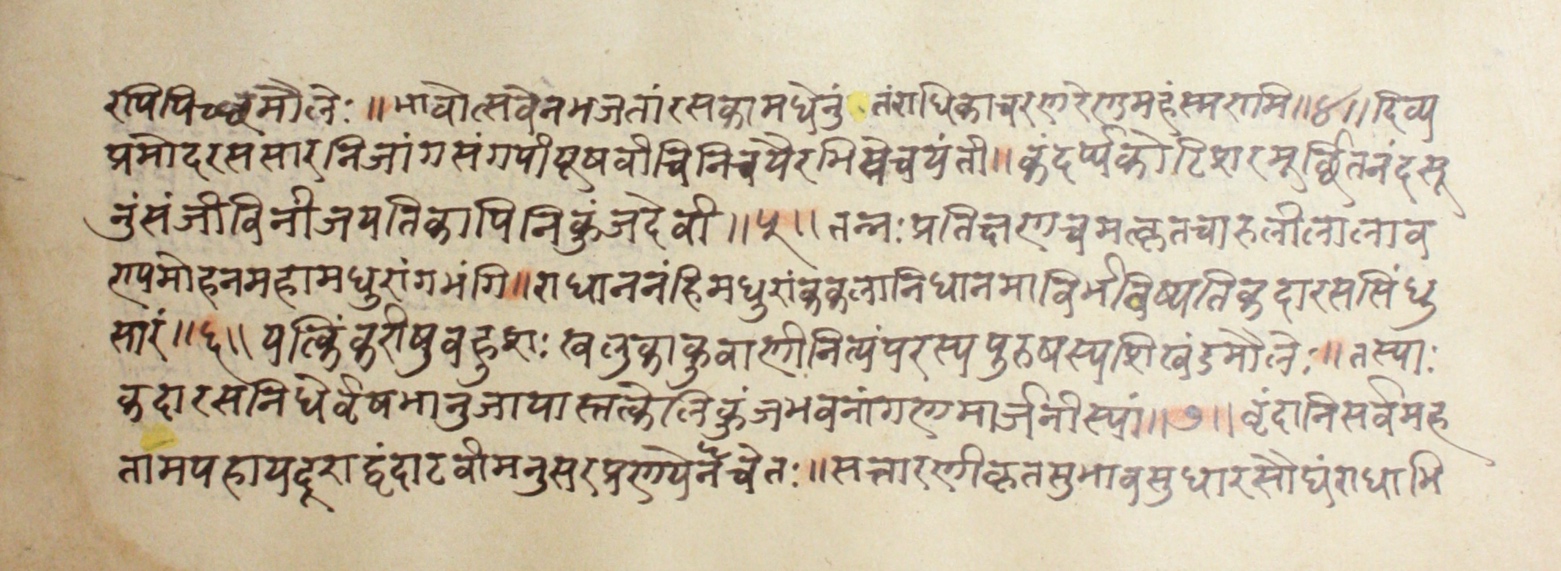
A second copy of the Rādhāsudhānidhi survives in the collection — and its opening is a reminder of why this poem was copied more than once. The same images return: Rādhā as the treasure of rasa, her foot-dust as the object of meditation, and the poet's longing to be near her.
The treasure of rasa
The opening salutations establish the poem's theology — Rādhā as the essence of devotional emotion, the essence of rasa itself. The poem bows to her, calling her the most difficult-to-attain goal, even for the great Madhusūdana.
Obeisance to Śrī Gaṇeśa. Śrī Rādhāvallabha is victorious. Obeisance, obeisance to Śrī Rādhā. Now begins the composition of Śrī Rādhā-sudhā-nidhi. She whose garment's edge, when playfully moved, creates a supremely blessed and most blessed breeze by which even the self-satisfied become accomplished—may there be obeisance to her, to the direction of Vṛṣabhānu's daughter.
Even the movement of her garment is liberating — the poem opens by making Rādhā's presence itself a form of grace.
The dust of her feet
Then comes the image that runs through the whole work: the foot-dust as a wishing-cow of rasa. This is not literal dust, but the condensed blessing of her presence, and it grants what those who worship ask for.
I meditate upon the dust of Rādhikā's feet, which is infinite power, an instantaneous subjugating powder, which was not quickly perceived even by Brahmā, Rudra, Śuka, Nārada, Bhīṣma and others, though they are the chief of men. One with a peacock-feather crown! I meditate upon that dust of Rādhikā's feet, which is a wish-fulfilling cow of rasa for those who worship with the festival of ecstatic emotion. Glorifying that certain grove-goddess who, with waves of nectar arising from the embrace of her own body filled with the essence of divine bliss, sprinkles the son of Nanda, who is swooning from the arrows of millions of Cupids.
The image is deliberately extravagant — the dust of her feet grants every wish of devotion — and the poem keeps returning to it, like a devotee circling a shrine.
The faces of devotion
Deeper into the manuscript, the poem branches into many modes of prayer. The devotee asks not for enlightenment or escape from the world, but for one simple thing: the chance to serve. The language shifts between the intimate and the cosmic.
I meditate upon the moon-like face of Śrī Rādhikā, which is the joy of the cakora bird satisfied by Govinda's eyes, which is the bud of the expansion of the essence of the rasa of love's splendor, which showers with streams of wonderful nectar-moonlight. When will I, with joy, worship that crest-jewel of rasikas, the son of Nanda, in the festival of the wondrous rasa-dance? She who sustains my life, deceiving me with the pretext of foot-caresses — may that couple, engaged in ever-fresh sport in the grove-cluster filled with the humming of bees, be victorious.
The poem does not ask for transcendence; it asks for presence. For a place in the groves of Vṛndāvana. For the gift of seeing Rādhā and Madhava in their play. This is the peculiar generosity of the text — it sets its aim not beyond the world but in the depths of love's intoxication.
The language of longing
The Rādhāsudhānidhi develops a specialized vocabulary for forms of desire and worship. Every page adds new names for Rādhā, new postures of prayer, new metaphors for her grace. The redundancy is deliberate — like a musical theme, it is not meant to say something new each time, but to return to one truth from every angle until the reader is so surrounded by it that resistance becomes impossible.
O Rādhā, you who are the essence of all loveliness, the sole essence of the essence of joy, the essence of compassion, the essence of sweet beauty, the essence of cleverness, the essence of amorous pastimes—you are the complete essence of my mind! You are the wish-fulfilling jewel of those who bow down, the crest-jewel of the women of Vraja, the family jewel of Vrishabhanu. You are the jewel that pacifies the desires of the dark one, the ornament of the nikunja groves.
The survival of two copies of the Rādhāsudhānidhi in one collection is a fact about the poem's popularity: this was a text people wanted, copied by hand and kept. The bhakti poetry of the Rādhā tradition traveled through such copies — each one a small act of devotion in itself, preserving the treasure of rasa for the next reader. Where manuscripts traveled, the tradition lived.