
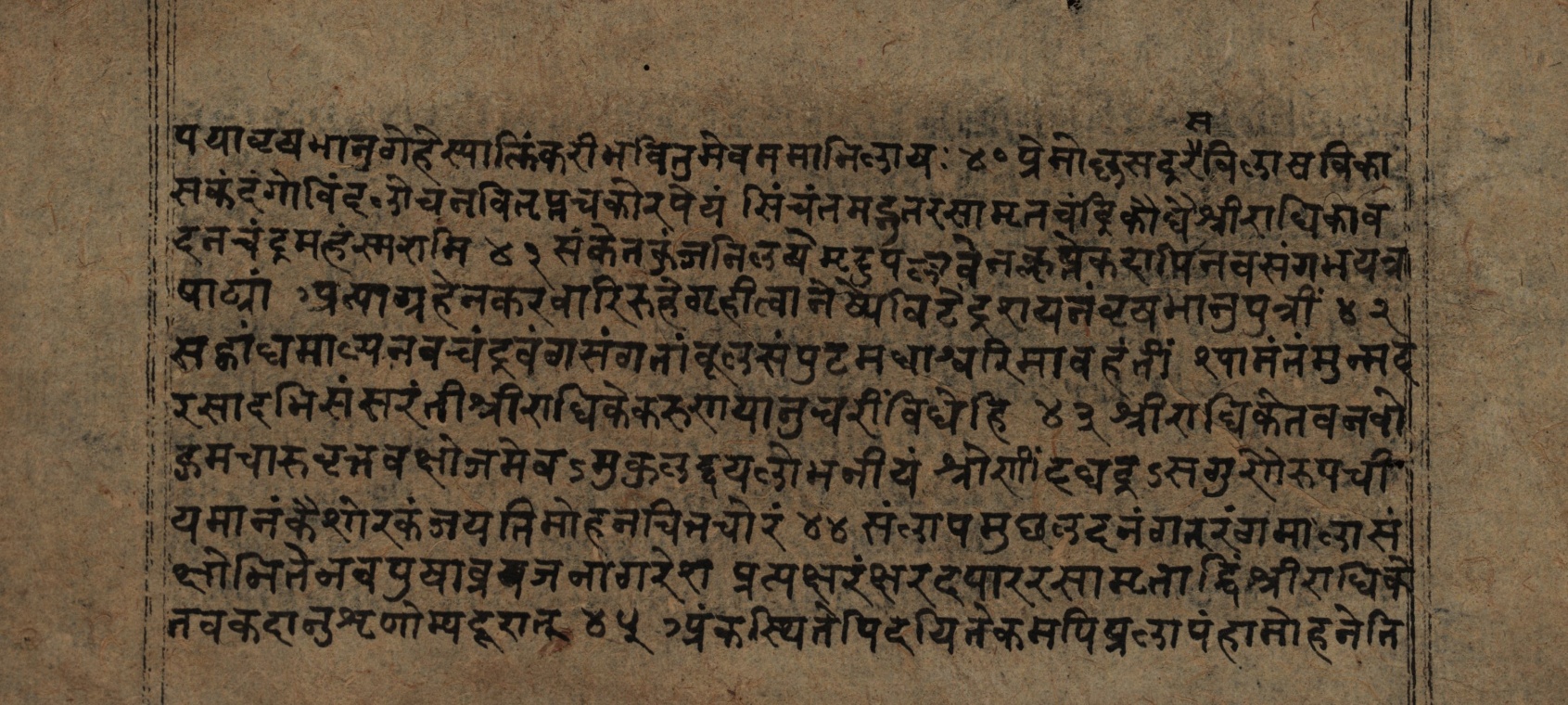
Devotional poetry in Sanskrit often turns worship into a job application — the poet asks, not for wealth, but for the lowest position in the beloved's household. The Rādhāsudhānidhi, a poem by Śrī Vyāsa Kāśīrāma, does exactly that: it praises Rādhā as the embodiment of rasa — the essence of aesthetic and devotional emotion — and then asks, verse after verse, only to serve her.
Rādhā as the essence of rasa
The poem's central image, established in its opening invocation, is Rādhā as the embodiment of rasa itself — a paradox of sweetness and intoxication.
For in Radha's face, the essence of the ocean of rasa manifests as the sweet abode of poison. That cuckoo voice of hers, repeatedly calling out to the Supreme Person, the crested one — may I become the sweeper of the courtyard of the pleasure-grove of that Vrishabhanu's daughter, who is the treasure of the essence of rasa.
The paradox is deliberate — the 'sweet abode of poison' is the beauty that intoxicates and transforms. And the poet's response is immediate: not admiration from a distance, but the wish to sweep the courtyard.
The wish to serve, worked out in detail
The poem returns again and again to that wish — not to be Rādhā's equal, but to be her servant, and it grows remarkably specific about what that service would actually involve.
O Vṛṣabhānu's daughter, by your mercy I desire to become a maidservant in your household... Make me, O Śrī Rādhikā, an attendant by your mercy, who carries her own garland, fresh sandalwood paste, and a wonderful box of betel.
Later verses push the fantasy further into intimate domestic detail — arranging leaf-patterns on Rādhā's shoulders, placing a decorative dot on her cheek, searching through her hair, binding a loosened braid, fastening a fallen pearl necklace. The poet imagines devotion not as distant reverence but as the small, repeated tasks of a lady's attendant.
To spread out the bed of leaves at the appointed bower, to arrange everything properly all around, to bring you to the dark moon, O fair one — O Radhika, bestow upon me your merciful glance.
Radha's service placed above union with Krishna
What the shorter draft of this article missed entirely is the poem's most striking theological claim — a passage arguing that serving Rādhā is actually superior to seeking direct union with Kṛṣṇa himself.
One who rejects service to Radha and strives for direct association with Govinda — such a person desires the full moon of nectar without the experience of the night... Those whose hearts meditate without limit on Radhika... who have attained the path consisting of rasa — I offer my obeisances to those great souls.
This is the Rādhā-dāsya theology of the Gauḍīya Vaiṣṇava tradition stated in its sharpest form: Rādhā is not a step toward Kṛṣṇa but the destination itself, because her love for him is the very substance of the rasa the devotee seeks. Wanting Kṛṣṇa without first wanting to serve Rādhā, the poem says, is wanting the moon's nectar without ever having sat through the night to earn it.
Naming, remembering, becoming
Threaded through the poem is a smaller, quieter claim about the power of Rādhā's name itself, treated as inseparable from her presence.
That which, when chanted even once, attracts the Lord of Gokula that very moment; where, for those filled with love, all other goals of life appear trivial; whose two syllables 'Rā-dhā' cause Śrī Kṛṣṇa Himself... to manifest wonderfully.
The theology of the servant
The maidservant wish that runs through the Rādhāsudhānidhi is not humility as performance — it is the devotional logic of the tradition worked out to its furthest conclusion: the closest one can come to the divine is not to possess it, but to be allowed to serve it, and even that service is placed above the union it seems to only prepare for. This manuscript preserves the poem's fifth book — where longing itself, made specific down to the betel box and the loosened braid, becomes worship.