
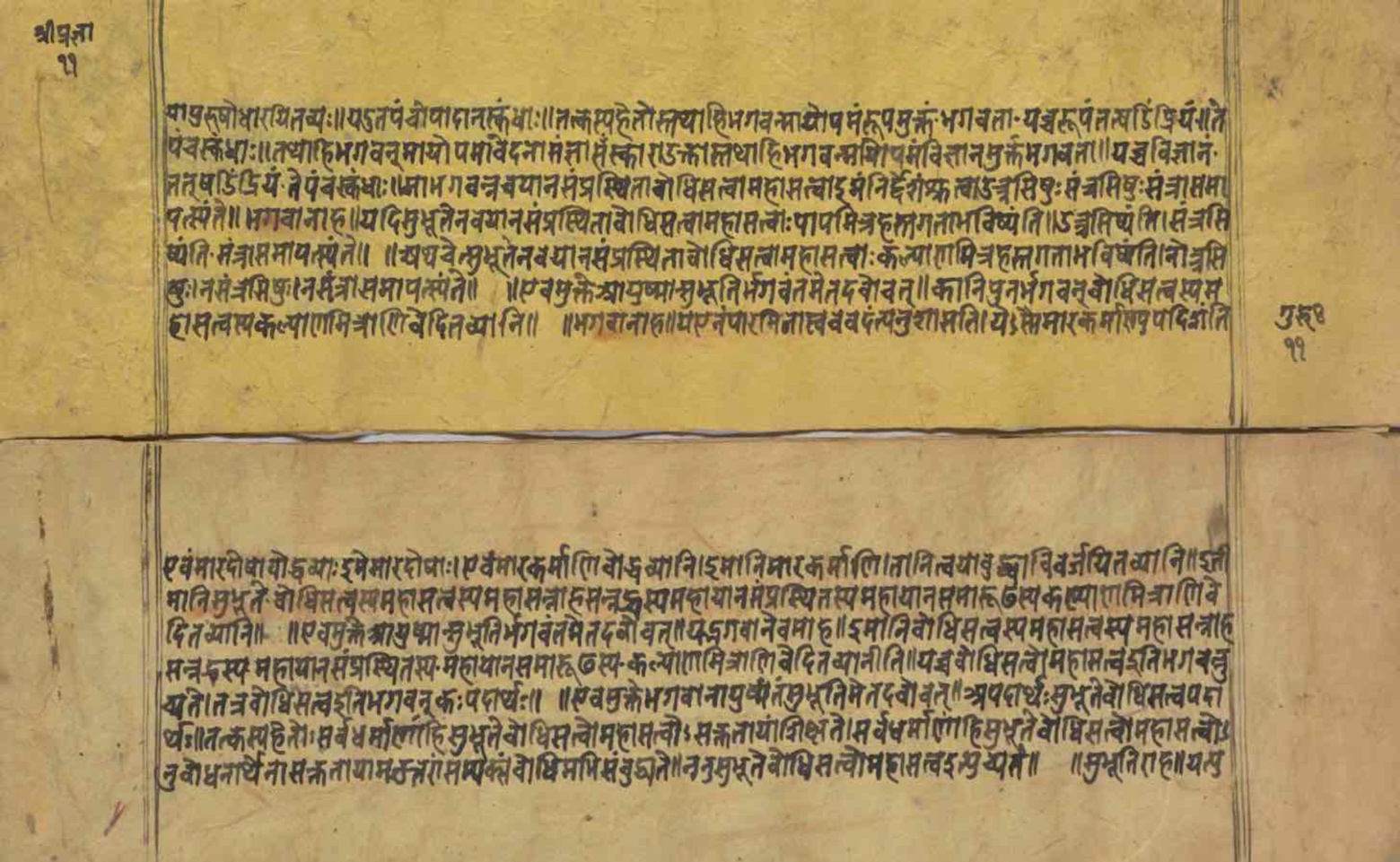
Wisdom, in the Prajñāpāramitā tradition, is not something you accumulate — it is something you see. This manuscript of the Aṣṭasāhasrikā ('eight thousand lines') Prajñāpāramitā opens by praising that wisdom with a single image: it is like space, without stain, without proliferation, without syllables.
Praise of the perfection of wisdom
The opening verses set the tone for the whole tradition — wisdom as the vision that sees the Tathāgata. The Buddha has instructed the bodhisattvas to call upon Prajñāpāramitā, and the text responds with a hymn:
Like space, without stain, without proliferation, without syllables—whoever sees you with true perception, sees the Tathāgata. The virtuous who see no distinction between your noble host of qualities and those of the Buddha, the world's teacher, are like those with subtle vision. One who is compassionate, who has taken refuge in you, who goes before the Buddha and Dharma, attains greatness with ease, O you who are affectionate to matchless devotion. Even one who, with pure intention, reveres you even once according to proper method—by that one too, success is certainly attained, O unerring vision.
To see wisdom truly is to see the Buddha. The identity is that direct — the perfection of wisdom is not a description of reality but the seeing itself.
All things like an illusion
The core teaching follows: form, feeling, perception, formations, and consciousness — the five aggregates that make up experience — are all like an illusion. The manuscript records the dialogue in which the Buddha and Subhūti work through what this means:
One should maintain [the view that phenomena are] like an illusion. Form has been declared by the Blessed One to be like an illusion, and whatever is form, that is to be understood as the five aggregates. Thus indeed, Blessed One, feeling, perception, and formations have been declared to be like an illusion; thus indeed, Blessed One, consciousness has been declared to be like an illusion. Those, Blessed One, newly set out bodhisattvas, great beings, who have fallen into the hands of good friends, will not become frightened, will not become terrified, will not fall into terror.
The bodhisattva's infinite task
The Prajñāpāramitā insists on something counterintuitive: that to practice this wisdom is also to practice infinite compassion. The bodhisattva does not withdraw from the world; they engage more deeply, knowing that all beings are infinite and limitless.
Because beings are infinite and limitless—why is that? Because no end, middle, or final limit of beings is found. There is no dharma that is produced, nor any that ceases. The Perfection of Wisdom was not taken up, not held, not recited, not mastered, not practiced by the sons of gods. Those sons of gods will not obtain enlightenment through the Perfection of Wisdom taken up or not taken up.
This paradox — that enlightenment cannot be grasped, that the Perfection of Wisdom was never held by anyone — is the text's way of protecting the teaching from becoming just another acquisition. The moment you try to possess wisdom, you have lost it.
Not a doctrine, but a way of seeing
This manuscript — 421 pages of the Prajñāpāramitā — is a window into the Mahāyāna's most ambitious idea: that wisdom is not a belief but a perception, and that the one who perceives the illusion-like nature of things sees what the Tathāgata saw. The text's own image for itself is a lamp: it does not add light to the world, it reveals what is already there. For those ready to see, the illumination is immediate. For others, even endless study of these eight thousand lines will yield nothing but words. The scripture knows this and addresses both readers equally, without judgment.