
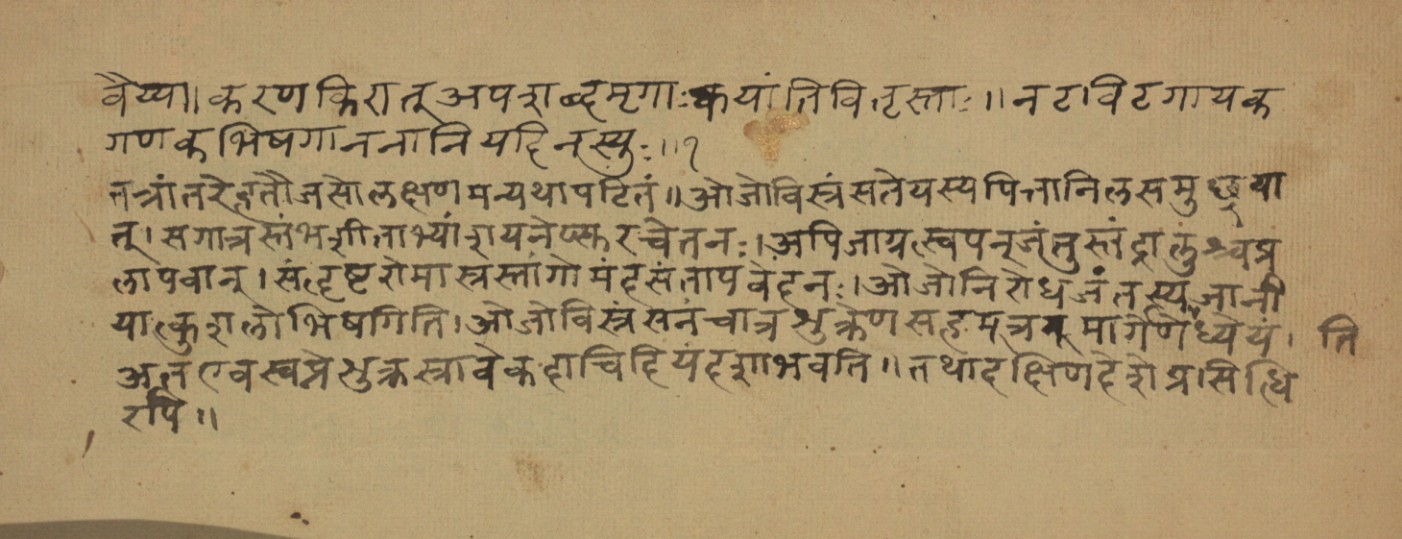
In Ayurveda, the first prescription is often the menu. The Pathyāpathyānighaṇṭa is a whole manual built on that idea—an organized list of what is wholesome (pathya) and what is unwholesome (apathya) for each disease, from fever to gout to abscess. Its 34-folio index alone reads like a table of contents for the clinic, covering diseases the tradition did not lump together but carefully distinguished: new fever, chronic fever, irregular fever, and fevers caused by external injury all warrant separate dietary chapters.
A practical index organized by disease
The manuscript opens with a marvel of organizational clarity. For every disease, two columns—the foods that help and the foods that hurt. The index spans 25 major disease categories and their subdivisions, from fever to elephantiasis, each with its own wholesome and unwholesome regimen.
Index of the Pathya-Apathya Nighantu: Wholesome foods in fevers, in diarrhea disease, in pandu disease, in hoarseness disease. Unwholesome foods in fevers, in diarrhea disease, in raktapitta, in anorexia disease. Wholesome foods in rajayakshma disease, in vomiting disease, in grahani disease, in shvasa disease, in thirst disease.
The principle: remove the cause first
The opening verses of the text reveal its clinical philosophy. Disease should be removed through wholesome diet alone, not through medicines without proper regimen. But before diet can work, the physician must address three things in sequence: the etiology (the root cause), the medicine appropriate to the condition, and the regimen that will sustain the cure. And of these three, the text insists, etiology comes first.
By that alone diseases wither like sprouts with dried-up water. Protecting in all cases the wholesome regimens, one should abandon what is unwholesome. By those unwholesome regimens they grow like plants with desire, even without medicine.
The author compares the effect: a disease without its cause is like a plant without water. It withers. Leave the cause intact, even without adding medicine, and the disease flourishes like any plant with soil and sunlight.
Fever: the foremost disease
Because fever is "generally the foremost" among all diseases, the text devotes more space to it than to any other condition. But the text does not treat fever as one thing. Fresh fever (taruna-jvara) is young and hot—you must not bathe, purge, or exercise the patient. Old chronic fever (jirna-jvara) is different: purgation, emesis, massage, and cool water baths are now wholesome. Intermediate fever (madhya-jvara) has yet another diet, one built on easily digestible grains and light meats.
Vamana (therapeutic vomiting), langhana (lightening therapy), proper timing, barley gruel, and sudation; pungent and bitter tastes, and digestion-promoting measures in recent fever. In sannipata (complex fever), all these should be done to remove ama and kapha.
The text also recognizes that fevers have causes beyond disease: anger, desire, grief, fear, sorcery, curses, planetary afflictions, even demonic possession each have their own fevers, and each requires a different remedy. A fever born of anger needs pitta-pacifying medicines. A fever born of desire needs desire itself as its cure—that is, fulfillment. A fever born of sorcery needs exorcism.
Diet by disease: the specificity that works
For diarrhea, the text prescribes old rice, Shashtika rice, rice gruel, and lentils, along with meat soups of rabbit and partridge. It forbids wheat, curd, buttermilk, and fish—foods too heavy or too sour for the already-weakened digestive fire. For grahani (a condition of malabsorption), the regimen shifts again: sleep, fasting, specific juices, and herbs like jivanti and kakamachi that the text names precisely because they work.
Wholesome (regimen) in madhya-jvara (intermediate fever). Old shashtika rice, shali rice, vastuka, shobhanjana, and karavella. Vidari, ashadha fruit, patola, karkotaka, mulaka, and potika. Soup prepared with mudga, masura, chanaka, kulattha, or mukushtaka.
For hemorrhoids, the text prescribes vata-alleviating and digestion-promoting foods—foods that are not antagonistic to the body's own work. For gout (vatarakta), it combines bloodletting with dietary restraint. The text does not offer one cure-all; it offers precise matches between condition and food, between cause and remedy.
A physician's reference, not a patient's book
The Pathyāpathyānighaṇṭa was written for practitioners who already understood Ayurveda's foundational concepts—the three doshas, the six tastes, the eight factors of diagnosis. The text is terse because it expects the physician to know the practice; this is a reference, a reminder, a quick index when the patient comes with a specific complaint and the physician needs to remember exactly what foods are safe and which are dangerous.
What makes it invaluable is that it took the knowledge scattered across longer texts and distilled it into a usable form: 34 folios covering every major disease the clinic encounters, with explicit lists of wholesome and unwholesome foods for each one. For a physician working without modern diagnostic tools, this was practical knowledge that prevented harm and guided healing. It remains so.