
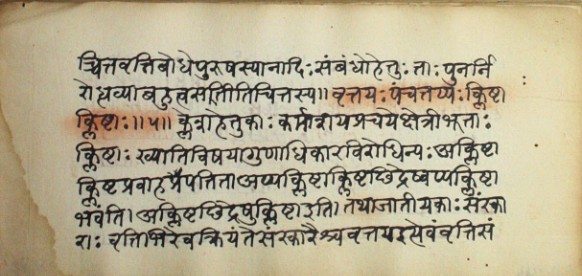
Yoga begins with a diagnosis of the mind. The Pātañjalayogasūtra, the foundational text of classical yoga, opens not with postures but with a map of mental states — distracted, stupefied, scattered, one-pointed, restrained — and defines yoga as the restraint of the modifications of the mind.
The five states of mind
From its opening pages, the commentary in this manuscript lays out the spectrum of the mind's conditions.
Now the instruction on yoga. Yoga is samādhi, and that is the universal characteristic of the mind. Distracted, stupefied, scattered, one-pointed, restrained — thus the states of mind.
Two of the five — one-pointed and restrained — belong to yoga; the other three are the mind's ordinary turbulence. The path is a movement along this spectrum.
Modifications, afflicted and unafflicted
The second chapter of the inquiry is the fivefold classification of the mind's modifications (vṛttis) — valid cognition, misconception, verbal construction, sleep, and memory — each either afflicted or unafflicted.
The modifications are fivefold, afflicted and unafflicted. Those that are caused by afflictions are the accumulations of the deposits of karma, becoming the field (of experience). Fallen into the stream of the afflicted, even the unafflicted become afflicted; in the breaches of the afflicted, even the unafflicted become unafflicted.
The passage is subtle: whether a mental state helps or harms depends on the current it falls into. Affliction is contagious, and so is its opposite.
The definition that launched a school
Yogaś citta-vṛtti-nirodhaḥ — 'yoga is the restraint of the modifications of the mind' — is perhaps the most quoted definition in Indian philosophy, and this manuscript preserves it in its native context: the opening of the sūtras, with a commentary working out exactly which modifications are restrained and which are not. It is a reminder that the Yogasūtra is not a book of postures but a systematic psychology — and its first act is to name the five minds we all carry.
There, when the mind is distracted, samadhi which is subordinate to distraction does not function on the side of yoga. But that which illuminates the real object when the mind is one-pointed, destroys the afflictions, loosens the bonds of karma, and turns one toward cessation—that is called samprajnata yoga. And that will be explained further below as accompanied by vitarka, accompanied by vicara, accompanied by ananda, and accompanied by asmita. But when all vrittis are ceased, there is asamprajnata samadhi. To describe its characteristics, this sutra proceeds: [Yoga is the cessation of the modifications of the mind.
vi Salutation to Śrī Gaṇeśa. He who, having abandoned the first form, manifests as the manifold origin of the world, the serpent with many hoods, whose mass of afflictions is destroyed, the enjoyer with many faces.
He who, having abandoned the first form, manifests as the manifold origin of the world, the serpent with many hoods, whose mass of afflictions is destroyed, the enjoyer with many faces. The source of all knowledge, surrounded by serpents, for whose pleasure always, the divine lord Īśa—may He, of pure body, the giver of yoga, united with yoga, protect you.
The source of all knowledge, surrounded by serpents, for whose pleasure always, the divine lord Īśa—may He, of pure body, the giver of yoga, united with yoga, protect you. Now the instruction on yoga.
It does not arise from cultivation. That supreme discernment is called by meditators 'the highest reflection.' The power of consciousness, unchanging, through the reversal of transformation, shows the purity of objects; from that, the purity of sattva-guna; from that, this wisdom consisting of discriminative knowledge of the contrary. Therefore, when the mind becomes dispassionate toward even that highest knowledge, and when it suppresses that state, it arises from cultivation. That is seedless samadhi. There nothing is cognized; therefore it is called 'without cognition.' Twofold is the yoga of the cessation of the modifications of the mind.
That supreme discernment is called by meditators 'the highest reflection.' The power of consciousness, unchanging, through the reversal of transformation, shows the purity of objects; from that, the purity of sattva-guna; from that, this wisdom consisting of discriminative knowledge of the contrary. Therefore, when the mind becomes dispassionate toward even that highest knowledge, and when it suppresses that state, it arises from cultivation. That is seedless samadhi. There nothing is cognized; therefore it is called 'without cognition.' Twofold is the yoga of the cessation of the modifications of the mind. In that state of the mind, due to the absence of objects, the awakening of the intellect...
Paṇḍit Śaṅkara 2 Therefore, yoga is also called 'saṃprajñāta' due to the cessation of all modifications. For the mind, being of the nature of illumination, activity, and stability, is three-guṇa. The mind, being of the nature of illumination (sattva), when mixed with rajas and tamas, becomes attached to power and objects of desire. That same [mind], when accompanied by tamas, becomes attached to adharma, ignorance, non-detachment, and lack of power. That same [mind], when its veil of delusion is destroyed, when fully illuminated from all sides, when accompanied by only a trace of rajas, becomes attached to dharma, knowledge, detachment, and power.