
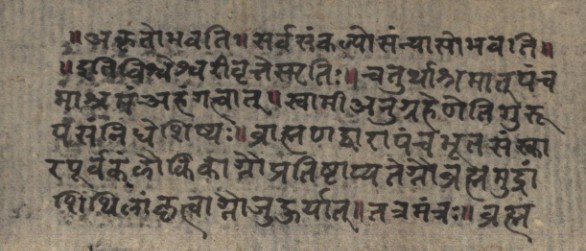
The classical order of life has four stages. But some traditions added a fifth — the final renunciation, beyond even the forest-dweller. The Pañcamāśramanirūpaṇa is a manual for that last crossing: when to undertake it, what to do, and what to leave behind.
The auspicious moment
The text opens with the timing — renunciation is not taken on a whim. It requires the right season, the right day, the right alignment of heaven.
Now the procedure for the fifth āśrama (stage of life). The acceptance of the fifth āśrama through intense attachment or moderate attachment. When, during the waxing fortnight of the northern solstice, on an auspicious day, under a favorable constellation, with a specific yoga and zodiac sign, in the early morning, after completing one's daily duties — thereafter, one goes to the āśrama of the supreme Paramahaṃsa guru.
The choice matters — intense or moderate attachment to the world — and so does the calendar: the northern solstice, the waxing fortnight, the right constellation, the right morning. A guru is required at this stage, as at every stage: 'One should not abandon the sacred fire without a paramahaṃsa guru.'
The ritual of crossing
The crossing itself is a ritual of fire and cutting — a visible break with the old life.
One becomes an avadhūta. One becomes the renouncer of all resolutions. Thus the renunciation composed by Viśveśvara. From the fourth āśrama to the fifth āśrama I shall go. May the Lord be gracious — thus the disciple in the presence of the guru. Having established through a brāhmaṇa in the worldly fire with the five-element saṃskāra preceding, having cut the śikhā up to the ājyabhāga in that fire, one should offer oblations.
The topknot is cut in the fire; the oblations are offered; the renouncer of all resolutions is born. The text is careful to require a guru at this stage — as at every stage — because the last crossing, like the first, is not meant to be made alone.
The way of the sky-clad
Once the ritual is complete, the renouncer abandons everything: garments, cord, possessions. The text is unflinching about what this means.
I am sky-clad, I am naked, I am shameless day and night. Just as one is naked at the time of birth, so am I liberated. Just as Shambhu is sky-clad, I am liberated, non-dual.
This is the fifth stage — the final letting go, when even the markers of the previous stage are shed. The renouncer wanders alone "like a child, a madman, or a ghost," eating only to still hunger, speaking only when asked, indifferent to heat and cold, to respect and abuse. The text describes the qualities demanded: freedom from self-conceit, constant meditation, devotion to the Self, compassion toward all beings. Such a one "conquers all," the text says, but what is conquered is not the world but the desire to conquer it.
The end of becoming
The Pañcamāśramanirūpaṇa's vision of the fifth stage is not escape but completion — the final stage where one ceases to become and simply is. All previous stages were becoming: the student becoming learned, the householder becoming prosperous, the forest-dweller becoming detached. In the fifth, even the identity of the ascetic falls away.