
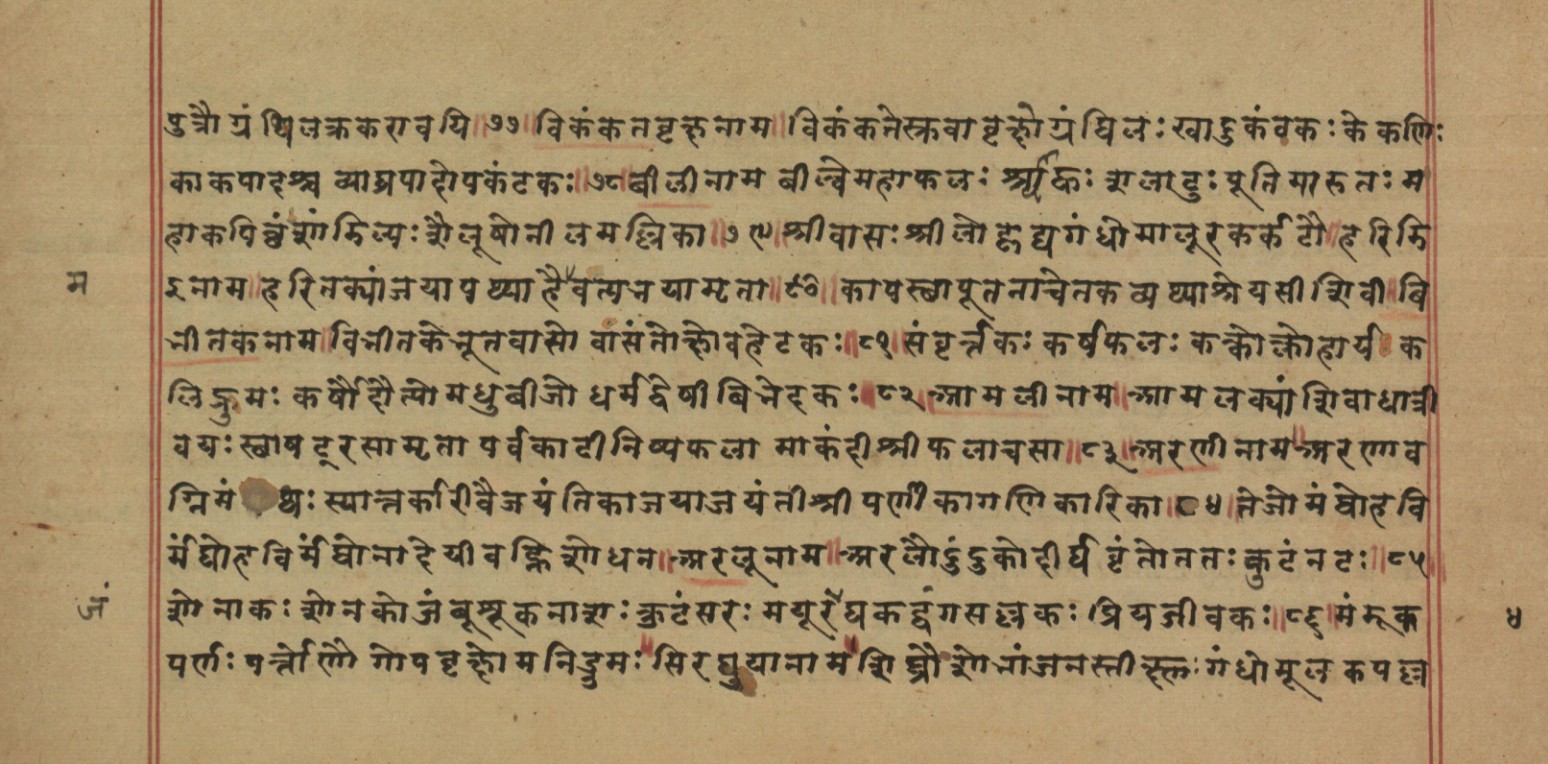
In a medical tradition that used dozens of regional names for the same herb, a dictionary was not a luxury — it was a safety device. The Nighaṇṭuśeṣa, a glossary by the great Jain scholar Hemacandra, collects the synonyms of medicinal plants so that a physician who knows a plant by one name can recognize it by another. Its twenty folios, in a clean hand with the Bhandarkar Institute's note 'good calligraphy,' are a working reference for the Ayurvedic dispensary.
The names of a tree
Take sandalwood. The Nighaṇṭuśeṣa gives it a small constellation of names — śrīkhaṇḍa, malayaja, candana, gandhasāra — each drawn from a different region or property, all pointing at the same fragrant wood.
Names of Śrīkhaṇḍa: Śrīkhaṇḍe syān-Malayajaṃ, Candanaṃ, Śvetacandanam. Gośīrṣakaṃ, Gandhasāraṃ, Bhadraśrīs-Tailaparṇikam, Phalakī, Surabhiḥ, Sāraṃ, Mahārhaṃ, Rohaṇodbhavam.
The same page moves through pāṭalā (trumpet flower), agaru (agarwood), and red sandalwood — each with its roll call of aliases. The very name Nighaṇṭuśeṣa — 'the remainder of the glossary' — marks it as a supplement, filling in the synonyms that the earlier nighaṇṭus left out.
The three myrobalans
The glossary is especially generous with the fruits of Ayurveda's most famous trio — the three myrobalans that anchor countless formulations.
Harītakī named — Harītakyā, Abhayā, Pathyā, Hemavatī, Amṛtā. Bibhītaka named — Vibhītaka, Tuṣavāsa, Vaheṭaka. Āmlī named — Āmlakyāṃ, Śivā, Dhātrī, Vayaḥsthā, Ṣaṭrasā, Amṛtā, Parvakaṭī, Niṣphalā, Māṃkadī, Śrīphalā.
Harītakī is Abhayā, Pathyā, Amṛtā. Āmalakī is Dhātrī, Vayaḥsthā, Śivā. Knowing these aliases was not trivia — it was how a prescription written in one region could be filled in another.
The many names of the mango
One of the most generous entries is the mango, whose synonyms the lexicon strings out like a garland — each one a different angle on the tree: its season, its sweetness, its guest.
āṃre rasālo mākaṃdaḥ kāṃāṃgaḥ pikabāṃdhavaḥ vanapuṣyo śavaśrṛtaḥ parapuṣṭamahotsavaḥ madhudūto madhuphalaḥ suphalo madirāsakhaḥ vasaṃtapādapo sauga sahakāreti saurabhaḥ
'The friend of the cuckoo' (pikabāndhava), 'the messenger of spring' (vasantapādapa), 'the sweet one' (madhudūta) — the synonyms are poetry as much as nomenclature, and each name would help a physician or a poet identify the tree.
Counting the faces of rudrākṣa
The lexicon also preserves the lore attached to a plant — as with rudrākṣa, the sacred seed whose faces are read as forms of the gods.
Rudrākṣe tu mahāmunīḥ. 40. Sa tu caturmukho brahmā dvimukhas tu varārgalaḥ. Ṣaṇmukhas tu kārttikeyaḥ pañcamukhas tu śaṅkaraḥ. 41. Mādhavas tv ekavadano vijayāstradhāraṇaḥ.
A seed with four faces is Brahmā, five is Śiva, six is Kārttikeya — the plant encyclopedia shades into theology, showing how a glossary of materia medica could carry religious meaning as naturally as botanical fact.
Lotus flowers by their colors
In its chapter on aquatic plants, the text turns to the lotus — and discriminates the blooms by hue and by the hour they open.
In the white lotus, the white lotus, O Śūraka, is called kamala. The red lotus is called raktotpala, kokanada. The day-blooming lotus is called dinī. In the night-blooming lotus is kumudatī. The blue lotus is called nīlotpala. In the blue one is indīvara, sandhika.
Kamala for the white, kokanada for the red, kumudatī for the night-bloomer, indīvara for the blue — the synonyms sort the flowers of the pond into a precise grid of color and time.
A scholar's gift to physicians
Hemacandra was a polymath — grammarian, poet, and lexicographer — and the Nighaṇṭuśeṣa is the medical wing of his lexicography, its chapters running from trees through vegetables, grasses, and grains, each signed with the author's name as the sections close. The manuscript itself, in the Bhandarkar collection, is a clean copy with 'good calligraphy,' the kind of reference a working physician would keep close. It is a reminder that the materia medica was held together not just by herbs, but by words — and by dictionaries that made sure no plant was lost behind an unfamiliar name.