
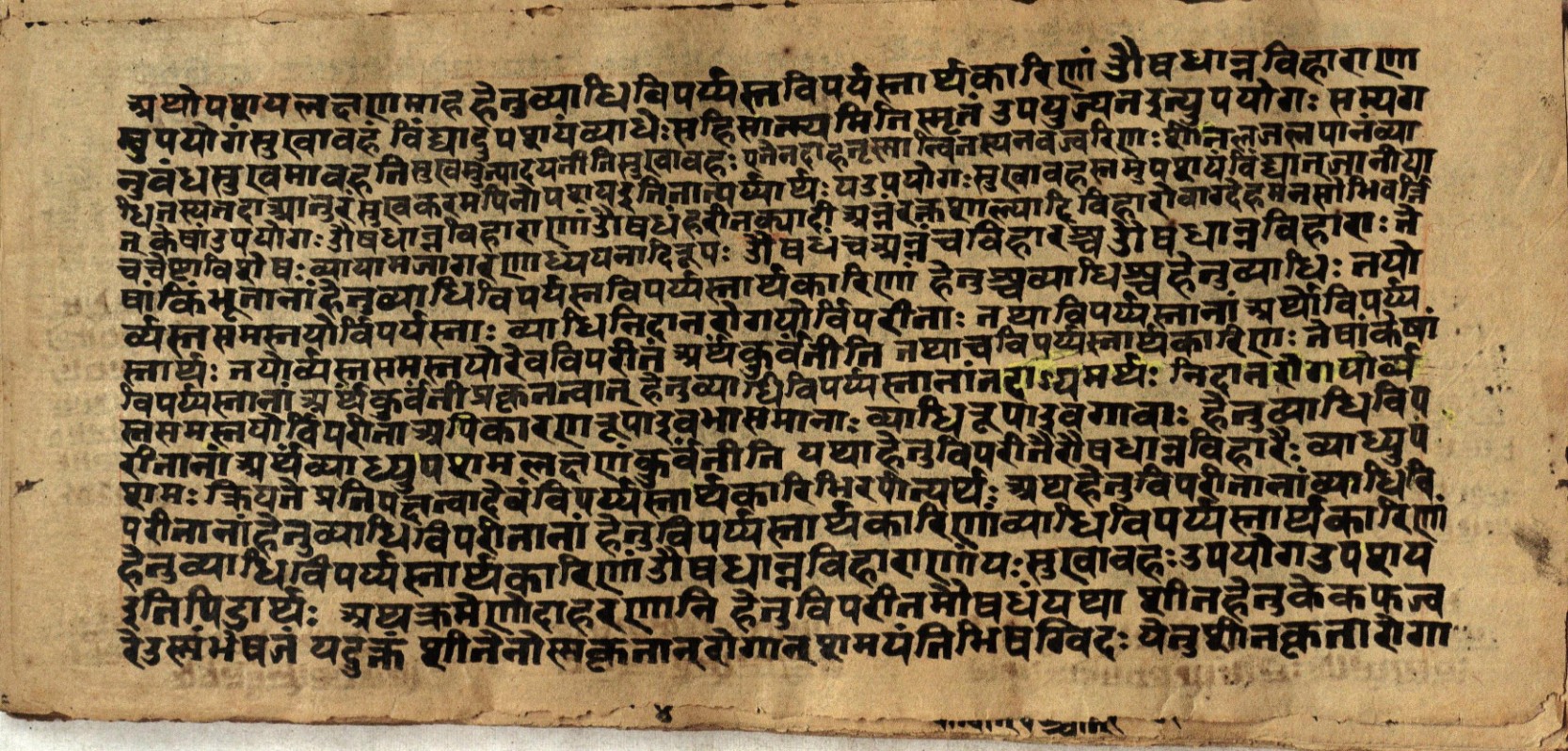
How do you diagnose a disease before it fully shows itself? The Mādhavanidānaṃ — a foundational Ayurvedic treatise on diagnosis, here in a manuscript dated Samvat 1907 — turned that question into a system. It organized all of clinical reasoning into five questions: cause, premonitory signs, manifest signs, therapeutic test, and pathogenesis. This framework made diagnosis a teachable skill rather than intuition alone.
The Five-Fold Framework
The opening verses lay out the method with the precision of a textbook's table of contents: Nidāna (causation), Pūrvarūpa (premonitory symptoms), Rūpa (manifest symptoms), Upaśaya (therapeutic test), and Samprapti (pathogenesis) — the knowledge of diseases is said to be fivefold. Each term is then defined carefully. Nidāna is the cause that sets the disease in motion; pūrvarūpa is what a physician can spot before the illness has settled into a definite form; rūpa is the disease once manifest; samprapti is the journey from cause to full-blown condition.
Nidāna (causation), Pūrvarūpa (premonitory symptoms), Rūpa (manifest symptoms), Upaśaya (therapeutic test), and Samprapti (pathogenesis) — the knowledge of diseases is said to be fivefold.
Treatment as Diagnosis
The most subtle of the five is upaśaya — using the patient's response to treatment as evidence. The Mādhavanidānaṃ is careful about how that works, warning against mistaking temporary comfort for genuine therapeutic effect.
The use of medicines, food, and regimens which act contrary to the cause, the disease, or both the cause and disease together, and which bring comfort upon use, constitutes upaśaya. Cold water drunk by a person burning with fever in a new fever, though it may give quick comfort at that time, is not upaśaya.
That distinction — between something that merely feels good and something that genuinely counteracts the cause — is the same discipline a clinician applies today when deciding whether a response to a drug is evidence of the diagnosis or just placebo. The text is precise: only when a treatment opposes the underlying cause or disease itself, and brings sustained relief, does it count as upaśaya.
Fever: The Text's Core Teaching
Nearly half the manuscript is devoted to fevers, which the text treats as a map of the body's imbalances. The Mādhavanidānaṃ classifies fever into eight types by cause (vāta, pitta, kapha alone, or in pairs, or all three together), and then into six more by periodicity — continuous, every other day, tertian, quartan, irregular, and from external causes. Each has distinct signs. Vāta fever brings trembling, dryness of throat and mouth, loss of sleep, and hard stools; pitta fever brings intense onset, diarrhea, sweating, and a bitter taste; kapha fever brings heaviness, sluggishness, and excessive sleep.
From the wind come trembling, irregular onset, dryness of throat, lips and mouth, loss of sleep, sneezing, stiffness, roughness of the limbs, pain in the head, heart and body, astringent taste in the mouth, hard stools, colic, flatulence, yawning — these occur in vāta fever.
But the text goes deeper still. When a dosha lodges in different tissue layers — plasma, blood, muscle, fat, bone, marrow, or semen — it produces fever of increasingly severe character. Fever in plasma is relatively mild; fever that has reached the marrow is often fatal. This layered understanding of disease pathology connects diagnosis to prognosis. A physician who knows which tissue a fever has reached knows whether the patient has days or weeks, and which treatments have any hope of success.
The Critical Days
The manuscript assigns special significance to the seventh, tenth, and twelfth days of fever. On these days, fever either turns toward recovery or toward death. The text describes detailed signs of incurability — the patient's eyes roll, speech becomes distorted, extremities become cold while the core burns — and these are grounds for recognizing when the case is lost. A modern physician would recognize this as the description of systemic collapse, the point where the body's defenses have failed.
The five-fold method was Mādhavakara's great contribution: it made diagnosis a teachable, systematic skill rather than an intuition held only by the most gifted physicians. A student could learn to ask these five questions in order, and through that discipline, arrive at understanding. That structure has never been bettered — modern medicine's diagnostic categories still amount to a reordering of the same framework.