
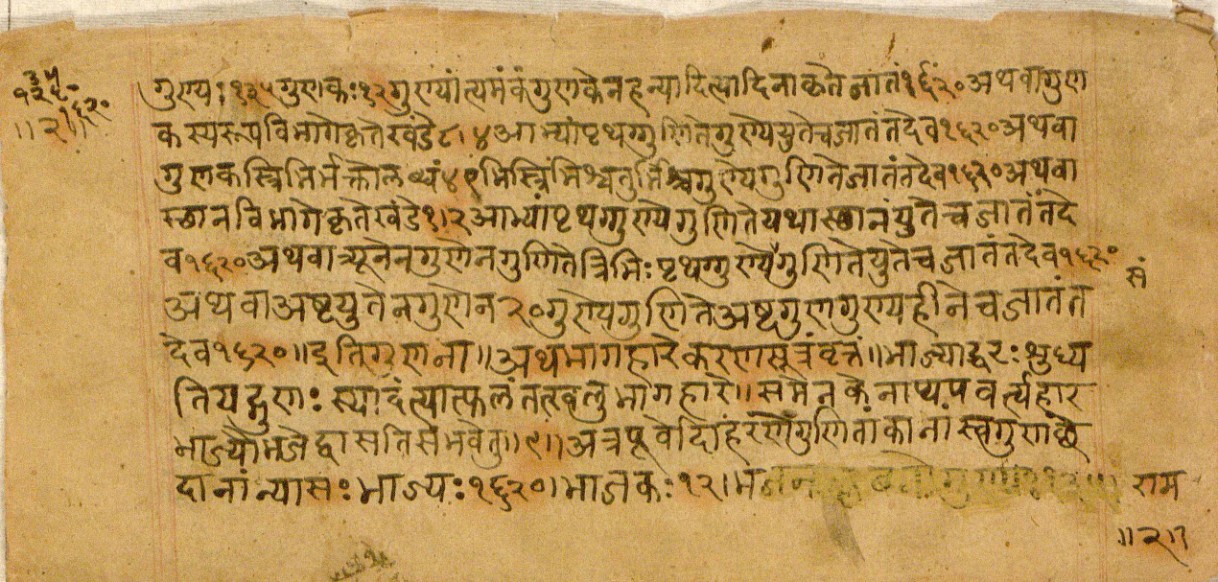
Before zero made big numbers easy, big numbers had to be named. The Līlāvatī — Bhāskara's arithmetic — opens its practical teaching with the names of the number-places, and the list is a poem of scale: lakh, crore, arbuda, kharva, mahāpadma, śaṅku, jaladhi, antya, madhya, parārdha — each ten times the last.
The ladder of names
The text gives the whole series in a single verse, then notes who made it.
One, ten, hundred, thousand, ayuta, lakh, prayuta, crore in order, arbuda, abja, kharva, nikharva, mahāpadma, śaṅku — beyond that, jaladhi, antya, madhya, parārdha — these are the names increasing tenfold. These names of places of numbers were made by the ancients for practical use.
The names are drawn from the world — abja, the lotus-born (a billion), śaṅku, the stake, jaladhi, the ocean, parārdha, the far shore — so that numbers become images, and the place-value system becomes a landscape. A merchant does not think in abstract powers of ten; they think in terms they can visualize, images they can hold. A crore is vast enough to be called an ocean. A parārdha, the furthest shore, is a number so large that it enters the realm of myth.
One problem, many methods
The same manuscript then demonstrates the Līlāvatī's pedagogical philosophy: showing one multiplication solved many ways.
The multiplicand is 135, the multiplier is 12. The product obtained is 1620. Or else, when the multiplier is divided into its component parts 8 and 4, and these are multiplied separately with the multiplicand and then added, the same 1620 is produced. Or else, the multiplier divided by 3 gives 4. When the multiplicand is multiplied by these three and four separately and added, the same 1620 is produced.
Split into 8 and 4, split into 3 and 4, split by place value — every route arrives at 1620, and the student sees that arithmetic is not one fixed procedure but a family of them. A student who learns only one method learns a rule; a student who learns many learns a principle. The Līlāvatī chooses depth over breadth at every turn.
The geometry of growth
Pages later, the text moves from multiplication into the extraction of square roots and cube roots — operations that reveal the hidden structure of numbers.
The product of three equal numbers is declared as cube. Having placed the cube of the last, then the square of the last; the first multiplied by three, then the square of the first multiplied by three, the product of the last, and also the cube of the first—all these, united with place-value difference, become the cube. Here is an example: Tell the cube of nine, the cube of the cube of three, and also the cube of five, O friend.
The Līlāvatī asks the student to see that 9 cubed is 729, that this can be built from parts — the cube of each component, the products of pairs. This is not mere computation; it is the discovery that every large number contains within it smaller structures, waiting to be seen.
The merchant's wisdom
Later chapters of the Līlāvatī turn to practical problems: the pricing of jewels, the mixing of metals, the rule of three applied to trade. The text assumes that the student will need mathematics not for its abstract beauty but for the world.
If three hundred are obtained here for one dramma, say how many pomegranates in the market for thirty panas? Or, friend, how many pomegranates are obtained for ten mangoes with ten, and what is the exchange for three friends? The rule for inverse proportion is to be known there by those skilled in calculation.
The problem is not mere arithmetic—it teaches proportional reasoning, the ability to see that if the price rises, the quantity received falls. A merchant who understands this will not be cheated. A scholar who understands it has learned something about the structure of the world.
A mathematics that could speak
The Līlāvatī's names of numbers are a reminder that the tradition did not treat large numbers as an abstraction — it gave them names from the natural world, so that a crore and a parārdha could be said, heard, and remembered. This copy, one of several in the collection, keeps that ladder of tens intact, a bridge between the countable world of everyday commerce and the immense scales of time and space that the tradition imagined.