
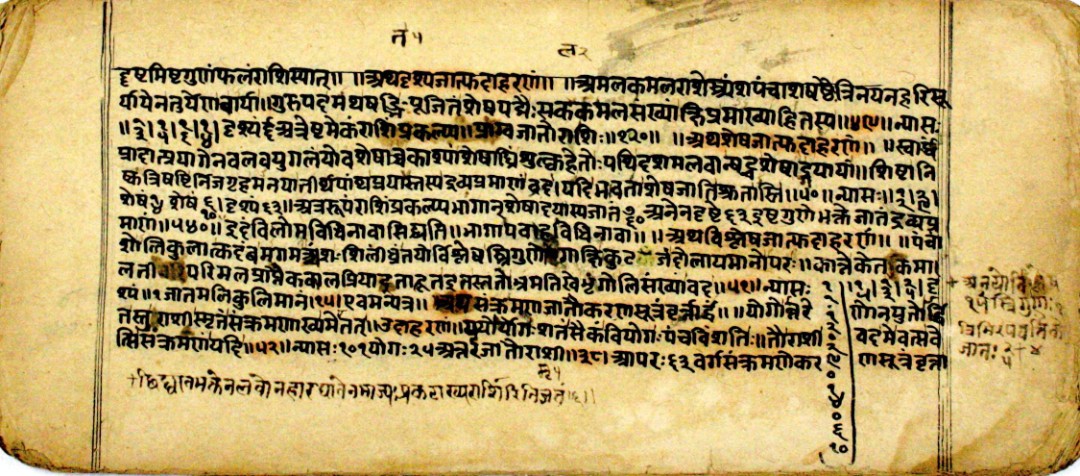
The most famous textbook in Indian mathematics opens not with a theorem but with a prayer — and then tells you that twenty cowrie shells make one kākiṇī, four kākiṇīs make one paṇa, and sixteen paṇas make one dramma. That is the Līlāvatī of Bhāskara II, a twelfth-century treatise that teaches arithmetic in verse, and every unit, rule, and worked example is a stanza meant to be recited.
A currency system built from cowrie shells
The definitions section of the manuscript starts with money, weights, and measures, all anchored to everyday objects. Cowrie shells stack up into kākiṇīs, paṇas, and drammas; barley grains define the guñjā; and sixteen māṣas make a karṣa. The text works its way from grain to gold with the same care a modern textbook gives to the metric system — but every step is rooted in what a person can hold in their hand.
Twenty cowrie shells (varatikas) make one kakini; four kakinies make one pana; sixteen of those make one dramma here, as should be understood; and sixteen drammas make one nishka. One gunja is said to equal two barley grains (yavas); three gunjas make one valla; eight of those make one dharana. One gadyanaka equals two indra-vallas; and one ghataka is likewise prescribed.
The text is systematic: each jump from cowrie to coin to weight is explained through simple ratios that a merchant would already understand. A student learning this could walk into a market and know exactly what a given weight of gold was worth in coins and cowries. The conversions are not arbitrary — they reflect the actual systems of commerce that existed, the weights that customs houses used, the coins that kingdoms minted.
Word problems as small stories
The Līlāvatī rarely presents a bare sum. Instead, each problem is a miniature narrative — pilgrims scattering wealth, bees visiting flowers, swans on a lake. One of the most famous is the Arjuna problem, where the arithmetic is hidden inside a battle scene.
Arjuna, enraged at Karna's slaughter, took aim at him on the battlefield. With half of his arrows, he warded off Karna's shower of arrows; with four arrows, he killed Karna's horses; with six, his chariot; with three, his umbrella and banner; and with one arrow, he severed Karna's head from his body.
The answer — a hundred arrows — falls out of a square-root method the text explains in the same breath. The pedagogy is unmistakable: wrap the mathematics in a story, and the student remembers both the procedure and its purpose. The students of the Līlāvatī would have known the Mahabharata; the image of Arjuna on the battlefield was already in their minds. The arithmetic becomes something not imposed from outside but discovered within a story they already cared about.
Why verse worked
Putting mathematics in verse was not ornament; it was storage. In a manuscript culture where books were copied by hand and students memorized what they read, a well-formed stanza was easier to remember than a page of prose. The Līlāvatī's poetic frame — its salutations, its lilt, its playful problems — is precisely what let this arithmetic survive centuries of hand-copying without corruption, and why a reader today can still follow a cowrie-shell economy line by line.