
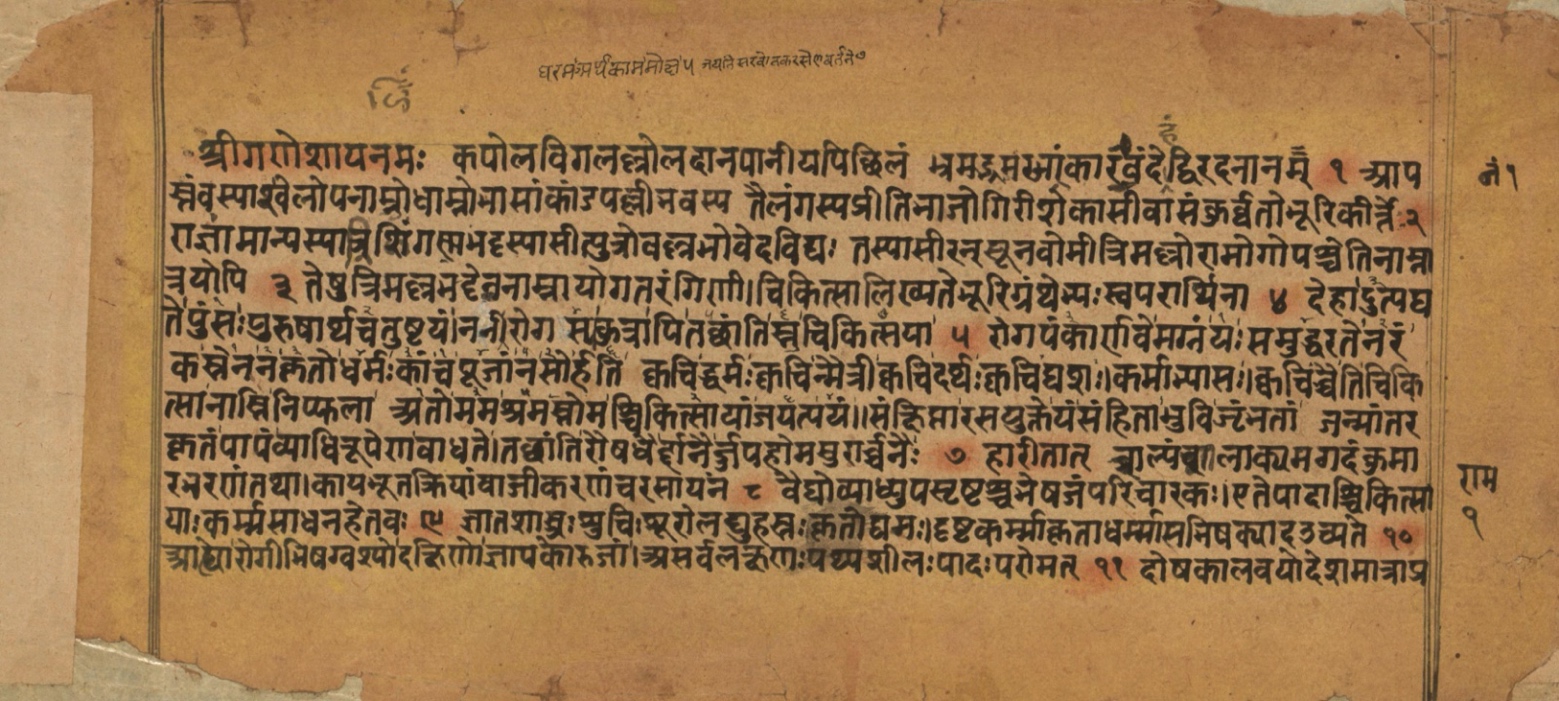
The Laghuyogataraṅgiṇī—'The Little Wave of Yoga'—is a 217-folio medical compendium by Trimallabhaṭṭa, a Tailaṅga physician of the Āpastamba lineage residing in Kāśī, dated Saṃvat 1703. It opens by tying medicine to the four aims of life—dharma, artha, kāma, and mokṣa—then settles into what distinguishes this text from its contemporaries: a focus on people, not drugs.
The Patient, the Physician, and the Attendant
The text begins not with pharmacology but with character. The ideal patient is described with precision: "one who has control over his senses, who is endowed with good memory, who is obedient, who is pure in habits, who is devoted to the physician, and who is not afraid of the disease." The attendant must be "devoted to the patient, skilled in nursing, pure, clever, conversant with the duties of the time and place, well-versed in many arts, and dexterous in work." Medicine here is a three-party enterprise—physician, patient, nurse—and the manual trains all three. No physician can heal a disobedient or fearful patient; no medicine can cure without a skilled attendant to administer it at the right moment in the proper way.
When Disease Resists the Formulary
Then comes a strikingly modern caveat. "That disease which, though determined according to śāstra and treated according to the disease, does not attain pacification—that should be known by the wise as karma-born." The text admits that some illness resists the formulary; its cause lies elsewhere, and its cure may be the destruction of karma-doṣa rather than of doṣa alone. This is an honest limit drawn around the pharmacopeia, an acknowledgment that even the best physician, armed with the best medicines, will encounter suffering that medicine alone cannot touch.
That disease which, though determined according to śāstra and treated according to the disease, does not attain pacification—that should be known by the wise as karma-born.
The Precision of Measures
The manual is full of exactitude. One whole page is a conversion table: three rājikās make a sarṣapa, eight sarṣapas a yava, four yavas a guñjā, six raktikās a māṣaka, four māṣas a śāṇa, two ṭaṅkas a kola—rising through pala, prastha, āḍhaka, and khārikā, with a note that liquid, wet, and dry substances share the same measure up to the kuḍava. The oil-cooking rules are equally exact: paste four times the herbs, oil four times the paste, decoction four times the oil, water four times the decoction. No approximation, no intuition—every formulation depends on precise ratios, reproducible by others, verifiable in principle.
A wisdom that cannot be quantified is a wisdom that cannot be transmitted.
Diagnosis by Observation, Touch, and Word
The diagnostic chapters read the body directly. The pulse of a pregnant woman has its own gait: "Having fallen from its own place, approaching, performing like one mounted on a wheel... the sages know it as resembling the artery of a pregnant woman." The tongue follows; then the eye: rough and yellow for vāta, burning and yellow for pitta, "watery, dull vision, unctuous and intoxicated" for kapha. The urine carries its own language, visible to those trained to read it. From weights to glances, this is a complete clinician's kit—the kind that travels across centuries, carrying within it the accumulated observations of generations of practitioners who knew that medicine is learned not from books alone but from standing at the bedside, feeling the pulse, watching the breath, listening to the voice.
A Physician's Vade Mecum
The Laghuyogataraṅgiṇī's title calls itself a "concise wave," not a flood but a flowing stream—portable, practical, sufficient. It is meant for the working physician who cannot consult larger texts at the moment of need. It gives the essential measures, the diagnostic signs, the foundational theory, and the recognition that sometimes the best medicine is understanding the patient's fear, the attendant's skill, and the humility to know when the disease has reasons that the pharmacopeia cannot reach. In this balance of precision and humility, science and human care, the text finds its strength.