
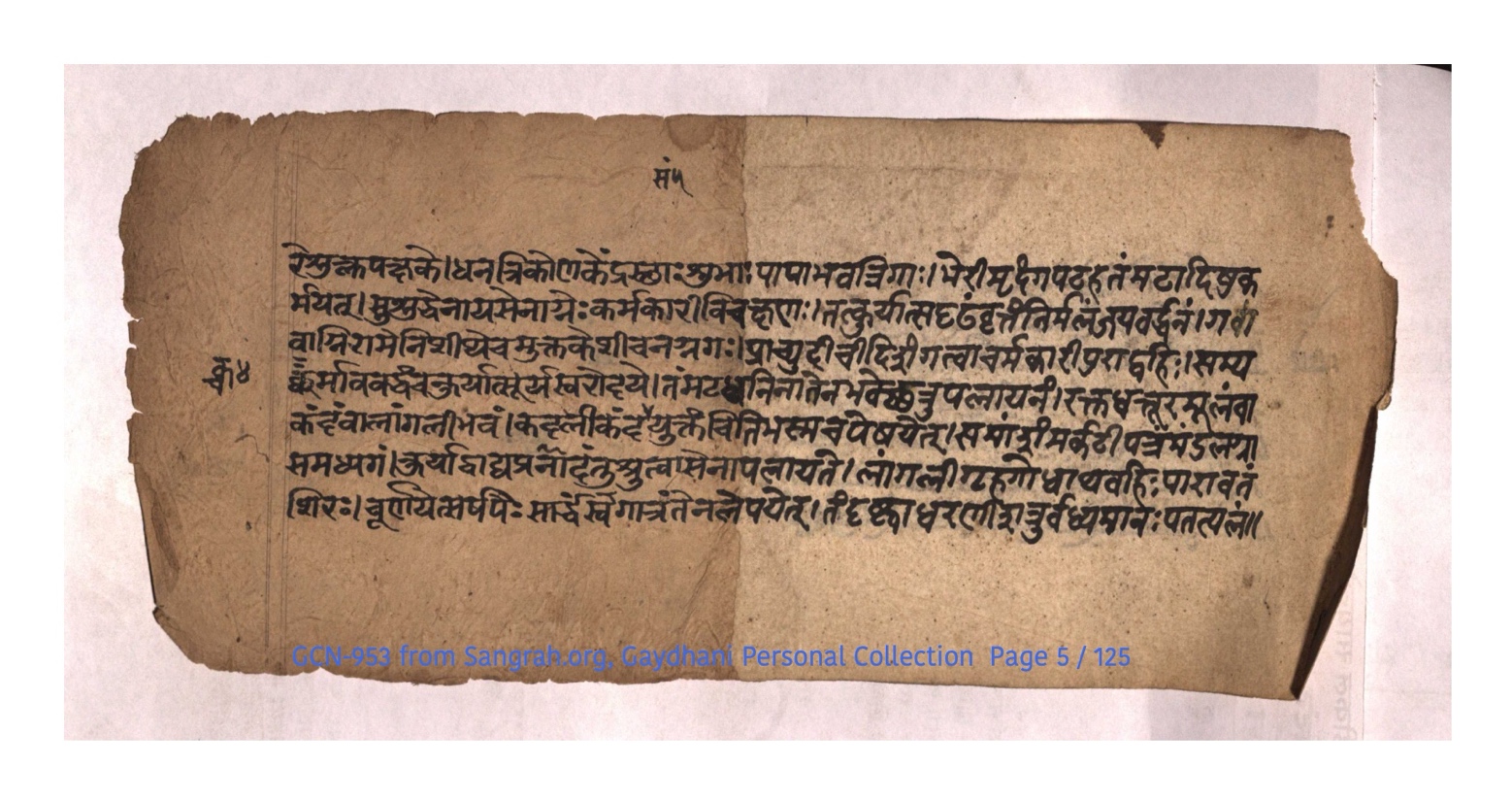
What does a king do when the wars are won? The Kautukacintāmaṇi — 'the jewel of curiosities' — has an answer. It is a manual of royal leisure, a collection of the amusements, protective rites, and marvels that filled a court at peace, and its opening declares the whole premise: a king who has conquered the directions should pass his time in entertainment.
Leisure after conquest
The text's frame is political — entertainment as the proper occupation of a settled king, not idleness but a kind of statecraft in its own right.
It was previously stated by the wise that a king who has conquered the directions and established stability in his kingdom through the application of political medicine should pass his time merely by observing entertainments, having dispelled all troubles.
The phrase 'political medicine' (nīti-cikitsā) is deliberate: the text positions itself as the aftercare for a king who has finished the hard work of conquest. It goes on to sort its subject into two broad families — entertainments of substance (object-based tricks: paralyzing, subjugating, stimulating, the milking of trees for wonders) and entertainments of sound (prose and verse dressed in ornament). Everything that follows in the manuscript is really an elaboration of that first division.
The magician's toolkit
Before any trick, the performer protects himself — the text is emphatic that amusement is only for those who have first guarded their own body. What follows reads like a conjuror's private notebook: a toe ring made from cremation-ground roots and wrapped in red thread that renders the wearer invisible to a whole crowd; a ring of copper, gold, and other metals worn on the foot that binds the sight of onlookers; drums and kettle-drums whose sound, timed to specific lunar days, is said to make an opposing army flee outright.
Śmaśāne tarumūlena kuryāt pādāṅgulīyakaṃ. Mṛtanirmātyasaṃyuktaraktasūtreṇa veṣṭayet. Tena niḥśeṣalokasya dṛṣṭibandhaḥ prajāyate. — In the cremation ground, from a tree's root one should make a toe-ring, and wrap it with red thread bound with grave-matter; by this, the sight of all people becomes bound.
The battlefield applications continue for several pages: a red dhattūra root ground with lāṅgalī bulb and bone-ash, wrapped in wool and sounded from the center of a ritual diagram, is said to rout an army by hearing alone. These aren't idle party tricks — they sit at the intersection of court entertainment and battlefield psychology, magic doing the work that a general might otherwise do with numbers.
Fire-walking and the body made invulnerable
A long middle section turns from illusion to endurance — recipes for walking on coals, handling molten iron, and resisting poison, framed as much as pharmacology as magic. Frog fat, white guñjā juice, and ram's fat are each described as pastes that let the wearer stand in fire unburned; a pill of vāsaka root, pāṭha, balā, and musta placed in the mouth is said to stop fire in its tracks when a trained physician applies it.
One whose body is smeared with a paste of frog fat does not get burned... A person whose body is smeared with a paste containing ram's fat does not get burned in the midst of fire.
There's a coal-eating remedy too — long pepper, black pepper, and dried ginger chewed repeatedly so a man can swallow a live ember without his mouth burning — and a house-fire mantra invoking the Himalayas to pacify a blaze that has already caught. Whether any of this actually worked is beside the point; what the text preserves is a coherent folk-physiology of fire, built from the same herbs Ayurveda used for very different complaints.
Subjugation, attraction, and the pharmacology of desire
The manuscript's longest section by far is devoted to vaśīkaraṇa — rites for subjugating kings, women, elephants, and rival armies — followed by an equally extensive treatment of vājīkaraṇa, the aphrodisiac science. Kings are to be won over with incense of devadaru, costus root, and saffron, or with a pomegranate root tied to the hand under the right constellation; women are to be charmed with tilaka marks ground from arka root, priyaṅgu, and rocanā, applied to the forehead or worn as collyrium around the eyes.
The vājīkaraṇa formulas that follow are elaborate alchemical productions — mercury and sulphur ground for days with red lotus juice, cooked in sand baths and sealed vessels, bound and rebound across repeated cycles of grinding and heating. The promised results are frankly cosmic in scale: pills said to let a man 'enjoy a hundred women' or, in one formula named Purṇendu ('Full Moon'), a thousand, 'like the god of love.' The specificity of measurement — palas, karṣas, niṣkas, precise counts of days in a sand bath — sits oddly next to the fantastical claims, and that friction is exactly what makes the text worth reading: it is pharmacological method in service of a purely aspirational outcome.
A window into the court's inner life
The Kautukacintāmaṇi is a rare survival — not a treatise on statecraft or religion, but on the space between, where a king amused himself, protected himself, and pursued pleasure with the same systematic seriousness his ministers brought to revenue and war. It preserves the texture of court life that formal chronicles never record: the drums, the invisibility rings, the fire-pastes, the desire for potency measured out in karṣas of mercury. It is the 'miscellaneous' category of its own era, and for that very reason, invaluable — a manuscript that tells us not what a king conquered, but what he did afterward, alone in his own leisure.