
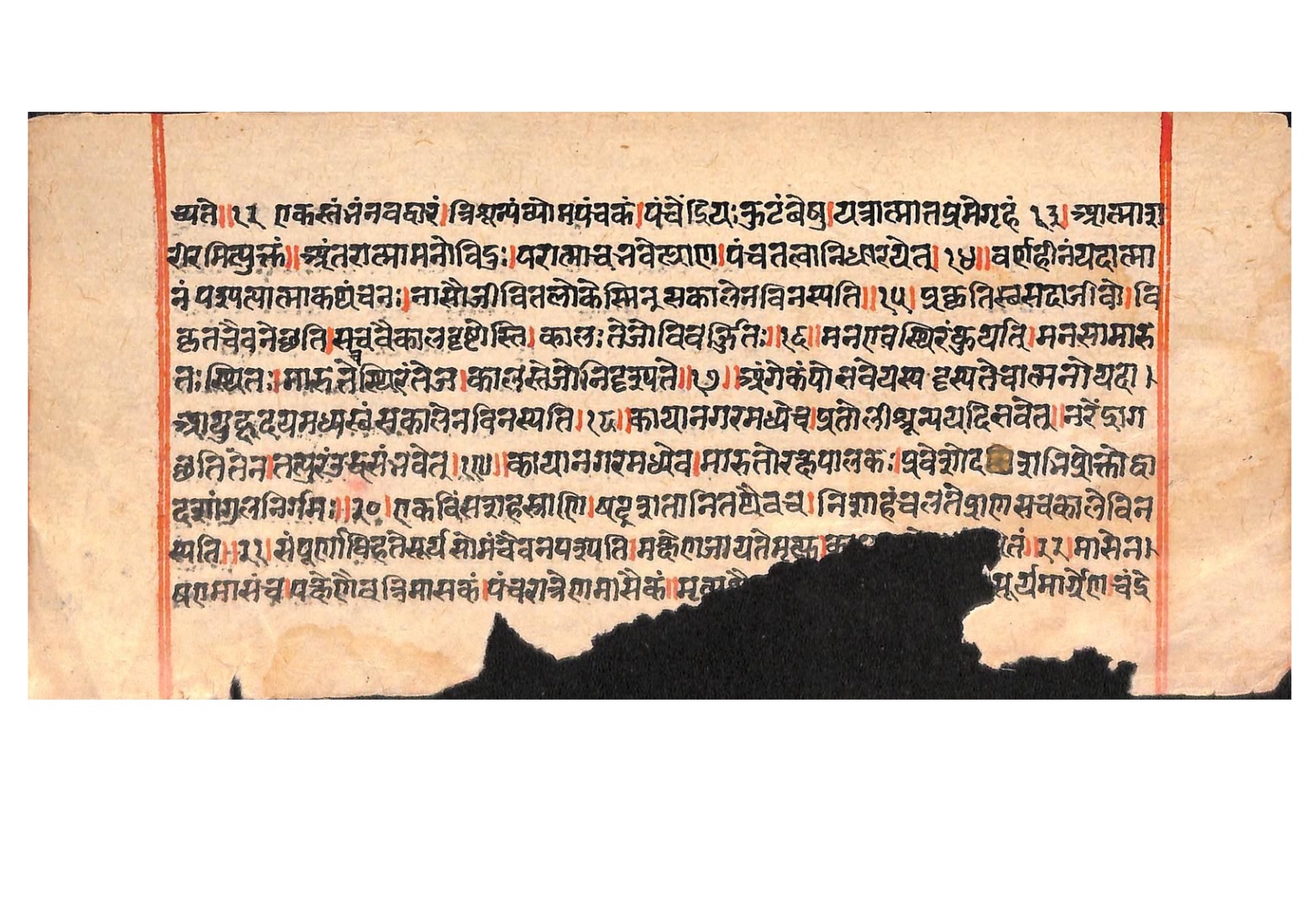
The Kālajñāna, attributed to Śambhunātha, rests on a striking premise: that kāla—time itself—is the true physician's subject. The body is not merely flesh and humors; it is a city (kāya-nagara) with one pillar, nine doors, three voids, and five spaces, where the self dwells with the five senses as its household. And time is the force that moves through all of it.
Time as Creator and Destroyer
The manuscript opens with time as the creator and destroyer of all beings. The text counts 21,600 breaths in the cycle of a day's inhalation and exhalation—the number that became famous in later yogic literature—and treats breath as the very currency of lifespan. This is not metaphor. The physician who knows time knows disease; the physician who miscounts the breath miscounts the years remaining.
From anger and fear comes disease; for embodied beings, constant practice of jñāna-yoga always protects one from time.
The Body as Clock: Mapping Death
Much of the manuscript is devoted to recognizing the signs of approaching death. Unfavorable signs include burning at night with coldness by day, throat fullness, cough, diminished voice, and prolapsed rectum. More fatal still are hiccup with sorrow, cold hands and feet with a burning head, discharge from teeth, nose, and ears, and a black tongue or saffron-red face. The text assigns timelines—seven nights, seven days, two months—with precision that feels clinical even in its literary frame.
Even more remarkably, the manuscript maps the body onto the sky: the tongue represents Arundhatī, the nose tip Dhruva, the eyebrow center Viṣṇu's step. When these astronomical correspondences fail—when the patient no longer perceives them—death is near. This is diagnosis through celestial anatomy, the meeting of cosmology and clinical observation.
One whose tongue becomes black, or whose face becomes saffron-red, and whose eye is burst—his death is in the abode of Yama.
Pulse and Prognosis
The manuscript contains a compact treatment of pulse diagnosis (nāḍī parīkṣā). Pulses are classified as slow, swift, hard, steady, white, and bloody; a vāta pulse moves like a serpent, and dark or mixed pulses indicate death. The text then describes how to diagnose the progression of different fever types through the pulse, with fevers mapped to the seasons and the months each doṣa rules. In spring, pitta rules; in autumn, vāta; in winter, kapha. Each season carries within it the seeds of its own diseases.
Fever in Time, Time in Fever
The manuscript's approach to fever treatment follows the same temporal logic. For the first three days of fever, fast; in the middle period, give water; only afterwards administer medicine. This is not random sequence but recognition that fever itself moves through stages, each with its own curative principle. The body does not cure on our schedule but on time's schedule.
Seasonal considerations permeate the treatment. The text specifies that vāta becomes "king" in Margashirsha, Magha, Ashadha, Shravana, and Bhadrapada; pitta in Ashvina, Karttika, Vaishakha, and Jyeshtha; kapha in Phalguna and Chaitra. A physician treating fever in summer treats a different disease than one treating fever in winter, because time itself has shifted the body's internal balance. This is not mere theory; it transforms practice. The cold water given in summer becomes poison in winter.
The Colophon: A Gift to Understanding
The Kālajñāna closes with attribution. The text was written in Samvat 1781 in Dabapura by Brahmana Somadatta. The specificity of time and place transforms this from abstraction to testimony: a physician once sat in a particular city and wrote down this knowledge. That writing is itself an act against time, an attempt to preserve what time devours. The manuscript is time made visible, teaching the reader to see time in fever, in breath, in the black tongue and the saffron face, in the very pulse that counts away the hours of a life.