
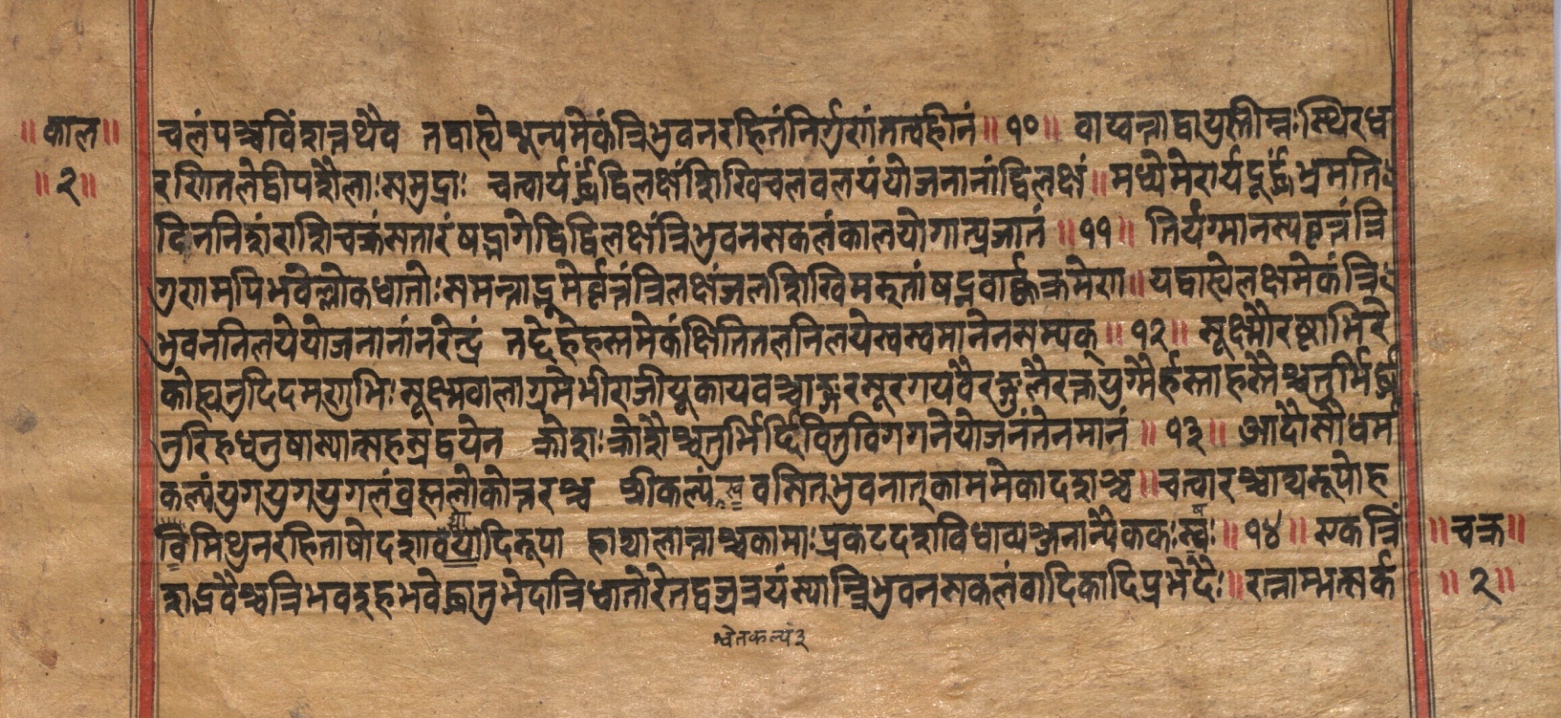
No system in Indian thought took time more seriously than the Kālacakra. The 'Wheel of Time' tantra is a complete science of time — cosmic, astronomical, and inner — and its promise is bold: in the Kali age, it teaches, this yoga is the path to liberation. This manuscript, from the Oriental Institute at Baroda, preserves the tantra's opening chapters, where cosmology and astronomical calculation build the outer framework the later inner yoga will mirror.
A yoga for the Kali age
The text opens with homage and an announcement of purpose, framed as a dialogue between the Buddha and the sage Sucandra.
Om homage to glorious Kālacakra. The all-knowing, embodiment of wisdom, sun-like in form, lotus-petal-eyed Buddha, seated on the lion throne, the god-king bowed to by the gods with their heads — I, having bowed, asked the wise Sucandra, placing my lotus-folded hands upon my head. The yoga of glorious Kālacakra in the age of Kali for the sake of liberation of men.
The framing is deliberate: this teaching is not for a golden age of easy practice, but precisely for the degenerate age, when the path is hardest and the need greatest.
Seven hells, seven oceans, and a diamond mountain
What the shorter draft of this article skipped past is the tantra's full cosmography — a structured universe of hells, oceans, mountains, and continents laid out with the same precision an astronomer brings to the sky.
The copper-colored hell called Tamra is the first; the second is the sandy-water hell; the third is the mud-water hell... The seven oceans are of salt water, wine, sugarcane juice, milk, ghee, and honey. The seven mountains are Nila, Abha, Mandara and others... The islands are Jambu, Shita, Bhum, Vara, Parama, Kusha, Kinnara, and Bhoga.
At the center of it all stands Sumeru, described as made of diamond, with the four cardinal regions — Videha, Haimavata, Godānīya, Kuru — set around it and the whole world-system measured out in exact yojanas, down to the width of the world-encircling mountain at its base.
The universe measured
The tantra builds its cosmic geometry from the same units used to measure a breath or a fingerspan, folding the vast and the minute into one continuous scale.
Wind, end, life, then firm earth, cold, continents, mountains, oceans, four half-lakhs, the garland of peaks and hair, two lakhs of yojanas. In the middle of Meru, day and night revolve, the zodiac circle with stars — all of the three worlds, born of time-yoga.
A separate passage runs the measurement ladder all the way down: fine hairs, lice, nits, barley-corns, finger-joints, hands, and bow-lengths, climbing back up through the kośa to the yojana — the same gesture as the Līlāvatī's grain-to-horizon ladder, but here in service of a religious cosmology rather than a merchant's arithmetic.
The four ages and a coming king
The tantra ties this cosmology directly to historical prophecy — the doctrine of the four yugas, and a startlingly specific forecast about the future.
In six hundred years of the Aśāka, the king will manifest the future in a place called Sambhala. From that, in a hundred years of the Nagas, indeed in the Maru region, the practice of mleccha-dharma will prevail... the destruction of the siddhāntas will occur in all the world at the conjunction of time.
This is the Kālacakra's famous Śambhala prophecy in its earliest textual form — the promise of a hidden kingdom and a king who will rise as the age's dharma collapses, a motif that would go on to have an enormous afterlife in later Tibetan Buddhist eschatology.
Astronomy as spiritual technology
The bulk of the surviving manuscript is given over to dense astronomical calculation — planetary motion, eclipse timing, the reckoning of Rāhu and Ketu, and elaborate rules for determining auspicious and inauspicious moments.
Rahu enters the orb of the Moon, and the orb becomes completely pure in total eclipse by the Moon's power; the southern beginning in the orb, half-eclipse becomes in the upper horn by the Moon's power.
This is not decoration — in the Kālacakra system, mastering the precise mechanics of planetary motion is itself part of the practice, because the practitioner's own subtle body is taught to contain the same winds, the same cycles, the same Meru-like axis as the cosmos being calculated.
The body as the universe
The signature idea of the Kālacakra is that the outer world and the inner body are the same system — the planets, the elements, and the breaths all map onto one another, and the practitioner who understands the correspondence, calculation by calculation, understands time itself. This manuscript, running to over a hundred folios of the tantra, is a window into that grandest of Buddhist sciences: the wheel of time, turning both outside and within, with hells and oceans and a diamond mountain measured out precisely so the body might, one day, be measured the same way.