
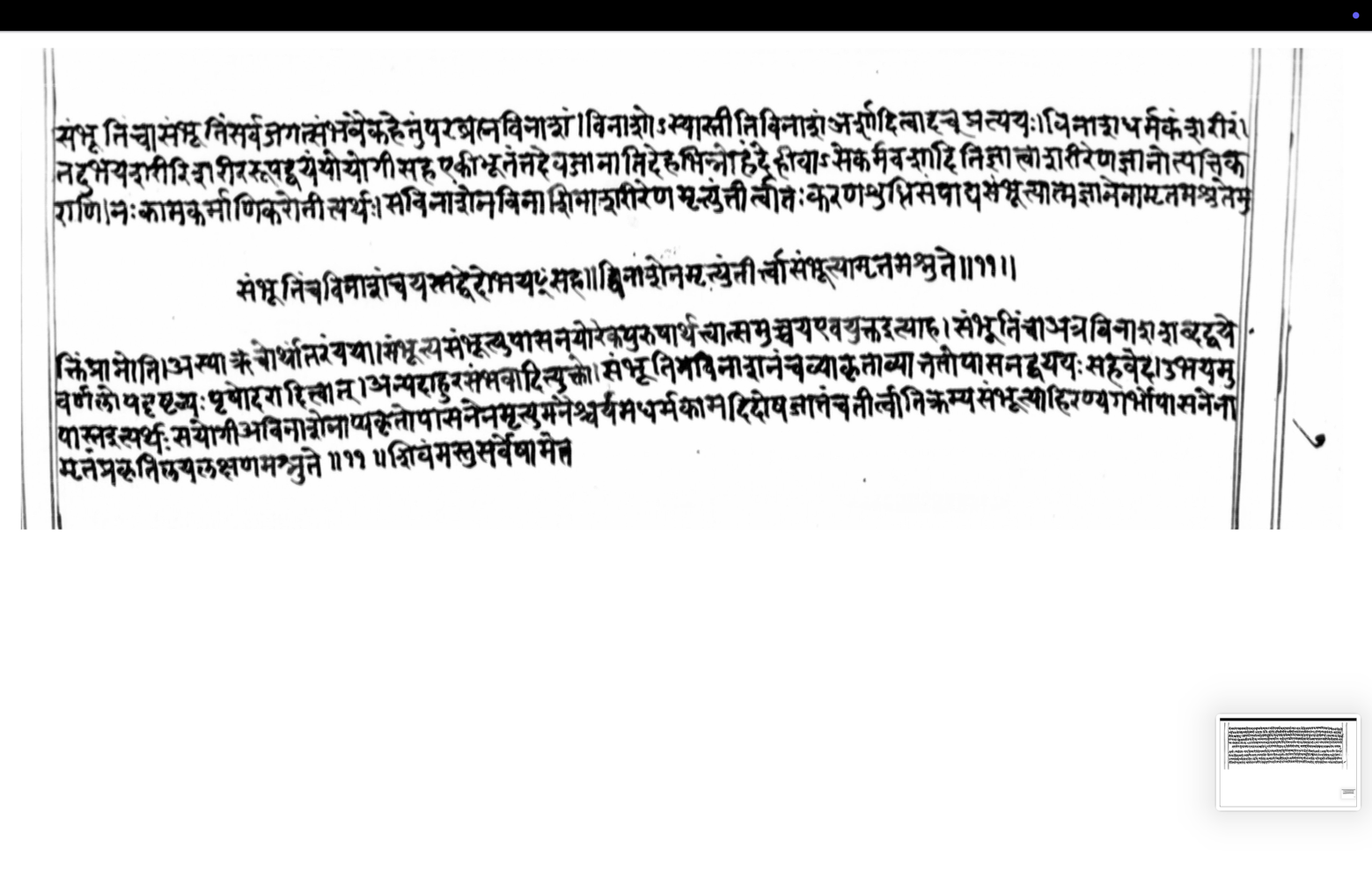
The shortest of the principal Upaniṣads carries one of the boldest opening lines in all of scripture: everything that moves in the moving world is to be covered by the Lord. The Īśāvāsyopaniṣad begins there — and this manuscript pairs that famous verse with the ritual context in which it was actually chanted, and with a commentary that pushes past the opening line into the Upaniṣad's harder teachings on action and knowledge.
The first mantra
The text opens with the verse that gives the Upaniṣad its name — īśāvāsya, 'enveloped by the Lord.'
All this — whatever moves in the moving world — should be covered by the Lord. Protect your Self through that. Do not covet anyone's wealth. Enjoy by renouncing that. Do not be greedy for whose wealth.
The injunction is not to escape the world but to see it differently — as already inhabited by the divine. And with that vision comes renunciation: enjoy by renouncing, covet nothing.
A verse with a ritual life
What makes this manuscript distinctive is that it records the Upaniṣad's verses in use — how they were actually employed in the saṃhitā, with the middle tone, for the daily and occasional rites, rather than only studied as abstract philosophy.
In the Samhita, with the middle tone, with the daily and occasional, one distinguishes the ritual action. Isha Upanishad — these verses are to be used. With the golden vessel, having covered, having covered the golden. With the golden vessel, the face of truth is covered.
Action that does not bind
The commentary then works through one of the Upaniṣad's most debated puzzles: how can performing ritual action — Agnihotra and the rest — lead to liberation, when action is elsewhere said to bind a person to the fruits of what they do? The text's answer is that desireless action purifies the inner instrument rather than accumulating karmic fruit.
And which actions — such as Agnihotra and others — are desireless and give liberation? Performing them indeed in this world for a hundred years... By the performance of desireless action, through the purification of the inner instrument, there is liberation — this is the meaning. But if by action there is bondage through its fruit, how can there be liberation? Therefore it is said: Action does not stick.
It's a resolution the Bhagavad Gītā would later make famous under the name niṣkāma karma — but here it appears as commentary on one of the very oldest formulations of the problem, wedged between the Upaniṣad's opening renunciation and its closing metaphysics.
Darkness on both sides
Before its famous close, the text delivers a warning that neither ignorance nor knowledge alone is sufficient — a verse whose severity is easy to miss on a first reading.
Into blinding darkness they enter who worship ignorance; into greater darkness, as it were, than that, they enter who are devoted to knowledge... This is for the purpose of teaching the combination of knowledge and action; for this is not meant to censure either one.
Action pursued for its own sake and knowledge pursued in isolation from action are both, in this teaching, dead ends — the Upaniṣad insists on their combination, jñāna-karma-samuccaya, rather than letting the reader retreat into either one as an easier path.
The two powers of the Self
The text closes with the Upaniṣad's famous pairing of sambhūti and asambhūti — the manifest and the unmanifest — and the claim that liberation requires knowledge of both together, not a choice between them.
Sambhūti and asambhūti — one who knows both, transcending death through asambhūti and attaining immortality through sambhūti. The destruction of this is not destruction; the destruction of the other is the goal, giving liberation from duality.
A whole philosophy in six pages
The Īśāvāsya is a whole philosophy compressed into six pages, moving from the covering of the world by the Lord, through the paradox of action and liberation, to a closing insistence that manifest and unmanifest, knowledge and action, must be held together rather than played off against each other. This manuscript shows the text living in both of its lives at once: as a philosophical argument to be reasoned through, and as a text to be recited, with a golden vessel, in the middle tone, as part of the daily ritual round.