
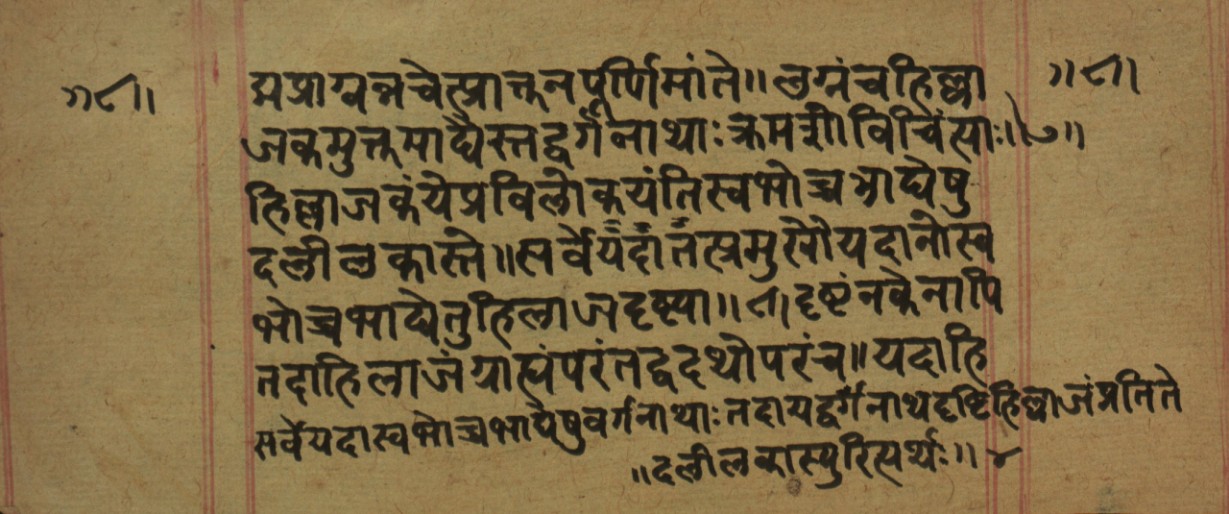
Can the sky tell you how long you will live? The Hillājadīpikā — the 'Lamp of Hillāja' — is built on that question. Attributed to Nṛsiṃha, it is a treatise on āyurdaya, the calculation of lifespan, and its signature method reads the Sun's position relative to the full moon to decide between long life and short.
What hillāja means: The Sun at the full moon
The treatise opens by defining its own name — a rare and useful habit for a technical text. Hillāja literally means "body-released" or "body-born," referring to the state of the body at the moment of the full moon. In traditional Indian astrology, this is no casual observation. The full moon marks a astronomical turning point: when the Sun and Moon are exactly opposed. The Hillājadīpikā uses this moment to read a person's entire lifespan.
Hillāja — by this name, the body is released; first the Sun, then the ascendant — hence it is auspicious. Previously full moon or the ascendant, and divisible — this solar course is indeed worthy of examination.
The method is computational, not intuitive. It works from the position of the Sun at the full moon, combined with the ascendant (lagna) and the placement of the sign-lords (rashiadhipati). It is a procedure for arriving at a verdict from specific planetary data — the difference between astrology as prophecy and astrology as diagnosis.
Six grades of life: from excellent to utterly destroyed
The Hillājadīpikā classifies longevity outcomes into six distinct categories, from uttama (excellent) down to atināṣṭa (utterly destroyed). This is not metaphor but measurable classification — the way a medical text ranks the severity of disease by specific signs and symptoms, or the way Ayurveda grades constitutional imbalances.
Those who observe Hilla in their own exaltation, etc., are playful. When all the said [factors] are in their own exaltation, then Hilla is visible. In such a case, by whomsoever it is said, even in Hilla, the other is seen above. For when all the lords of the signs are in their own exaltation, then the sight of the lord of the sign is directed towards Hilla.
The six gradations are not arbitrary. Each reflects a specific astronomical condition: planets in exaltation (swoccha), their own sign (sva-rashi), friendly signs, neutral positions, inimical signs, or debilitation (neecha). Every grade is checkable, given the birth data. A person born when all the lords of the signs are in their own exaltation — an extraordinary rare configuration — experiences the highest grade of longevity. Conversely, when planets sit in their worst possible positions, longevity is destroyed.
The planetary indicators of death and short life
Where Hillājadīpikā becomes most specific and clinically precise is in describing the planetary combinations that shorten or destroy life. Pages 18-22 enumerate exact conditions that function like diagnostic markers. The text is blunt about causation: Saturn conjoined with the Sun produces short life. Mars conjoined with both Sun and Moon causes reduced longevity, especially when the Moon is positioned between them — sandwiched, trapped, overpowered.
Saturn conjoined with the Sun produces short life, and how Mars conjoined with both Sun and Moon causes reduced longevity, especially when the Moon is positioned between them. The text also explains that the Moon situated between two malefic planets without benefic aspect leads to short life, and that the Moon and Venus in the seventh house, even when aspected by benefics, bring death when both are in one sign under the Sun's aspect.
The precision extends to house positions: the Moon in the sixth or eighth house from the ascendant, especially when combined with Mars, Saturn, Rahu, or Ketu, indicates death and departure to Yama's realm. Each combination yields specific results — not vague warnings but calculated outcomes. If Mars and Mercury form a trine (120-degree aspect) while the Moon sits in Cancer or Leo, specific dangers arise. The astrologer's job is to read these patterns.
Protective factors: Jupiter and the strong Moon
But the Hillājadīpikā is not a text of doom. Pages 23-26 describe protective factors with equal specificity. When Jupiter sits strong (bala-yuta) in the chart, especially in the ascendant or exalted, it guards against fatal combinations. The Moon, when in its own sign, house, or exalted position, becomes what the text calls a "father protecting his child" — protective, sustaining, life-giving.
When the Moon is in a benefic position or its own sign, it protects merit like a father protects his child. The text describes how a strong Moon in the lagna sign removes danger from the house, comparing it to disease cured by proper medicines. When the Moon is free from malefic aspects, very long life is declared.
A technical literature sustained through generations
The Hillājadīpikā belongs to a whole family of longevity texts, and this manuscript pairs it with the Lājadīpikā and related works in a single compendium. Two copies of the same treatise survive in this collection — a reminder of how often these technical manuals were copied and recopied, each scribe keeping a working reference alive for the next generation of astrologers. These were not philosophical works meant to inspire; they were working tools, recopied because they were used, consulted, and trusted.