
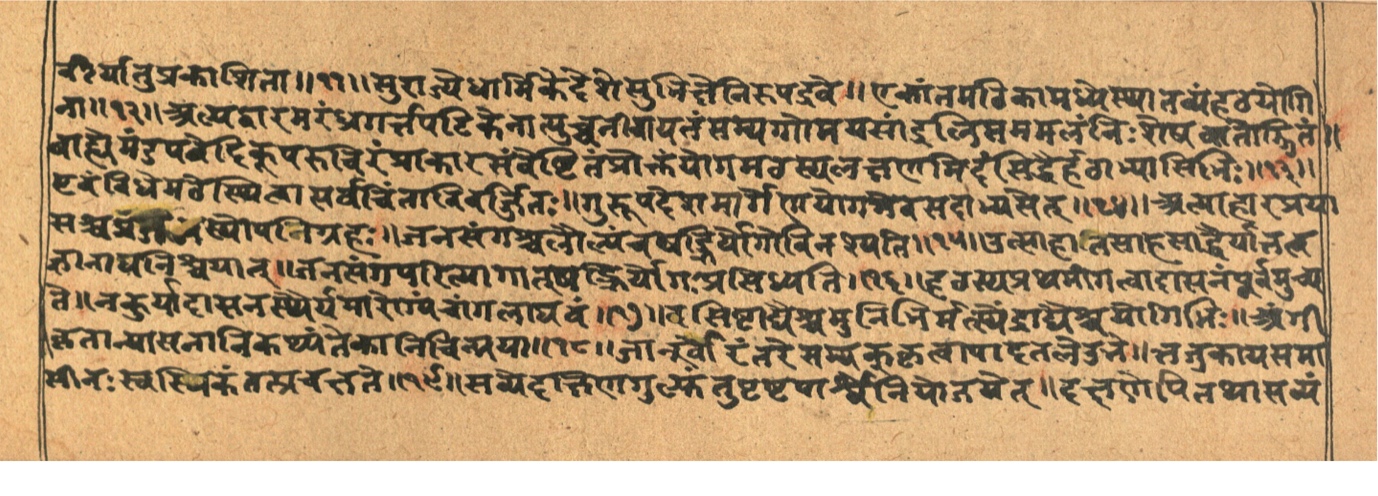
Before there were yoga studios, there was a specification for the yoga monastery: few doors, small apertures, plastered with cow-dung and soil, free from dirt and insects, enclosed by a wall. That is how the Haṭhayogapradīpikā of Svātmārāma opens its practical teaching — not with philosophy, but with the room you practice in.
The lineage of the Nātha yogis
The Haṭhayogapradīpikā doesn't begin with instructions; it begins by naming its source. Svātmārāma traces the knowledge through a specific genealogy of masters — not as historical record, but as spiritual transmission. The opening verses list the teachers who unlocked this knowledge: Śrī Ādinātha, the primordial Lord; Matsyendra and Goraksha, the legendary Nātha yogis; and a chain of thirty-some accomplished practitioners including Bhairava, Chaurangi, Virupaksha, Bileshaya, Manthana Bhairava, Bindunatha, Allama, Prabhudeva, and Kapalika.
Sri Adinatha, Matsyendra, Shavarananda, Bhairava, Chaurangi, Mina, Goraksha, Virupaksha, Bileshaya, Manthana Bhairava, the Yogi Siddhi, the wise Kanthari, Korantaka, Surananda, Siddha Pada Charpati, Kaneri, the venerable Pujyapada, Nityanatha, Niranjana, Kapali, Bindunatha, Kakachandishvara, Allama, Prabhudeva, Ghoda, Choli, Tintini, Bhanuki, Naradeva, Khanda, Kapalika, and other great Siddhas, by the power of Hatha Yoga, have shattered the staff of death and roam freely in the universe.
This is striking: the claim is explicit. These practitioners did not merely study yoga or teach it — they transcended death itself. The "staff of death" shattering is not metaphorical in the Nātha lineage; it is the central accomplishment. Hatha Yoga, in this view, is technology for outliving mortality.
The monastery and the six destroyers
The text is blunt about what ruins practice. It lists six destroyers of yoga — excessive eating, exertion, talkativeness, rigid observance, socializing, and restlessness — and six things that build it: enthusiasm, boldness, fortitude, knowledge of truth, firm conviction, and the abandonment of company.
In a righteous kingdom, a peaceful land, free from calamities and famine, the Hatha Yogis should reside in a solitary monastery. With few doors, small apertures, cavities, not too lofty or low, properly plastered with a mixture of cow-dung and soil, free from dirt and insects, enclosed by a wall.
Notice the specificity: not just "a quiet place," but a precise environment. Few doors limit distraction and draft. Small apertures keep the interior stable. Cow-dung plaster (which was common in South Asian construction) absorbs moisture and insects. The wall creates a boundary — both physical and psychological. This is not romantic; it is practical engineering for the body and mind.
The six cleansing actions
Where modern yoga tends to emphasize posture, the Haṭhayogapradīpikā treats the body as a vessel that needs internal cleaning first — especially for anyone overweight or phlegmatic. Its answer is the shat-karmas, six practices it calls secret and reserves for those with imbalanced humors.
- Dhauti: swallowing a moistened cloth and drawing it out again — said to remove cough, asthma, spleen disorders, and twenty types of phlegmatic disease
- Basti: drawing water in and out through the anus to cleanse the lower channels
- Neti: nasal cleansing
- Trataka: steady gazing
- Nauli: churning of the abdomen
- Kapālabhāti: frontal-brain cleansing
One who was previously overweight and phlegmatic should first perform the six karmas. Others need not perform them, since their humors are balanced. The six karmas are secret, purify the body-vessel, and are revered by accomplished yogis for their wondrous qualities.
The supreme posture: Siddhasana
The Haṭhayogapradīpikā describes numerous asanas — Gomukhasana (cow-face), Virasana (heroic), Kurmasana (tortoise), Matsyendrasana (Lord of the Fish), Paschimatasana (western stretch). But among them all, one stands apart: Siddhasana, the accomplished posture. It is not the most complex or demanding — it is described simply as sitting with the heel pressed against the perineum and the ankles crossed — yet the text places it above all others.
Some call it the Gupta posture, others the supreme posture. The sages know the Siddhasana alone to be the principal among all postures, like moderation in diet among observances of yama, and non-violence among those of niyama. One should ever practice the accomplished posture on the four principal seats. It is the cleansing of the seventy-two thousand nadis.
The comparison is telling: as moderation in eating and non-harming are foundational ethics, so Siddhasana is the foundation of all postures. The text claims that constant practice purifies the seventy-two thousand nadis (energy channels) throughout the body. More: a yogi who practices Siddhasana consistently, moderately eating and meditating on the Self, attains perfection within twelve years. This is specificity about time and method — not vague spiritual promises, but a measurable path.
A body-first path
The Haṭhayogapradīpikā is a reminder that the classical tradition treated the body as the instrument — you purify the channels, steady the posture, then and only then does breath control become possible. The manuscript's practical, almost engineering-minded tone is why it still reads as fresh today. What matters is not the philosophy behind it, but whether you show up in a clean room, on a simple seat, and practice.