
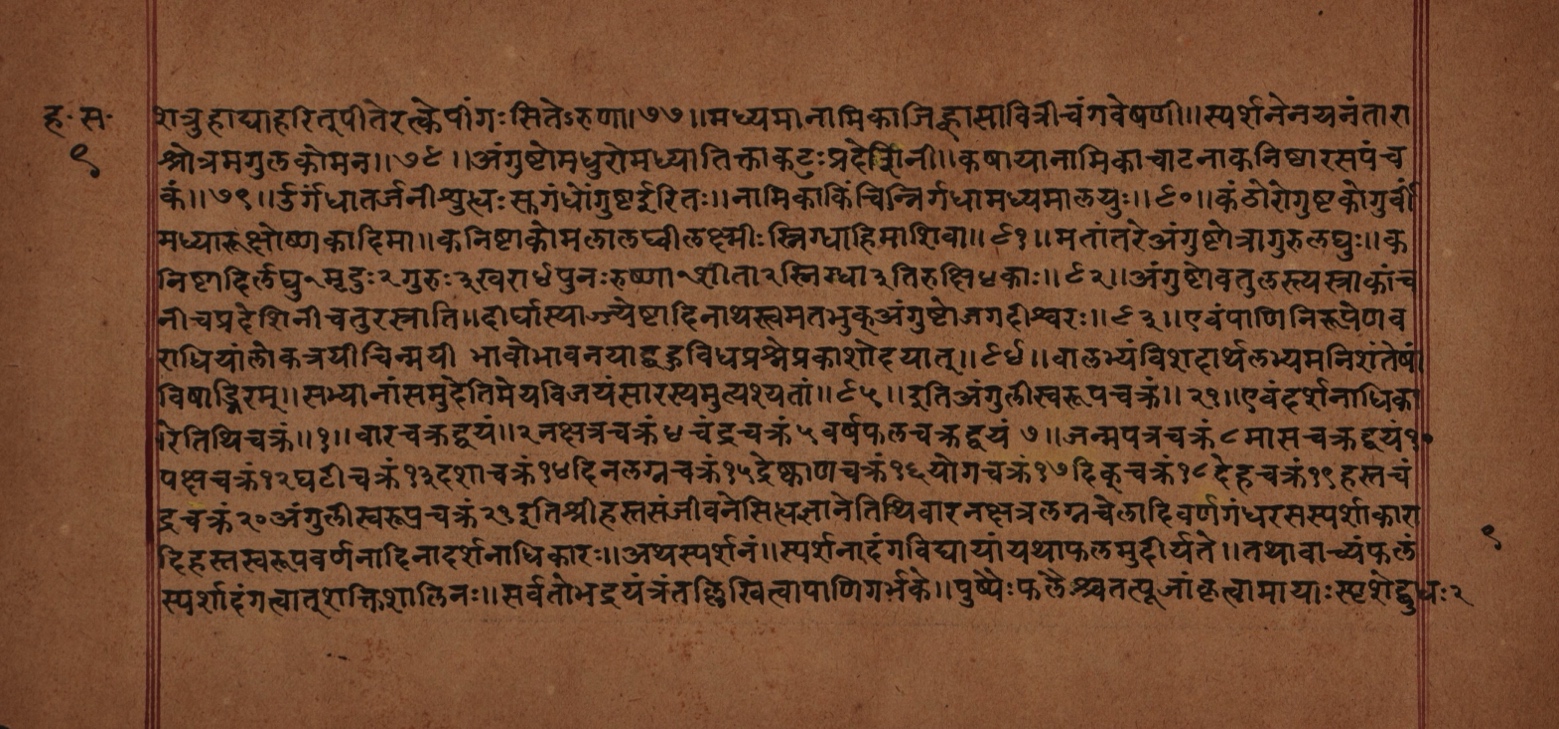
You don't need an almanac to know the day of the week — just hold up your hand. In the Hastasaṃjīvana, an eighteenth-century treatise composed under the patronage of Rājā Mādhavarāo Vināyaka Peśve, the fingers carry the entire cosmos: planets, days, elements, colors, even the five tastes. The palm is a divination chart you carry with you.
The Cosmic Hand: Planets on Every Finger
The text maps each planet to a specific part of the hand, from the nails to the wrist. Reading this map transforms the hand into a working astronomical instrument.
On the nail is the clear Moon. Mars is at the tip of the index finger, Mercury is at the king's seat [thumb base]. Jupiter is in Lakshmi [middle finger], Venus is in Gauri [ring finger], Saturn is in the mind [little finger]. Rahu and Ketu are on the back of the hand — thus are the days and planets.
The same page reads the day from the palm: daybreak at the thumb, midday at the middle finger, evening on the back of the hand. The day belongs to the right hand, the night to the left — and whichever finger is reached at the moment of asking gives the weekday. This is not mysticism dressed as astronomy; it is a mnemonic system practical enough that a merchant, a traveler, anyone with hands could know the time without instruments.
The Five Fingers as Five Categories
The hand's genius lies in its compression. Each finger is not just one thing; it is a category, and everything in the world can be filed under one of five.
The thumb is yellow, the index finger is green, the middle finger is red, the ring finger is pale, and the little finger is white. The thumb is sweet, the middle finger is bitter and pungent, the index finger is astringent, the ring finger is salty, and the little finger is the group of five tastes.
These correspondences are not random decoration. They connect to the five elements, the five tastes of Āyurvedic medicine, the five fundamental principles of sensory experience. A person versed in the system could hold their hand and immediately locate: Jupiter (wealth, north direction), Venus (pleasure, east), Mars (conflict, south), Saturn (obstruction, west), Mercury (communication, center). The thumb stands for the presiding deity, the organizing principle — the soul itself.
The Fingers as a Language of Omens
The text turns each finger into a figure of power, a deity or agent whose name reveals its function.
Lakshmi is indicated by the thumb, the king by the index finger, eloquence by the name of the middle finger, Shiva by the little finger, the crow by the ring finger — thus established in the fingers.
When a seeker asked which direction their fortune lay, or whether a venture would succeed, the trained palmist did not guess. They observed which finger was prominent, which carried signs of change or constancy, which direction the lines of the palm seemed to flow. Shiva (destruction and renewal), Lakshmi (fortune and harvest), the crow (bearer of omens) — each had a place. The hand became a lexicon for reading intention written in the body's own geography.
The Sacred Tirthas in the Palm
The Hastasaṃjīvana builds another layer: mapping sacred pilgrimage sites (tirthas) onto the hand itself. This allowed devotees to literally carry the sacred geography in their own body, worshipping the tirthas through meditation on hand placement.
At the root of the thumb is the Brahma tirtha, at the base of the little finger is the Kaya tirtha; the Pitr tirtha is between the thumb and index finger, and the Deva tirtha is at the tips of one's own fingers. Shatrunjaya is at the index finger, Ujjayanta at the middle finger; Arbuda indeed is at the ring finger, and Sametaka at the little finger.
By merely observing one's own hand, a believer could venerate all the great pilgrimage sites — Shatrunjaya (Mount Shatrunjaya in Gujarat, a major Jain site), Ujjayanta, Arbuda, Semetaka — in the morning ritual, without travel. The Pitr line becomes the Ganges; the Manu line becomes the Saraswati; their confluence at the wrist is the imperishable tirtha, the eternal bathing place.
Reading the Moment: A Seeker's Consultation
The methodology for consultation was precise. A seeker would approach the palmist at a specific time — daybreak for men, after midday for women, midnight for those of masculine nature. The practitioner would observe which lunar day (tithi), which nakshatra (constellation), and which finger-region was reached by the finger counting system.
In the bright fortnight, the hand of the husband, happiness of the father, the fortnight, acquisition of dharma and wealth. In the dark fortnight, the day of women, looking from the right hand. The sacrificer, having heard the fruit, saying 'so be it' to the guru.
The answer emerged from the intersection of timing and geography. Which element was at play? Which deity? Was the line broken or whole? Did the text prescribe this as an auspicious or inauspicious sign? The Hastasaṃjīvana is a striking blend of traditions — Jaina invocations, Hindu cosmology, and the practical craft of hand-reading — produced in eighteenth-century Maharashtra, where scholarly patronage kept such compendia alive. It is a reminder that divination was not mysticism for its own sake, but a systematic way of organizing knowledge — with the hand as its index, and observation as its method.