Purification in the ritual tradition was precise — which ash, which bath, which garment. The Ekavastrasnānavidhi — 'the bath with a single garment' — is a manual of that precision, beginning with the most common of daily acts: the tilaka drawn on the forehead, and building from there into a full account of the tripuṇḍra mark, its cosmic meaning, and the meditation that is meant to accompany the outward rite.
The best ash
The text opens with a hierarchy of ashes for the sacred mark — not all ash is equal, and the manual is exact about which fire produces the most potent kind.
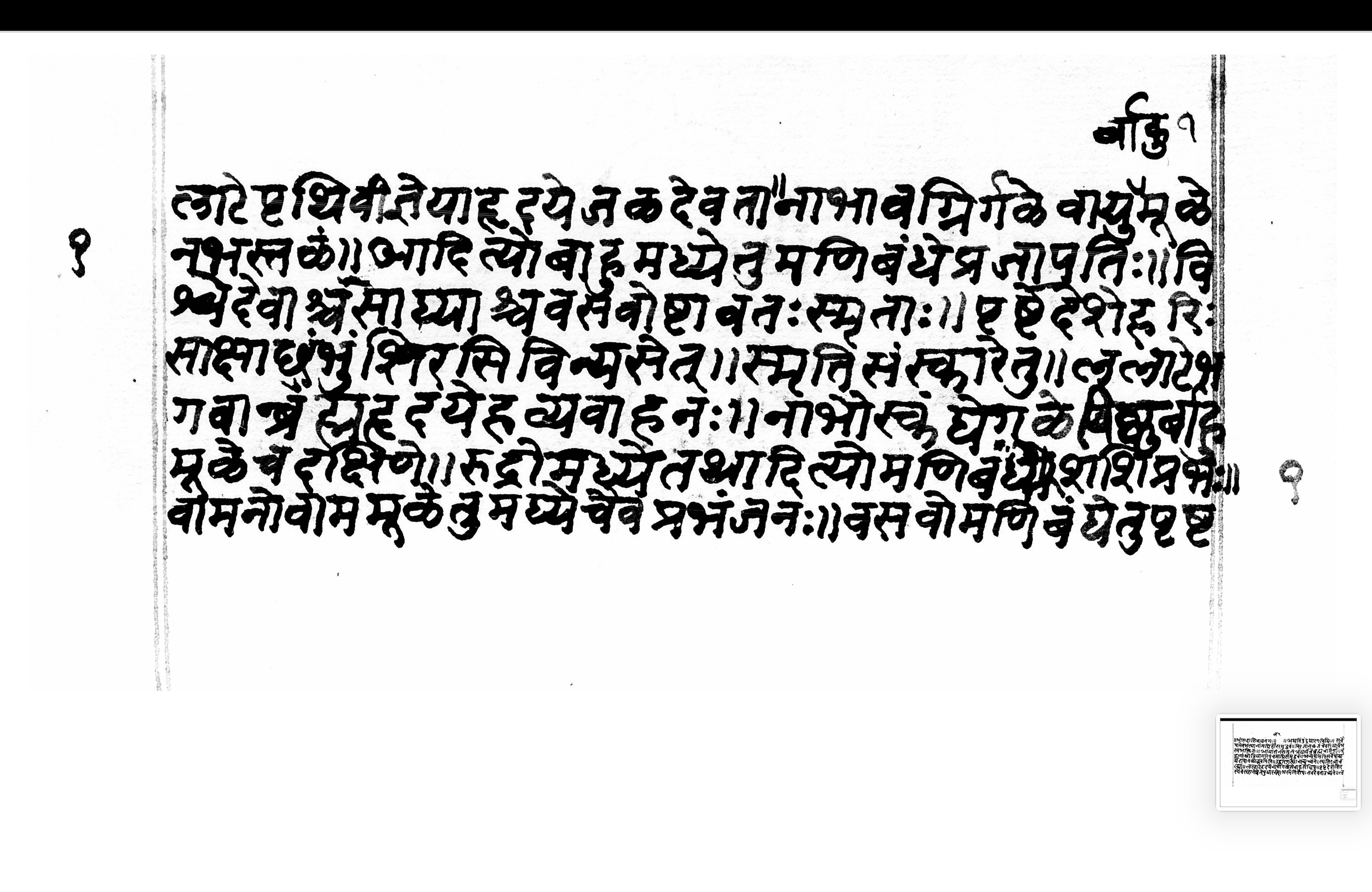
Salutations to Śrī Sadāśiva. The procedure for applying the broken three-line tilaka. Of all ashes, the Agnihotra ash rises supreme. The ash born from the Virajā and the Jaiva is excellent and imperishable. Fatigue does not arise, nor does fear from enemies.
The ash of the Agnihotra fire, kept burning by the twice-born as a daily obligation, outranks all others — the material of the mark carries the power of the fire it came from, and the text promises specific protections, from freedom out of fatigue to safety from enemies, to those who use it correctly.
The navel as the seat of wind
The manual then turns inward, from the ash on the forehead to the body's own subtle geography — the navel identified as the seat of vāyu, the vital wind, and tied to a specific astrological moment for its meditation.
When the sun is in the sign of Aries, the navel is the place of the wind. The first syllable is the root, the jewel-band is recited. The Viśvedevas are remembered as having come together for the sake of this. For this reason, the heart is made of essence, the head is made of essence, the body is made of essence.
The threefold mark and the syllable Om
What the shorter draft of this article left out is the manuscript's most developed section — a sustained explanation of the tripuṇḍra, the three-line ash mark, as an embodiment of the syllable Om itself, letter by letter.
The syllable 'a' is the name, the 'u' is the middle. The syllable 'ma' is the jaw and the face, the threefold, the tripundra. The syllable 'om' is the supreme thought. The divine Brahman, the threefold memory.
Each of the three horizontal lines corresponds to one sound of the praṇava, mapping the body's own act of marking itself onto the same syllable that, in Vedāntic thought, is said to contain creation, preservation, and dissolution. The text goes further, insisting that the mark is not decoration but a condition for any other rite to count at all.
With pure and cool sandal paste, the devotee should apply the tripundra. He who wanders in this Bharata land, having obtained liberation... Not that, not that moment, without the tripundra... The self of the tripundra, the Brahman, without that, what is the sacred bathing? What is the offering?
That last line is the manuscript's real claim: without the tripuṇḍra, the bath itself and the offering that follows it are empty gestures. The mark is not an accessory to the ritual — it is what makes the ritual a ritual.
Ritual as a full-body practice
The Ekavastrasnānavidhi is a reminder that the ritual tradition did not separate the outward act from the inner life: the ash on the forehead, the bath in the river, the navel-meditation timed to the sun's position, and the syllable Om folded into three lines of sacred ash were all one practice, not four separate ones. This manuscript, with its title page promise of a single-garment bath, preserves that unity — purity as a state of the whole person, marked, bathed, and meditated into being, with nothing left as mere formality.