
Some Upaniṣads begin by doubting; the Dhyānabindūpaniṣad begins by promising. It calls itself the 'crest-jewel of yoga' and announces that merely hearing it liberates from all sins. Then, with that promise made, it teaches the meditation itself — and, in this particular manuscript, the Sanskrit teaching arrives wrapped in a living multilingual tradition, with commentary in Odia and Bengali pressed around the old verses.
A promise at the threshold
The opening line is a hook unlike any other Upaniṣad's.
I shall now expound the Dhyanabindu Upanishad, the crest-jewel of yoga. By merely hearing it, one is liberated from all sins.
The claim is total: not by doing, not by years of practice, but by hearing. The text stakes its value on the ear — and on the belief that the sound of the teaching itself carries transformative power.
Meditation on the thousand-petaled lotus
Then comes the practice — meditation on Brahman in the sahasrāra, the thousand-petaled lotus above the crown.
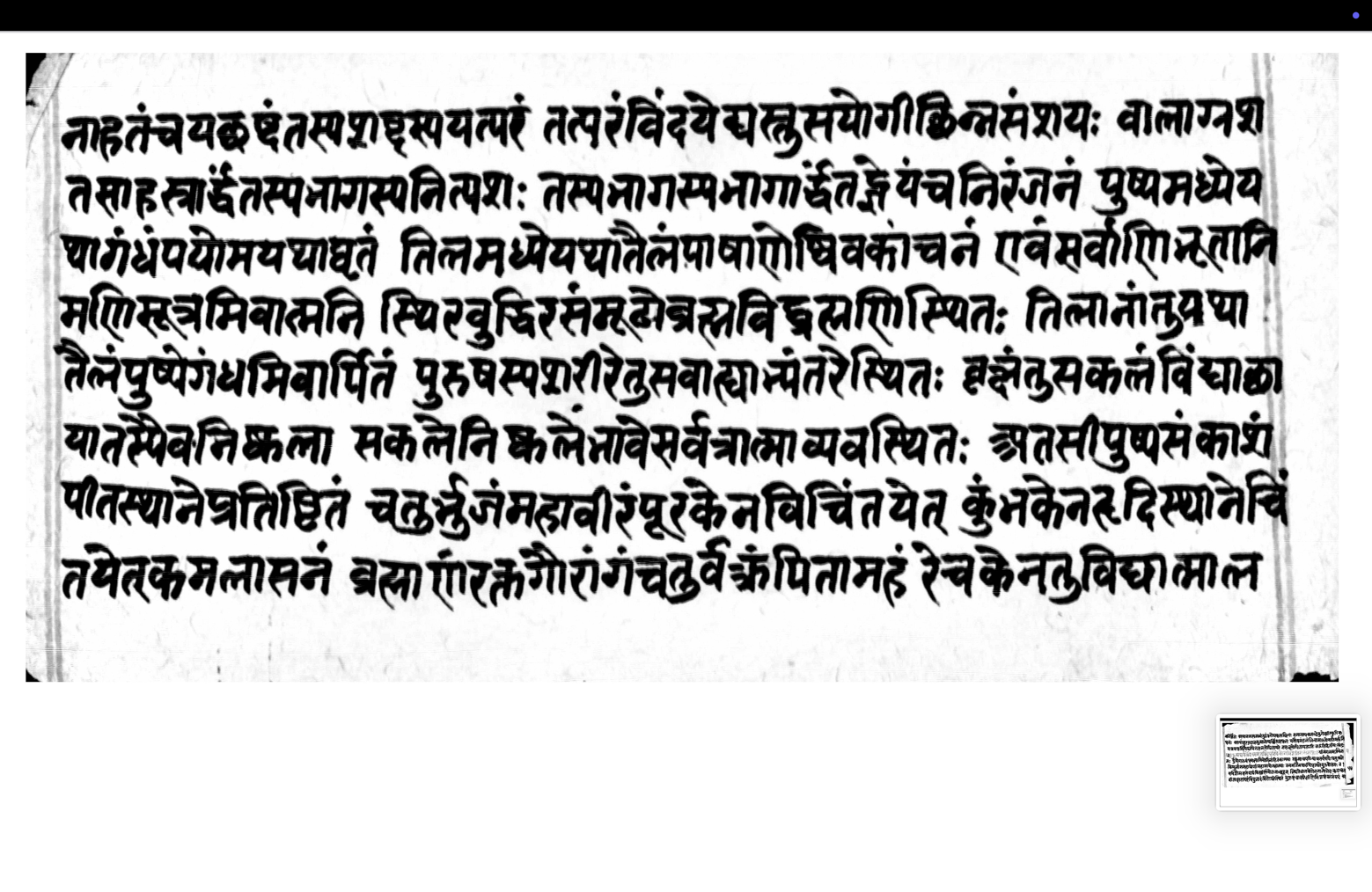
When dissolved in that, the yogi, with doubts cut away, [sees] that Brahman in the thousand-petaled lotus, stainless. In the middle of the flower, thus to be meditated upon, wonderful. As oil in the middle of sesame, in the mind, steady intelligence, unconfused, knower of Brahman, established in Brahman. As oil of sesame, and as fragrance in flowers, so established — in the body of the person, thus the Self, all-pervading, established.
The image is the classic one: the Self in the body as oil in the seed, fragrance in the flower — hidden, pervasive, waiting to be recognized. The passage closes with the terms of the subtle anatomy this text shares with the other yoga-Upaniṣads: the Self established 'in the with-parts and without-parts,' the highest point of a body imagined as a field of cakras.
Breath as the path
The same page begins to spell out the technique of prāṇāyāma — how the meditator actually moves toward that vision.
Established in the with-parts and without-parts, to be known. By inhalation, by retention, in its own place, Brahman, red-colored, and by exhalation.
The three phases — inhalation, retention, exhalation; pūraka, kumbhaka, recaka in the technical vocabulary — are the classical skeleton of breath practice, and the text connects them directly to the visualization: the red-colored Brahman is seen in its own place during retention. This is the Dhyānabindu's distinctive contribution to the yoga-Upaniṣad corpus — not just philosophy about the Self, but a concrete instruction set for perceiving it.
A manuscript with many voices
The other remarkable feature of this particular copy is what surrounds the Sanskrit core. The manuscript is multilingual, and its later pages carry the fingerprints of a living regional tradition.
The one whose eyes are fixed on the ground, whose face is like a blooming bud, who destroys the sins of the wicked, who grants prosperity, who is like a banana flower, who is praised by all gods, who should be worshipped in the morning. The three syllables should be recited with one's own hand, the three syllables of the name Lakshmi should be established with milk, and the two cloths should be placed on the sun and moon.
Alongside the yogic core, the copy has gathered devotional and artistic interpolations — temple ritual, the worship of Lakṣmī in the morning, references to the role of the śilpin, the artist, in sacred contexts — and its closing leaves dissolve into corrupted Bengali prose. The manuscript description records that these pages discuss Brahman, temple rituals, and the artist's place in worship, evidence that the text was not shelved as a museum piece but read, glossed, and added to for generations.
A yoga-Upaniṣad's double gift
The Dhyānabindūpaniṣad belongs to the group of 'yoga-Upaniṣads' — late texts that folded the practice of meditation into the Upaniṣadic frame. Its double gift is the promise and the method: hearing to begin, meditation to continue. This tiny manuscript, five pages, preserves both — and in its scattered Odia and Bengali glosses, it also preserves the more humbling truth that esoteric knowledge was not transmitted in a sealed Sanskrit jar. It was carried in languages, copied by hands, and reinterpreted in every region it reached, from the thousand-petaled lotus to the morning worship of a local goddess.