
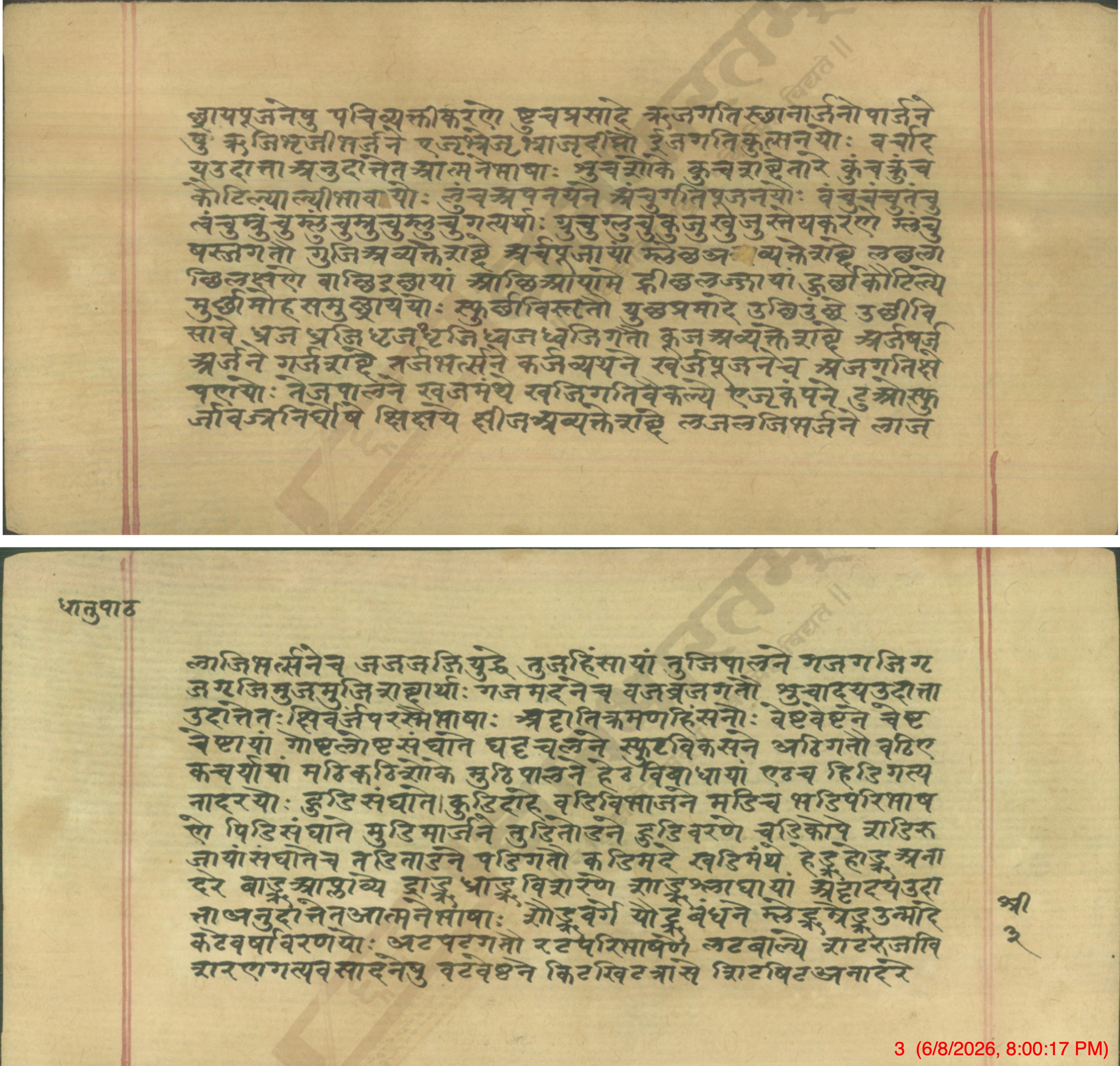
Every word in Sanskrit begins as a root. The Dhātupāṭha is the list of those roots — the raw material of the language, arranged not alphabetically but by class, each root with its meaning attached: aj for going, bhṛj for roasting, śuc for sorrow. This manuscript, a fragment of the Pāṇinian tradition's great inventory, preserves that list — and with it, a remarkable amount of information packed into each entry.
Roots with their meanings
The text works through the roots in series, each one defined by the action it names.
In purification, aj (is used) for going and throwing; tarj for threatening; bhṛj for roasting; ejṛ for trembling; bhrājṛ for shining; ij for going and censuring; vañcu for going. These are udātta (roots) with anudātta penultimate, ātmanepada (in conjugation). Śuc for sorrow. Kuc for crookedness. Kuñc for crookedness and becoming small. Mruc, mluc, sruc, gluc, gluñcu for going and concealing. Jaj, jaji for play, and also for battle.
Each entry is a small data packet: the root, its meaning, and its grammatical signature. The notation 'udātta with anudātta penultimate, ātmanepada' records the root's accent and the set of endings it takes — exactly the information a speaker needs to build any form from it.
From roots to classes
A later leaf shows the system organizing roots into their conjugation classes — the cur-ādi and jan-ādi groups, named for their first members.
With prīṅ, grīṅ in the sense of harming and going; with dhūrvī, jūrvī in the sense of harming and striking; with śārvī in the sense of harming and perceiving. With cyūrvī, from the cur-ādi [class], in the sense of satisfaction, theft, and covering an enemy; with cikkura in the sense of heating; with kāṅkṣā, long vowel, in the sense of desiring. From jan-ādi, with udātta [accent], ātmanepada [middle voice endings]; with lip in the sense of smearing; with cyuṣṭi in the sense of going.
The class markers do real work: a root's class determines how it conjugates, and the list makes that visible on the page. The same leaf runs off into the accentual distinctions that fascinated the tradition — udātta, anudātta, svarita — the tonal information without which Vedic recitation was thought impossible to get right.
The engine behind the grammar
The Dhātupāṭha and the Aṣṭādhyāyī work as one machine: the Aṣṭādhyāyī supplies the rules, the Dhātupāṭha supplies the roots. Without the list, the rules have nothing to operate on; without the rules, the roots generate nothing. The two texts were designed to be read together — the grammar assumes the list, and the list assumes the grammar's categories.
The fragment also shows how such lists circulated. Its pages mix the Dhātupāṭha proper with what appear to be pedagogical aids — a page of roots glossed in a simpler style, gam to go, śna to eat, bharma to support — the kind of crib a student might compile while working through the system.
gam - to go; śna - to eat; bharma - to support; sap - to curse; micc - to sprinkle; yam - to restrain; cadd - to give; rikṣ - to protect; ṣṭh - to stand; bhṛ - to support; hā - to abandon; ri - to go; kalk - to be dirty; phan - to move; balla - to speak.
Here the technical notation falls away and the list becomes something almost friendly — a bare vocabulary of action, the way a beginner actually meets the roots.
A language's DNA
There is something almost biological about the Dhātupāṭha: a finite list of roots, combined by a finite set of rules, generating an infinite language. The root is to the word what the seed is to the plant — the whole form latent in the beginning. This manuscript, a working copy of the list, is a reminder that the genius of Pāṇinian grammar was not just its rules; it was also its inventory, the patient cataloguing of every root the language was built from. And like so many manuscripts in the collection, it survives despite corruption and lacunae — pages of garbled text mixed with the clean lists — evidence of a text copied, studied, and worn thin by use.