
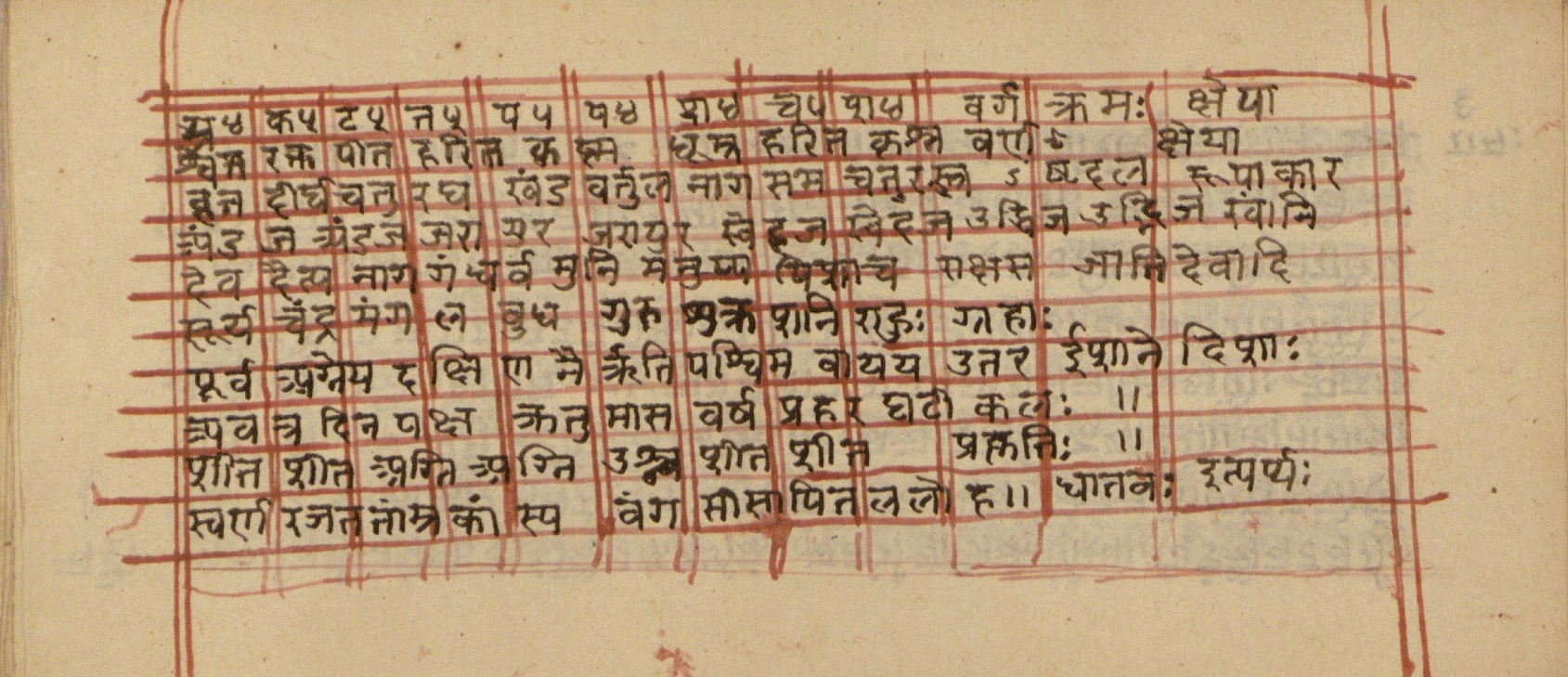
What shape is the letter A? In the Candronmīlana, the answer is not a metaphor — it is a precise correspondence. This treatise on phonetics and divination assigns each Sanskrit vowel a color, a geometric form, a place in the cosmos, and a destiny. The alphabet becomes a map of creation itself.
The vowel and its colors
The manuscript presents a systematic yantra — a correspondence table — that binds each of the twelve vowels to a specific color and geometric form.
a | ā | i | ī | u | ū | e | ai | o | au | aṃ | aḥ — vowels. White, white, yellow, yellow, variegated, variegated, red, red, smoky, smoky, black, white — colors. Circular, circular, elongated, elongated, triangular, triangular, quadrangular, quadrangular, vajra, vajra, fragmented, fragmented — shapes.
To know the alphabet is to know a set of colors and forms as much as a set of sounds. The 'a' sound, the most basic, is white and circular. The diphthong 'ai' is red and quadrangular. Each sound has a visible body; the audible and the visual are one system. This is not decoration — it is the structure of manifestation itself.
The consonant groups and their natures
The vowels are only the beginning. The manuscript then extends the same principle to consonant groups, the vargas. Each group has its own geometry and cosmological placement.
The a-varga is said to be circular, the ka-varga elongated, the ca-varga triangular, and the ṭa-varga a fragment. The ta-varga is wheel-shaped, the pa-varga like a sleeping snake, and the ya-varga quadrangular, the śa-varga many-angled.
But the correspondence goes deeper. Each varga is also classified by its mode of birth — how beings are born from these syllables.
By this knowledge, the wise understand: the a-varga and ka-varga are egg-born, the ca-varga and ṭa-varga are womb-born, the ta-varga and pa-varga are sweat-born, and the ya-varga and śa-varga are sprout-born.
The sound determines the category of life it produces. This is not allegory but a phonetic anatomy of creation — different sounds are the vehicles for different forms of life to manifest.
Sound mapped to the cosmos
The manuscript then assigns the consonant groups to beings and celestial realms.
The gods are the a-varga, the demons are the ka-varga, the ca-varga becomes the serpent, and the ṭa-varga the Gandharva. The ta-varga is called Muni, the pa-varga is known as Rākṣasa, the ya-varga is the human realm.
Sound is being. The letters of the Sanskrit alphabet, taken together, are not a neutral inventory of symbols — they are a taxonomy of existence. To utter the ka-varga is to sound the nature of asuras, the demonic forces. To speak the pa-varga is to embody the rakshasa principle. The alphabet is not a tool for describing the world; it is the framework through which the world manifests.
The medicine of sound
The Candronmīlana applies this phonetic cosmology to health and diagnosis. If each sound carries a specific elemental nature — cold, hot, or wind-based — then disease can be read and treated through vowels and consonants.
Consonants with short vowels, disease-alleviating, and also nasal — unequal from life, combined ones are happiness-bringing. The a-group becomes white, and the ka-group red. In the ca-group yellow color, and green in the ṭa-group.
A practitioner who understands this correspondence can not only read a disease but hear it — in the person's speech, their name, the sounds they naturally make. The remedy follows from diagnosis: if the disease is an excess of wind-nature (associated with certain vowels), use syllables of the cooling, water-nature. The alphabet becomes a pharmacy.
The directional placement
The manuscript then adds a spatial dimension. The consonant groups are positioned in the cardinal and intermediate directions, creating a mandala of sound.
The a-group should be in the eastern part, the ca-group in the southeast. The ca-group should be known in the south, the ṭa-group in the southwest. The ta-group should be known in the west, the pa-group in the northwest. The ya-group is proclaimed in the north, the śa-group in the northeast. By this knowledge of groups, the characteristic of direction should be known there.
Sound now occupies space. Utter the appropriate syllable to the east, and you align with the a-varga's qualities. Each direction brings with it specific sounds, specific forms, specific divine presences. The Candronmīlana is a complete phonetic universe — one that a practitioner can inhabit, move through, and manipulate through the precise utterance of syllables. For anyone who thinks of the alphabet as a neutral list of symbols, this manuscript is a bracing alternative: a world where every letter has a shape, a color, a place in the cosmos, and a destiny.