
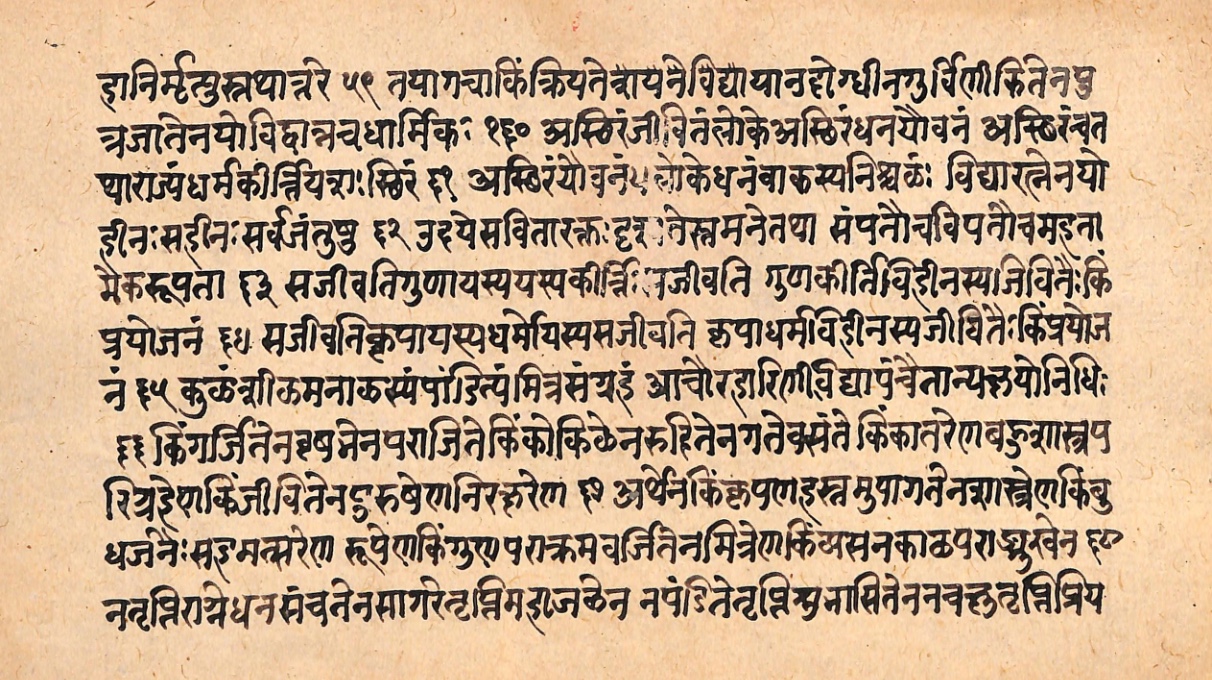
Cāṇakya — the minister who is said to have built an empire — left behind a set of aphorisms so practical they read like a field manual for life. The Cāṇakyanīti collects them, and its most famous verse is a rebuke to wishful thinking; the rest of the manuscript ranges from the sleeping lion to the twenty virtues a person can learn by watching six ordinary animals.
No wishes, only effort
The opening lesson is blunt: wanting is not doing.
Works are not accomplished by mere wishes; for deer do not enter the mouth of a sleeping lion. Where effort, courage, patience, intelligence, power, and valor reside — there even the gods hesitate.
The image is unforgettable: the lion asleep with its mouth open, waiting, and the deer walking in anyway. Fortune favors the awake — and the very next verse turns that principle into a rule about shame, insisting that in matters of wealth, food, and dealing with others, a person should act without embarrassment rather than hold back out of false modesty.
Who to wake, who to leave alone
The same page carries one of Cāṇakya's most-quoted lists — the seven who should never be woken, and the seven who always should be.
One should not wake seven who are asleep: a snake, a king with his crown, a child, a dog, a fool, a pig, and a bear. One should always wake seven: one tormented by hunger, a servant, a traveler, a student, a farmer, a storekeeper, and a doorkeeper.
It is a lesson in timing and judgment — knowing when interference is dangerous and when it is kindness, and the collection immediately doubles down with a companion image: lions, good men, and elephants abandon a place that no longer suits them and move on, while crows, wicked men, and deer stay and die exactly where they are.
Twenty virtues from six animals
What the shorter draft of this article left out entirely is one of the collection's most distinctive passages — a structured curriculum of virtues, each drawn from watching a specific animal's behavior.
One should learn one thing from the lion, one from the crane, four from the rooster, five from the crow, six from the dog, three from the donkey... Whatever work, small or great, a man wishes to do — he should do it with full effort, as the lion does with single-pointed focus.
The list runs through specifics: from the rooster, rising before dawn and fighting for what's earned; from the crow, caution, secrecy, and timely readiness; from the donkey, bearing burdens without complaint and being content regardless of heat or cold. It's practical ethics built entirely from observation of the natural world, with no appeal to scripture at all.
The danger of a foolish minister
Later in the collection, Cāṇakya turns specifically to statecraft, and the verse on appointing advisors reads like it was written for a king personally.
When a fool is appointed as minister, three great defects befall the king: disgrace, loss of self-interest, and certain fall into hell. When a wise person is appointed as minister, three qualities accrue to the king: fame, attainment of heaven, and abundant acquisition of wealth.
The same section tests character the way a goldsmith tests gold — by rubbing, cutting, striking, and burning it — arguing a person should likewise be judged by learning, conduct, virtue, and action, not by appearance or claim.
What is stable
The collection returns, again and again, to the question of what lasts.
Unstable is life in this world, unstable are wealth and youth. Unstable are wife and kingdom — dharma, fame, and glory are stable. He lives who has virtue; he lives who has fame. What is the use of life for one devoid of virtue and fame?
The ethics of a man who had seen courts rise and fall
Cāṇakyanīti is the ethics of a man who had seen courts rise and fall: work without waiting on wishes, judge people the way gold is tested, learn discipline even from a rooster and a donkey, and invest in the only things that survive — virtue and fame. The manuscript preserves that counsel in the terse verses it was written for, verse after verse, still legible in its incomplete but substantial twenty-nine pages.