
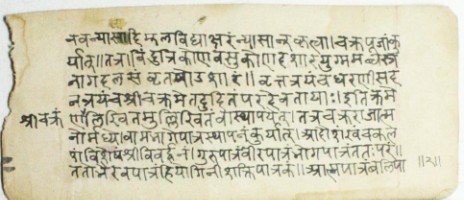
The Śrī Cakra is the most famous diagram in the goddess traditions of India — a geometry of nine interlocking enclosures said to contain the whole cosmos. Cakrapūjana is the manual for worshipping it, and this manuscript walks through the ritual step by step, from the first meditation to the final offering, each gesture laden with meaning.
The goddess's pavilion
The ritual begins in the imagination, building the goddess's world with the precision of an architect. "One should meditate on the pleasure garden adorned with a network of flowering creepers. There, at the gateway with festoons, one should meditate on the pavilion of the Goddess, served by many crores of deities eager to serve, fragrant with the aroma of incense smoke rising from golden censers, resembling the risen sun, decorated with jewel staircases." The text constructs every layer of this imagined world before the physical ritual even begins. The altar itself is precise: "In its center, one should meditate on the altar with corner spaces marked by lamp flames, kindled by camphor and fragrant wicks, with a canopy of jewel plates hanging from jewel pillars." Visualization is not embellishment in this tradition — it is the foundation of ritual.
One should meditate on the pleasure garden adorned with a network of flowering creepers. There, at the gateway with festoons, one should meditate on the pavilion of the Goddess, served by many crores of deities eager to serve, fragrant with the aroma of incense smoke rising from golden censers, resembling the risen sun, decorated with jewel staircases.
The geometry of the cakra
Then comes the diagram itself — its anatomy stated with geometric exactness. "In the bindu, triangle, eight-cornered figure, ten-cornered figure, pair of ten-cornered figures, fourteen-cornered figure, eight-petaled lotus, sixteen-petaled lotus enclosed, three circles — or the three residences of Dharaṇī — this Śrī Cakra of the Supreme Goddess is thus declared." Point, triangle, octagon, decagons, fourteen-cornered figure, lotuses, circles — the cakra is a nested structure, each enclosure a layer of the goddess's presence. The worshipper's hand traces the same path the mind has built. Each point, each petal, each circle is assigned deities, mantras, and elements of power.
The Śrī Cakra: in the bindu, triangle, eight-cornered figure, ten-cornered figure, pair of ten-cornered figures, fourteen-cornered figure, eight-petaled lotus, sixteen-petaled lotus enclosed, three circles — this Śrī Cakra of the Supreme Goddess is thus declared.
The vessel and the kalasha
Much of the manual concerns the ritual vessels themselves. The kalasha (pot) must be washed and installed with mantras. Water is drawn into it from conches, itself a meditation. The text specifies: "Having drawn with the water standing in the conch a triangular, hexagonal, circular, and square mandala... supporting it with the right hand in the Śaṅkhamudrā." Every vessel has a location, a mantra, a presiding deity. The incense holder goes to the north, the lamp to the right. What appears to be mere logistics is actually a diagram of divine presence rendered in physical space and ritual action.
The mudrās and the six limbs
The worship proceeds through six limbs — ritual segments each with its own mantras and hand gestures. The six limbs are nyāsa, the placement of mantras and powers on the body itself: on the heart, the head, the tuft of hair, the armor of protection, the eyes, and the weapon. "Aiṃ hṛdayāya namaḥ — Thus filling it with water, having invoked the tīrtha with the tīrtha mantra..." Each segment is performed with the appropriate mudrā — the precise hand positions that channel the goddess's power. The worshipper becomes a living Śrī Cakra, the diagram transferred from paper to flesh.
What is striking about Cakrapūjana is how exact it is. A ritual manual, one might expect, would give general guidelines. This one specifies: which direction to face, which mantra for each vessel, when to use which mudrā, how to sit, where to place flowers. It is a cosmos you can draw, and a ritual you can perform, both at once.