
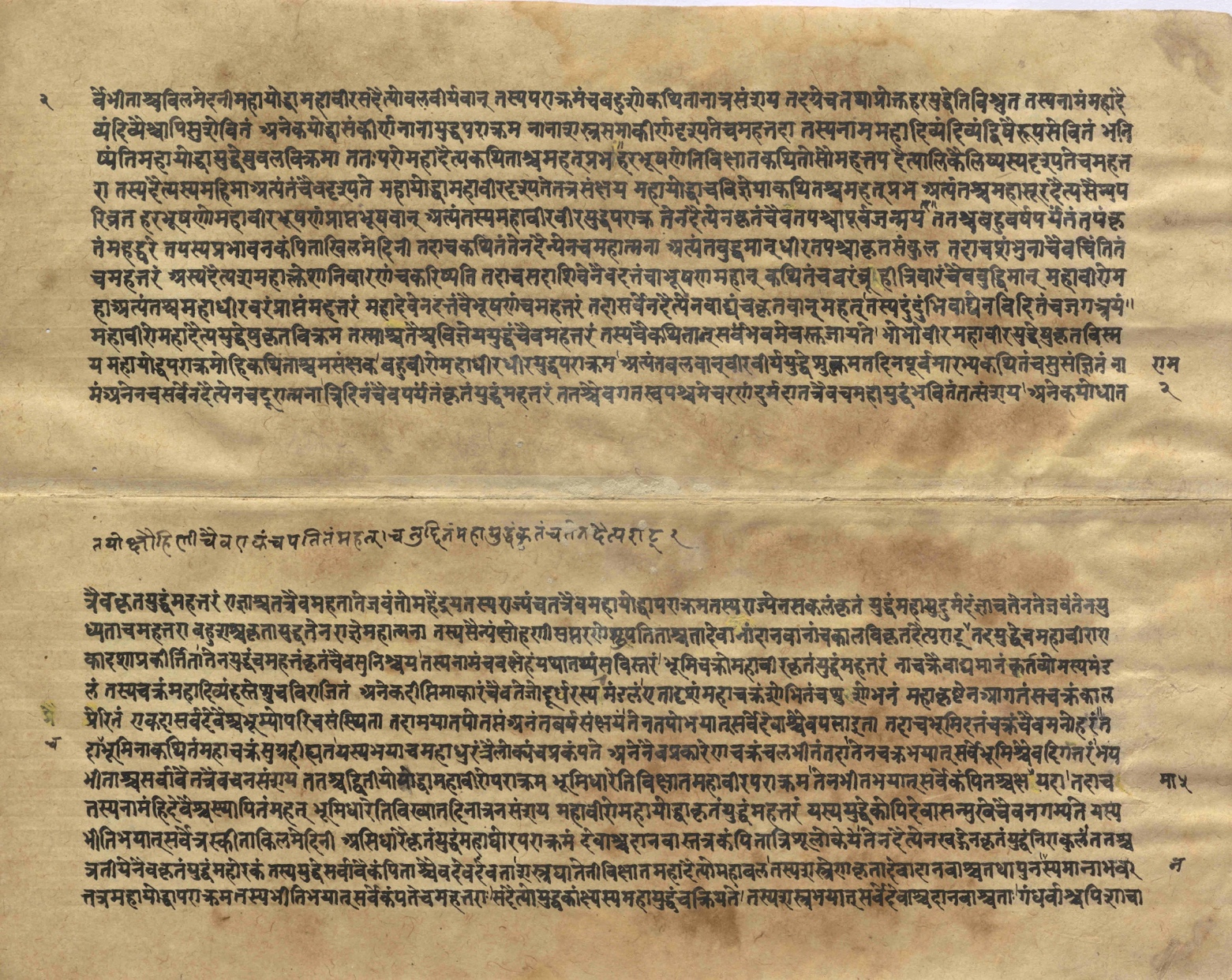
The title says 'the life of the Buddha,' but this manuscript of the Buddhacarita opens with a war. Not the Buddha's war — a war of gods and demons, told with the full machinery of Sanskrit epic: maces, clubs, spears, ten named demon champions, a palace built to specification by the architect of the gods, and armies counted in numbers that stop making literal sense long before the fighting starts.
The great battle in the north
The text announces its subject with full epic formality, piling weapon after weapon and epithet after epithet before a single blow is struck.
Salutations to Lord Ganesha. Now I shall describe in detail the great battle that took place in the north, a terrible war, extremely fierce, known to the wise, fought with great valor by the great demon, a great battle fought with knowledge-weapons, with maces, clubs, great spears, hand-to-hand combat, a very great battle fought without negligence, with various arrow-strikes.
The catalogue of weapons and the piling of epithets are the signature of Sanskrit war poetry — and here they are doing work inside a Buddhist text, borrowing wholesale from the same toolkit the Mahābhārata and Rāmāyaṇa use for their own battles.
Ten demons, named and ranked
What the shorter draft of this article missed is the manuscript's real structure: after the opening bluster, the text counts off ten demon champions by name, each introduced with the specific terror they inspire and the austerities that earned them their power. The fourth, Niśāndha, lord of night, performs impossible feats through ascetic power alone; the fifth, Rātristena, fights only after dark; the sixth, Kālavikṛtasena, brings a battle like a fall of meteors, and by the mere sound of his name gods, apsaras, vidyādharas, yakṣas, and serpents are said to tremble.
By the sight of that deformed one, gods, Apsaras-women, Vidyādharas, Yakṣas, Rākṣasas, serpents tremble—all this earth. By hearing whose name, the sun, the moon, and the stars are equal—Kāla, thus the great demon, Vikṛtasena is proclaimed.
By the ninth champion, Viryasena — described as a kṣatriya of noble birth turned rākṣasa warrior — the text has built an entire hierarchy of terror, each demon graded against the last, in a structure that reads less like theology and more like an epic's roster of enemy generals.
Viśvakarman builds a battlefield
Before the armies can fight, the gods need somewhere to fight them — and the manuscript spends several full pages on Viśvakarman, the architect of the gods, surveying the Himalayan foothills for suitable ground and then constructing, to precise measurement, a divine palace and a battlefield stretching over a hundred kośas.
Then a messenger was sent, and there Vishvakarman, the great-souled one, sent a messenger to the presence of the divine army... This land to the north, and also the excellent land, extensive. The excellent land was thus proclaimed, and great things were told. One hundred and eight kosas were made for the purpose of battle.
The palace itself gets an inventory any epic poet would recognize: coral pillars, crystal thresholds, avenues of ruby and sapphire, gardens stocked with pārijāta and Kāmadhenu, thirty-six thousand dundubhi drums distributed across forty-eight gates, three thousand women singing in a hundred and thirty-six languages at each one. It's less a battlefield than a stage set — the war that follows is meant to be witnessed in the same breath it's fought.
Messengers, boasts, and armies beyond counting
Before the fighting, there is diplomacy of a kind — messengers sent between camps carrying threats and counter-threats. The demon king's envoy warns that if his master's army reaches the ocean, 'the three worlds will all tremble'; the hero Sena's reply invokes precedent, listing the destruction of Rāvaṇa, Bali, and Hiraṇyakaśipu by earlier avatars as proof of what awaits him.
As done by the Solar dynasty to the rākṣasa, thus indeed I will do to you, O hero, terrible destruction. By the hero of the Solar dynasty, Rāvaṇa's head was made to fall to earth... of the danava lord Bali I will slay, and destruction was done of Hiraṇyakaśipu.
What follows is an accounting exercise that overwhelms its own arithmetic: akṣauhiṇī armies tallied in the hundreds, fifty-four hundred gods and sages, three times that number of men, the same again in animals and birds — a battle scheduled, with bureaucratic precision, to last twenty-two days across five separate locations.
A Buddhist text in epic dress
The Buddhacarita — Aśvaghoṣa's great poem — is famous as a literary masterpiece of Buddhism, a life of the Buddha in classical kāvya style. But this manuscript shows the tradition's other face: a Buddhist narrative that opens by borrowing the full apparatus of epic war — the ranked demon champions, the architect-god's construction project, the messengers trading boasts, the armies too vast to count — and tells its story in the language its audience already loved, before the Buddha himself ever enters the frame. The life of the enlightened one, in this telling, shares its opening stage with the gods and demons of the older epics, and waits.