
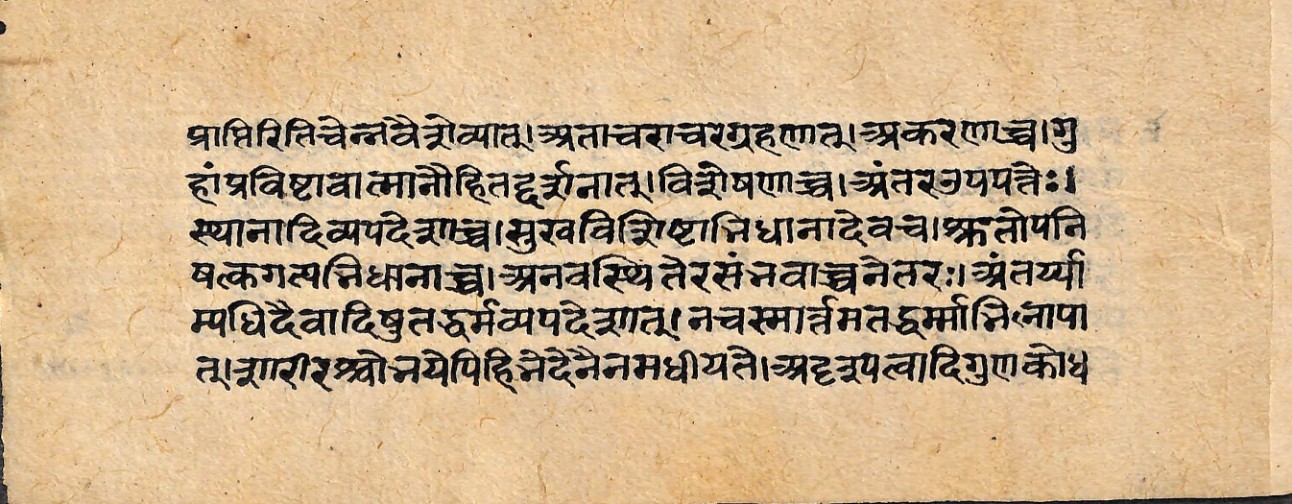
Some books begin with a bang. The Brahmāsūtra — the foundational text of Vedānta, attributed to Bādarāyaṇa — begins with four words: athāto brahmajijñāsā, 'now, therefore, the inquiry into Brahman.' This manuscript opens with those words and the chain of aphorisms that follow, the dense first moves of the entire Vedānta tradition.
The first aphorisms
The opening is a compressed engine of reasoning — every sūtra a claim, every claim an argument.
Now, therefore, the inquiry into Brahman. (That is the source) from which (are derived) the birth, etc. Because of being the source of the scriptures. But that (Brahman is known) from the agreement (of the Vedānta texts). (Brahman is not known) from the root 'īkṣ' (seeing), because it is not a word (denoting an agent).
In a handful of aphorisms, the text establishes the need for the inquiry, identifies Brahman as the source of the world, and defends the method by which Brahman is known — from the Upaniṣads, not from ordinary perception. Bādarāyaṇa sets the stage for centuries of philosophical debate by positioning Brahman not as an object of ordinary sense perception, but as the ultimate reality accessible only through the Vedic texts and rigorous reasoning.
Space, breath, and light as markers of the supreme
As the Brahmāsūtra unfolds on page 4, it takes up one of its most subtle and important philosophical moves: recognizing how the infinite appears within the finite. The text teaches that Brahman — the supreme, non-dual reality — reveals itself through three primary markers: space (ākāśa), breath (prāṇa), and light (jyotiṣ). These are not Brahman itself, but the characteristic signs by which the wise recognize the supreme reality manifest in the world.
Space, from that characteristic mark. From this very fact, breath. And light, from the statement of its being the support of the feet. If it be said that from the mention of meter it is not so, no, because there is the sending forth of the mind and the statement of 'thus' — for such is the seeing.
Here the Brahmāsūtra counters objections and defends the identification of these three elements as connected to the supreme Self. The text employs a method that will become standard in Vedānta: it interprets scripture carefully, distinguishes between apparent meanings and deeper significance, and uses the interconnectedness of concepts to show that space, breath, and light are not arbitrary but are the natural expressions of Brahman's presence in creation. This teaching becomes crucial for understanding meditation and for the later philosophical schools, which build entire metaphysical systems around these three principles.
The nature of meditation and the meditator
One of the Brahmāsūtra's most significant contributions is its treatment of meditation (upāsanā) as a path to knowledge of Brahman. Page 5 introduces Adhikaraṇa 11, which directly addresses the question: Is Brahman the object of meditation? This might seem obvious to the reader, but the philosophical stakes are high — the answer determines whether meditation is a valid means to liberation, or merely a preliminary practice.
If it be said that [Brahman is not the object of meditation] because of the absence of the characteristics of life and the chief vital air, [we say] no, because of the threefold nature of meditation, because of its being dependent [on the meditator], and because [the text] indicates that.
The text's response is striking: meditation has a threefold nature — it can take Brahman as its object in different ways depending on how the meditator approaches it. Meditation is dependent on the meditator's understanding and capacity. This opens a rich space for philosophical development: the same Brahman can be meditated upon in different forms, with different attributes, by different practitioners, all according to their capacity and the scriptural indications. The Brahmāsūtra thus validates meditation as a genuine means to knowledge while keeping Brahman's non-dual nature intact.
The soul and the Self
Later pages take up one of Vedānta's defining debates — whether the individual soul and the supreme Self are one or two.
If it is objected that the attainment is of the individual soul, no, because of the distinction. Because of the mention of the eater of the moving and the unmoving. And because of the context. Because the two selves are described as entering the cave.
The 'two selves entering the cave' is the Upaniṣadic image — the individual soul and the supreme Self dwelling in the same heart — and the sūtras argue carefully about whether they are the same. The Brahmāsūtra's response to this question will become the foundation for Advaita Vedānta's non-dualism, though other schools read these very passages differently, showing how the text's precision invites philosophical development.
A tradition in aphorisms
The Brahmāsūtra is the most commented-upon text of the Vedānta school — every major philosopher, from Śaṅkara to Rāmānuja, built a system on its sūtras. This manuscript, a copy of Bādarāyaṇa's text, preserves the source of all those systems: a book that begins with an inquiry, and never stops asking. With aphorisms so dense that they require centuries of commentary, the Brahmāsūtra exemplifies the method of Vedānta philosophy — to take the Upaniṣads as the source, to reason carefully from them, and to arrive at truths about the nature of Brahman and the path to liberation that transcend mere intellectual understanding.