
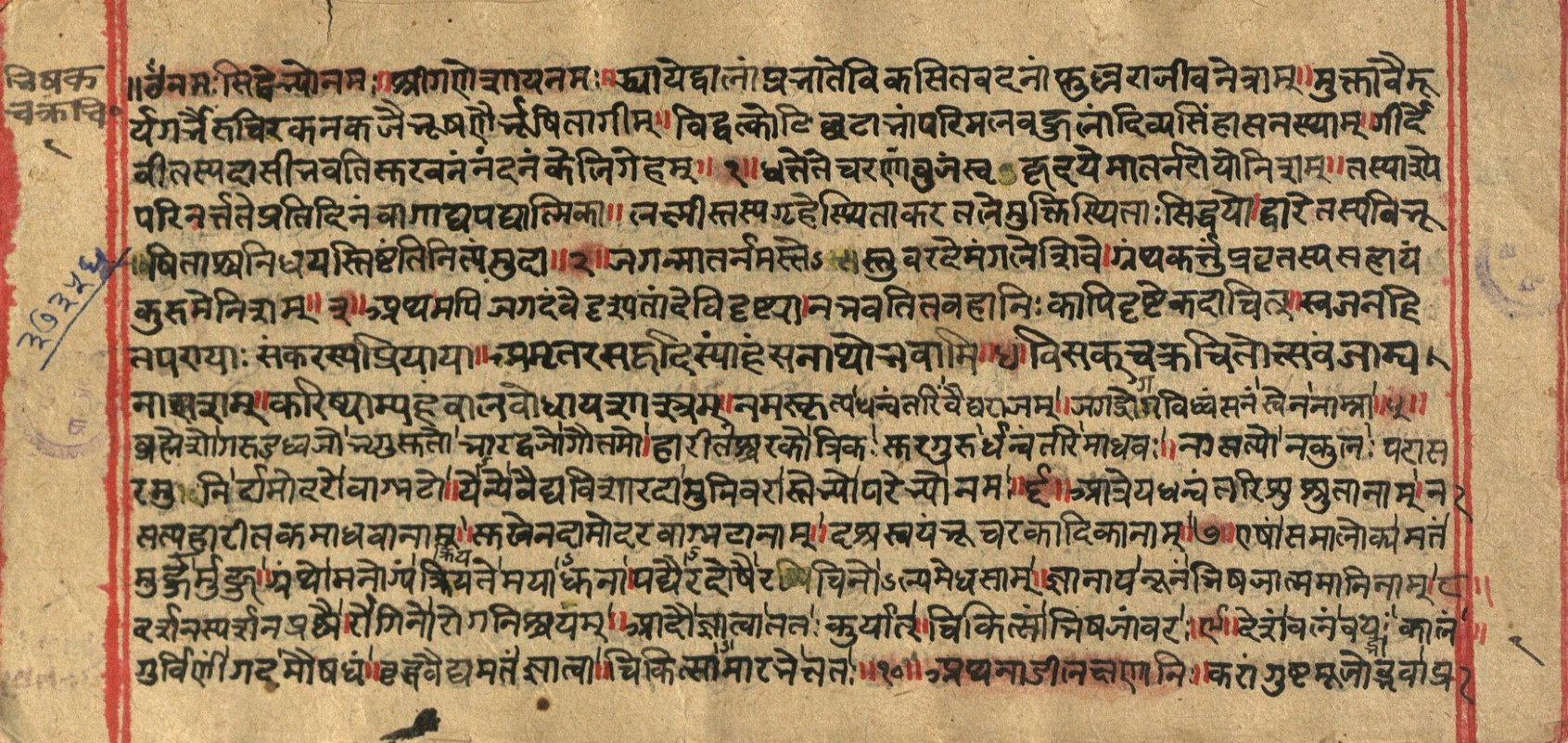
In 1945, the royal physician Haṁsarāja composed a medical treatise whose title announces its ambition: the Bhīṣakcakracittotsava, 'the festival of the physician's heart.' The manuscript, preserved at the Rajasthan Prachyavidya Pratishthan in Jodhpur, opens by saluting the lineage of healers — Dhanvantari, Caraka, Suśruta, Vāgbhaṭa, Ātreya, and Mādhava — and immediately sets out the three diagnostic gates: observation, touch, and inquiry.
Then comes the pulse. The text locates nāḍī-jñāna at the root of the thumb and describes the characteristic movements of the vāta, pitta, and kapha pulses through elaborate similes drawn from the movement of birds — the vāta pulse like a serpent, the pitta pulse swift and leaping, the kapha pulse slow and steady. Haṁsarāja presents pulse reading not as a single sign but as a window onto the doṣas' current state.
Naming the Fever
The fever chapters are the treatise's core. Fevers are classified by doṣa — vātajvara, pittajvara, śleṣmajvara, and their combinations — and the manuscript carries detailed symptomatology for each. Sannipāta fever, involving all three doṣas, is described with delirium, fainting, and trembling as its graver signs. The text also catalogs fevers by cause: grief-induced, fear-induced, anger-induced, even fevers arising from divine wrath. Each carries its own symptom cluster and its own prognosis.
Having paid homage to Dhanvantari, the king of physicians... To all those eminent physicians and sages, and to those beyond them, salutations... Having personally studied the works of Charaka and others.
A Book Written to Be Taught
Haṁsarāja states plainly that he composed the work in verse bālabodhāya — for the understanding of beginners. The result is a text that moves from the pulse at the wrist to the names of fevers to the signs of cure and death, all in memorizable meter. It is a teaching manual in the truest sense: a royal physician's attempt to make the whole of diagnostic medicine portable, and a manuscript that preserves that attempt for the modern reader.
|| 6 || Of Atreya, Dhanvantari, Sushruta, and the sage Satyaharita, Of Madhava, Shukra, Damodara, and Vagbhata, Having personally studied the works of Charaka and others, || 7 || Having observed their opinions, with joy, the wise compose this treatise, Adorned with verses, free from flaws, for those of modest intellect, For the sake of knowledge, for physicians who hold themselves in high regard
This ancient Ayurvedic manuscript page describes severe diseases caused by planetary influences and imbalanced doshas, including sannipata (tridosha fever), karnaka (ear lobe swelling with throat pain and breathing issues), bhugnanetra (memory loss, vision impairment, and fever), raktaṣṭhīvī (blood vomiting, internal burning, and cough), pralāpī (delirium, fever, and confusion), jihvaka (tongue discomfort, deafness, and emaciation), and abhināsa (body tremors, insomnia, and chronic weakness)
||10|| Now, the signs of one freed from disease: The characteristics of a man released from illness are the free passage of urine and stool, mental clarity, lightness in the body, extreme softness of the tongue, a good appetite, sound sleep, absence of itching in the chest and head, no sleeplessness after eating, and a clear mind
||72|| If the tongue is very dark and rough, with sleeplessness day and night; if breathing is labored, eyes protrude, the nose is slack, and the mouth is dry; if the body develops many circular marks, with fainting, delirium, and darkness; if cough arises with hiccups, the disease is incurable and declared untreatable by other physicians
||22|| Now, fever caused by pitta and phlegm: bitterness in the mouth, loss of appetite, discharge of phlegm, drowsiness, frequent nausea, coldness, pain in the joints, burning sensation in the heart, thirst, giddiness, cough, labored breathing, pallor, diarrhea, vomiting, and delusion—these are the signs of pitta-phlegm fever as declared by the ancient sages
|| One should meditate upon the youthful goddess at dawn, with a blossoming face and eyes like full-blown lotuses, Adorned with ornaments of pearls, cat’s-eye gems, and shining gold, Her form radiant like millions of lightning flashes, draped in fine garments, seated upon a throne of tiger and lion
|| 31 || Now, Bhuta fever: caused by spirits, ghosts, demons, || or goblins, this fever brings pain in the heart, trembling, fainting, delirium, intoxication, || vertigo, crushing of limbs, confusion, laughter, occasional wailing, singing, and bloodshot eyes—know these as signs of Bhuta fever in a person
||55|| Now, fever arising from grief: Fever born of grief for lost wives, mothers, or sisters causes Emaciation, constant mental distress, repeated lamentation, Transience, weakness, limb heaviness, fainting, delirium, wasting, Profuse sweating, great confusion, loss of appetite, severe thirst, Sleeplessness, and pallor of the body