
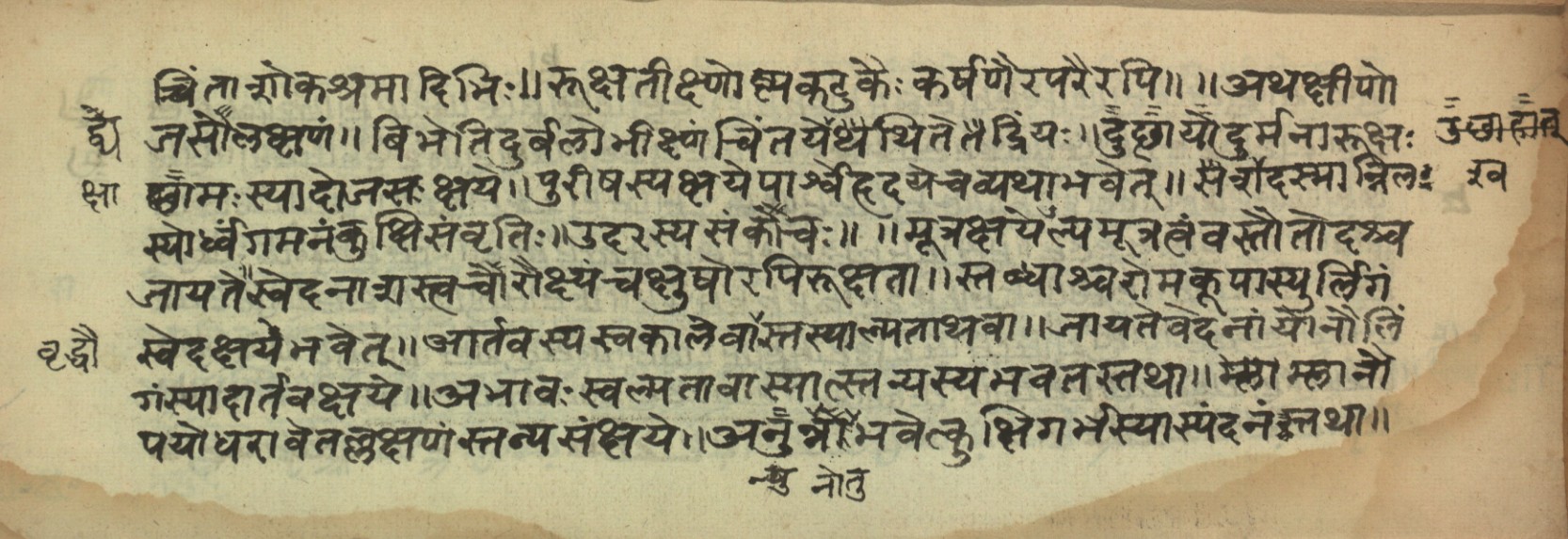
There is a difference between a doṣa that is raw and one that is cooked. The Bhāvaprakāśa — the great sixteenth-century compendium of Miśrabhāva, here in a short working copy — devotes careful attention to āma, the undigested residue that clogs the body, and nirāma, the same humor once the digestive fire has matured it. Telling them apart, the text insists, changes the treatment.
What āma looks like
The manuscript gives each doṣa two portraits — raw and cooked — with precise sensory signs that a physician can observe in the patient sitting before them.
He describes the characteristics of a non-āma condition of vāta: Non-āma is clear, rough, without obstruction, and causes little pain. It is pacified by opposite qualities, especially by unctuous ones. He describes the characteristics of āma-pitta: Pitta becomes āma — luminous, foul-smelling, green, heavy, sour, causing burning in the throat and heart, dark brown, stable, impairing appetite, and said to deplete strength.
The language is diagnostic: nirāma vāta is clear and rough; āma-pitta is foul, heavy, sour, burning. One look at the tongue, one question about appetite, and the physician knows which state they are in. The text moves from theory to bedside observation immediately — this is how you recognize āma when you see it.
Why the distinction matters for treatment
The reason for all this observation is therapeutic. Āma and nirāma demand opposite approaches — the raw state must be dried, heated, and digested; the cooked state can be pacified directly. Prescribing for one when the patient has the other is how treatment fails, how remedies backfire, how a physician loses a patient's trust and health.
A manual of depletions and their signs
The same manuscript carries a careful catalogue of depletions — of kapha, rasa, vāta, and vitality — each with its own sensory signature and dietary remedy.
Furthermore, the increase of blood produces erysipelas, splenic disorders, abscesses, leprosy, gout, tumors, fullness of veins, jaundice, heaviness of limbs, drowsiness, intoxication, burning sensation, freckles, black moles, delusion, redness of eyes and urine, and inflammation of the anus, penis, and mouth.
The text catalogs not just the ailments but also the cravings that accompany each state of depletion, and in those cravings lies the cure.
A man with depleted bile (pitta) desires sesame, black gram, horse gram, meat, altered foods, wine, sour curds, fermented gruel, vinegar, and likewise yogurt — foods that are pungent, sour, salty, hot, sharp, and those that provoke anger, instability, and restlessness.
The physician's art, as taught here, is to recognize the craving and honor it — for the body knows what it needs to restore balance. A man with depleted pitta is drawn to sour and sharp foods not by chance but by the wisdom of the body seeking what it lacks.
He describes the disease characterized by āma: Lethargy, drowsiness, impurity of the heart, non-movement of doshas, turbidity of feces, urine, and vomit, heaviness in the abdomen, weak digestion—these symptoms indicate a disease associated with āma.
Constant consumption of unsuitable food, persistent anger, grief, anxiety, fear, exertion, excessive sexual activity, fasting, excessive purification therapies, suppression of natural urges, overexertion, and trauma may lead to the depletion of doshas, dhatus, and malas.
The causes of depletion are as much emotional as they are physical. Grief, anxiety, and anger deplete as surely as overexertion or fasting — a teaching that sees the body and mind as a single system, not two separate machines.
Key symptoms include pain in the sides and heart, constipation (udvarta), scant urine, bladder pain, dry skin, stiff hair follicles, absent or painful menstruation (artava kshaya), and reduced breast milk (stanya kshaya).
Treatment should be administered at the proper time; if the procedure is performed when the opportunity for treatment has not yet arrived or is in the future, it will not succeed.
Timing is as much a part of healing as the remedy itself. The Bhāvaprakāśa insists that treatment must meet the illness where it is — not before it fully manifests, not after it has entrenched, but in the moment of readiness.
As it is said: 'Food is Brahma, its essence is Vishnu, and the enjoyer is the great Lord Shiva.' Reflecting thus while eating, the defect of sight does not afflict.
From anxiety, grief, exertion, and the like; from rough, sharp, hot, pungent, and other depleting factors. Now, the symptoms of diminished vitality: the weakened one fears, is frequently anxious, and has distressed senses; his complexion is poor, his mind troubled, and his body rough. In the depletion of vitality, he becomes emaciated.
The Bhāvaprakāśa's genius is observational: it teaches physicians to see. Whether it is the foul heaviness of āma or the anxious thinness of depleted vitality, the body is always giving signs — and this manuscript is a lesson in how to read them, how to listen to what the tongue, the pulse, the appetite, and the emotion are all saying together.