
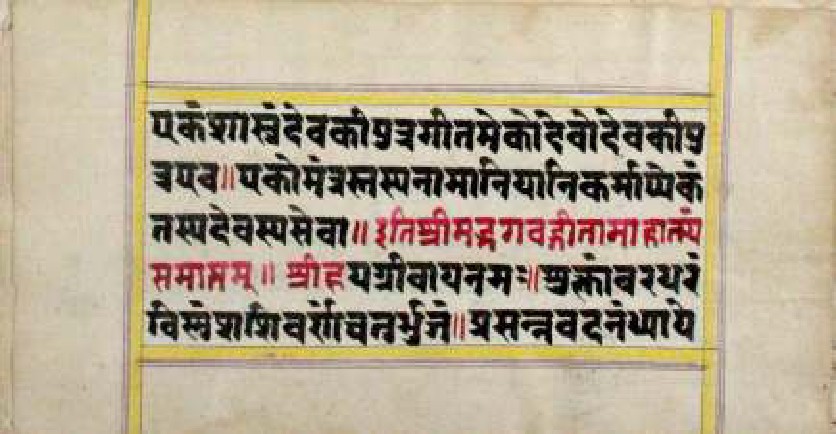
Some texts praise their subject. The māhātmya genre praises the text itself — and the Bhagavadgītāmāhātmya is one of the most enthusiastic examples. It is a work devoted to the power of the Gītā: what happens to you if you read it, recite it, or simply bathe in its waters. But this manuscript does something more than praise: it treats the Gītā as a liturgical object, complete with the rituals of worship that transform a scripture into a living presence.
What study does
The claims of the māhātmya are direct and total.
For one devoted to the study of the Gita and one engaged in pranayama, there are no sins, even those committed in previous lives. Bathing in water daily removes the impurities of men, but bathing even once in the waters of the Gita destroys the impurities of worldly existence.
The comparison is carefully built: daily bathing cleanses the body; a single immersion in the Gītā cleanses existence itself. The text is being described as a river — and, on the next page, as something even more exalted.
That which emerged of its own accord from the lotus-face of Padmanābha (Viṣṇu). The essence of all the nectar of the Bhārata (Mahābhārata), which emerged from the mouth of Viṣṇu. Having drunk the water of the Ganges of the Gītā.
The Gītā is not composed but 'emerged' — it wells up from the divine face, and drinking its water is the whole of the religious life.
A scripture with a mantra-body
What distinguishes this manuscript is what follows the eulogy: a full ritual apparatus for worshipping the Gītā as a deity. The text opens with a mālāmantra — a garland-mantra whose parts are assigned to the scripture's structure.
Om salutation to the Blessed Lord Vasudeva. Om. Of this garland of mantras of the Blessed Bhagavad Gita, the Blessed Lord is the deity, Vedavyasa is the seer, Anushtubh is the meter, Sri.
Like a mantra, the Gītā is given a seer, a meter, and a deity — the anatomy of a sacred formula. Then come the nyāsas, the ritual placements that put the text on the worshipper's own body.
'I shall liberate you from all sins, do not grieve' — this is the pin. Weapons do not cut this, fire does not burn this — with the thumbs, salutation. Water does not wet this, wind does not dry this — with the index fingers, salutation. This is uncuttable, this is unburnable.
The words of the Gītā itself — the promise of liberation, the stanza on the imperishable self — are turned into nyāsa formulas, recited while touching the thumbs, the heart, the head, the tuft of hair.
With the palms and backs of the hands: salutations. Thus hand placement. 'Weapons do not cut this' — to the heart: salutations. 'And waters do not wet it, wind does not dry it' — to the head: svāhā. 'Uncuttable is this, unburnable, unwettable, undryable indeed' — thus to the tuft: vaṣaṭ.
The six-limbed nyāsa completes the transformation: the scripture's phrases are assigned to armor, eyes, and weapon, each sealed with the ritual exclamations hum, vauṣaṭ, and phaṭ.
Eternal, all-pervading, immovable — thus for the armor, hum. Behold my forms, O Pārtha — thus for the three eyes, vaushat. Various divine — thus for the weapon, phat. Thus is the six-limbed nyāsa. For the pleasure of Śrī Kṛṣṇa, the application in recitation.
This is the Gītā treated as a tantric deity — a text with a body, placed on the worshipper's body, its words worn like armor.
The one scripture
The māhātmya ends by collapsing the whole religious life into a single focus.
One scripture, the song of the son of Devaki; one God, the son of Devaki alone. One mantra, His names; one work, the service of that God. Thus ends the Glorification of the Bhagavad-gītā.
Then the manuscript passes from the eulogy into the Gītā itself, invoking the text as a goddess before the first chapter begins.
By Vyāsa, woven by the ancient sage, in the midst of the Mahābhārata. The bestower of the nectar of non-duality, the blessed goddess of eighteen chapters. I meditate upon you with my mind. O Bhagavad-gītā, destroyer of the cycle of birth and death.
The text as a river of merit
Māhātmyas were the marketing arm of the tradition — texts that told you why another text was worth your life. The Bhagavadgītāmāhātmya, running to over three hundred pages in this manuscript, is a monument to that logic: the Gītā is not just true, it is powerful; not just wise, but cleansing. What this copy adds is the full ritual frame — the garland-mantra, the nyāsas, the meditation on the goddess of eighteen chapters — that makes the scripture not a book but a presence with its own body, its own water, and its own agency. Reading it, you see how a tradition took its most beloved text and dressed it for worship.