
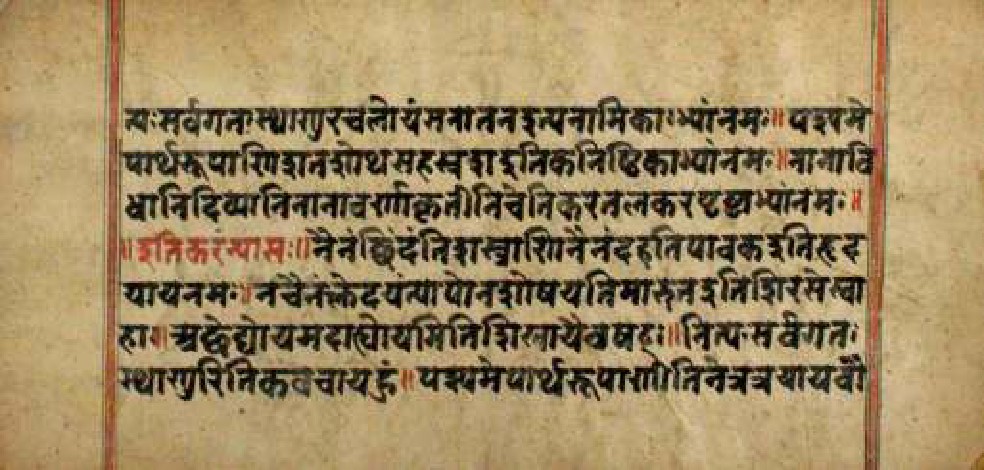
This 138-folio Bhagavad Gītā manuscript is not just a copy of the text — it is a ritual object. Before the first chapter begins, the Gītā is turned into a mantra with a ṛṣi, a meter, and a deity; its verses become seed-mantras placed on the body; and the book itself is meditated upon as the Bhagavatī, the Goddess of eighteen chapters. It is the Gītā as sādhana.
A mantra with lineage
The frame is precise. "Of this Śrī Bhagavad-gītā-garland-mantra, Śrī Bhagavān Vedavyāsa is the ṛṣi, anuṣṭup is the meter, Śrī Kṛṣṇa the Supreme Soul is the deity." The seed is Gītā 2.11 — "You grieve for those who should not be grieved for"; the power is 18.66 — "Abandoning all duties, take refuge in Me alone"; the pin is the same verse's promise — "I shall liberate you from all sins, do not grieve." The philosophical dialogue has been reclassified as a tantric mantra with parts.
The Gītā on the fingertips
Then comes kara-nyāsa, the placing of verses on the hands. "Eternal, all-pervading, firm, immovable, ancient — thus with the ring fingers, salutations. Behold my forms, O Pārtha, by the hundreds and thousands — thus with the little fingers." The famous verses on the indestructible self — "Weapons do not cut this, fire does not burn this" — are placed on the heart; "Waters do not wet this" on the head. The body becomes a diagram of the teaching.
Weapons do not cut this, fire does not burn this, water does not wet this, and wind does not dry this. It is eternal, all-pervading, stable, immovable, and ancient.
The cowherd milking the Upaniṣads
The dhyāna verses are devotional poetry at its richest. "All the Upaniṣads are cows; the milker is the son of the cowherd; Arjuna is the calf; the wise enjoyer; the milk is the great nectar of the Gītā." And: "He makes the mute eloquent, the lame cross the mountain — by whose grace, I bow to that supreme bliss, Mādhava." The Gītā is imagined as the river of battle, with Bhīṣma and Droṇa as its banks and Jayadratha as its water.
Then the text itself
After the consecration, the manuscript gives the Gītā proper — Dhṛtarāṣṭra's question, Sañjaya's narration, Arjuna's despondency, and Krishna's first teachings on the immortal self. Every familiar verse is here, from the trembling of Arjuna's limbs to the steady wisdom of the sthita-prajña. What makes this copy special is the frame: for its readers, the Gītā was not only to be understood but to be worn, chanted, and worshipped — a text with a ritual body as well as a meaning.
Those who are not learned, who delight in the words of the Vedas and declare "There is nothing else," who speak this flowery speech—whose souls are filled with desire, who are devoted to heaven, who promise rebirth as the fruit of actions, and who prescribe many special rites for the attainment of pleasure and power.
This manuscript preserves an entire tradition of embodied reading. The Gītā becomes ritual only when it has been placed on every part of the devotee's body, its verses mapped onto the hands and heart. Only then is it truly a mantra.