
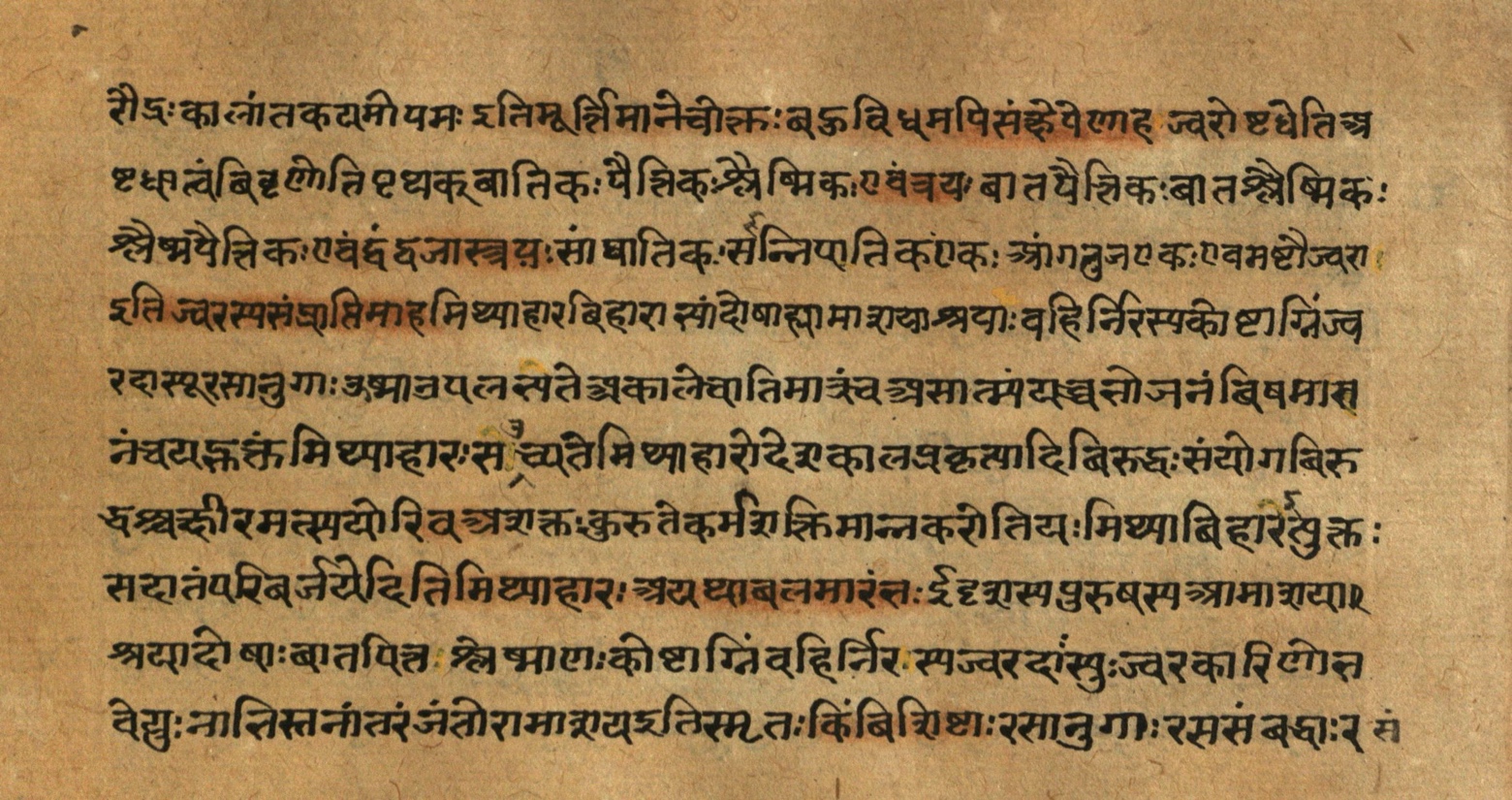
Some fevers are a diagnosis; sannipāta is a crisis. This nineteenth-century manuscript from Bikaner — the Ātaṅkadarpaṇanidāna, a commentary on the Mādhavanidāna — is devoted to the worst kind of fever: the one in which all three doṣas are inflamed at once. Its central question is timing — on which day does such a fever turn toward recovery, and on which day toward death?
Fever as a countdown
The text gathers the authorities — Bhaluki, Suśruta — on the critical days of a tridoshic fever, and they agree on a narrow window.
In the treatment of sannipāta (combined humoral disorder), the sage Bhaluki states that one must fight it with equal measures. Even according to Suśruta, in the case of sannipāta fever, the critical period for either recovery or death is indicated as the seventh, tenth, eleventh, or twelfth day. The fever caused by the three doṣas, due to the maturation of bodily tissues and waste, releases the person when vāta is predominant on the seventh day, pitta on the tenth, and kapha on the twelfth.
The days are not arbitrary — each is keyed to a doṣa. The physician watches, and the calendar decides.
Eight fevers, one system
Before descending into the crisis, the text sets out the full taxonomy — eight kinds of fever, with sannipāta as the most severe.
In brief, fever is said to be of eight types: Vāta, Pitta, Kapha, Vāta-Pitta, Vāta-Kapha, Kapha-Pitta — these three are dual; Saṃghātika (combined) and Saṃnipātika (tri-doshic) are one each, and Āgantu (external) is another — thus, eight fevers in total. The pathogenesis of fever is described: due to improper diet and lifestyle, the doshas residing in the stomach displace the digestive fire from the intestines, follow the rasa (nutrient fluid), and generate heat, which is perceived as fever.
The precision of prognosis
What makes the Ātaṅkadarpaṇanidāna remarkable is its diagnostic granularity — thirteen types of sannipāta, symptoms for each, and signs of tissue-maturation versus waste-maturation that separate the recoverable from the fatal. It is a fever manual that treats prognosis as seriously as diagnosis, and it survives as a working text of the Rajasthan Oriental Research Institute — the kind of book a physician in Bikaner would have reached for when the patient's fever reached the seventh day.
(39) Now, the symptoms of fever caused by the conjunction of all three (phlegm, bile, and wind) are described: One moment there is burning, the next moment cold; pain in bones, joints, and head; eyes bloodshot, teary, and impure; (40) Ears painful with noise, throat as if covered with thorns; drowsiness, confusion, delirium, cough, breathlessness, loss of appetite, and dizziness; (41) Tongue burned by excessively rough sensation, limbs heavy, vomiting of blood mixed with phlegm; (42) Rolling of the head, intense thirst, sleeplessness, heart discomfort, sweating, urine, and feces.
As stated in Suśruta: 'When the wind (vāyu), provoked by exertion or injury, fills the entire body, it gives rise to fever in living beings.' It is also stated in Caraka: 'Where the wind born of injury predominantly vitiates the blood, it causes discoloration of the doshas, along with pain and fever, thus becoming an external (āgantu) condition affecting the body.' Heat (ūṣmā) is observed in external fevers, but heat does not exist without pitta
Thirst and other symptoms, headache, dryness of throat and mouth (throat, lips, and mouth becoming dry), vomiting or the urge to vomit, horripilation, loss of appetite, a sensation of entering darkness (as if enveloped in darkness), joint pain (pain in the joints where they meet), and yawning—these arise from the combination of their own symptoms in dual (vata-pitta) and combined (sannipatika) fevers, produced by the confluence of doshas.
Therefore, its origin occurs later, as it is said: 'External fever first arises with pain and later becomes associated with the doshas.' It is also stated: 'An external fever follows its own pathological process, while an endogenous fever intensifies similarly.' The symptoms of fever are described as: suppression of sweat, burning sensation, stiffness of the entire body, and simultaneous occurrence in other diseases
Now, regarding the phlegmatic (ślaiṣmika), it is said: 'Stiffness, sluggish movement, lethargy, sweetness in the mouth, whiteness of urine and feces, rigidity, satiety, or alternatively, heaviness, coldness, pallor, horripilation, excessive sleep, nasal discharge, loss of appetite, cough—these are the symptoms of kapha-induced fever.' [Verse 33-34] 'Stiffness' refers to the softness of the limbs, as if they are heavy and sluggish
In fever caused by phlegm (kapha), symptoms such as a desire for food like that of a healthy person, heaviness in the limbs, coldness, excessive salivation, nausea, vomiting, frequent clearing of phlegm from the throat, horripilation, excessive sleepiness, nasal discharge, loss of appetite, and even with a desire for food, inability to consume it—these distinctions are observed