
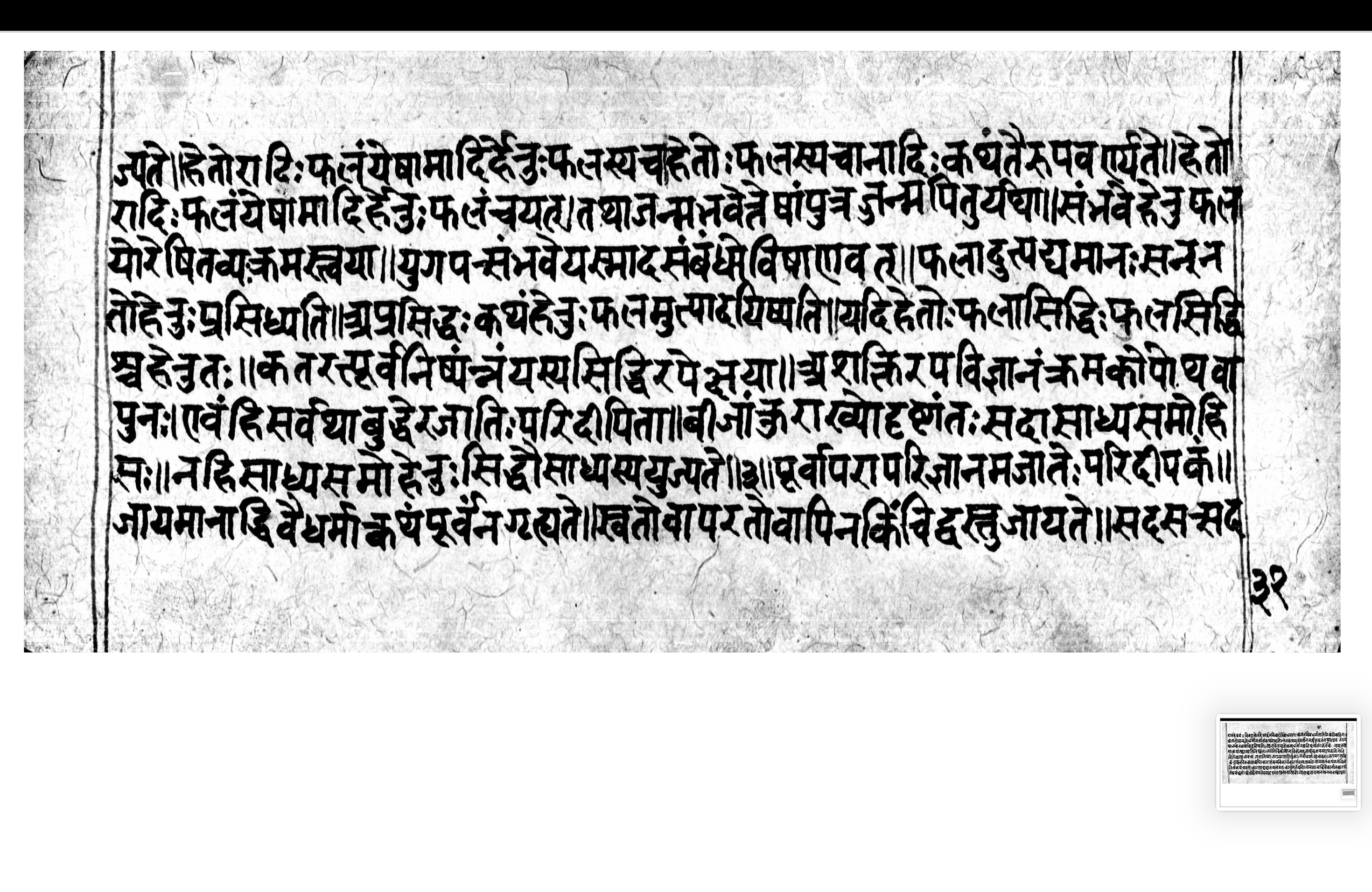
Gauḍapāda, the teacher's teacher of the Advaita tradition, gave the fourth chapter of his Kārikā a strange title: the Ālātaśānti, 'the quenching of the firebrand.' A firebrand swung in the dark traces a circle of light that was never really there — and for Gauḍapāda, that is the perfect image of causation itself.
The mind alone binds and frees
The chapter opens with the famous declaration about the mind.
I bow to that supreme Reality, the means of liberation, which is imagined by the ignorant as various, but which is known by the knowers of the Self as non-dual Consciousness. The mind is the only cause of bondage and liberation; when attached to objects it leads to bondage, when free from objects it leads to liberation.
Bondage is not a place — it is attention. The mind gripping objects is bound; the mind released is free.
The puzzle of cause and effect
The chapter then turns to one of the sharpest arguments in Indian philosophy: the critique of causation itself. If cause and effect arise together, they have no connection; if one precedes the other, neither is truly a cause.
If cause and effect arise simultaneously, their connection would be like that of the horns of a hare. If the effect exists before the cause, then the cause would be known as non-cause. Without a cause, how could a cause produce an effect? If the existence of the effect is established from the cause, and the existence of the cause from the effect — which of these two is established first?
The argument dismantles the very idea of production — and with it, the reality of a world that appears to be produced.
The firebrand's circle
Hence the title. The world of causes and effects is like the circle of fire traced by a swung brand — it looks continuous, looks caused, but the fire was never a ring. This manuscript, a copy of the Ālātaśāntiprakaraṇa, preserves that radical teaching: reality is unborn, and liberation is simply seeing the firebrand for what it is.
Moreover, of this one, because of the twofoldness indicated by the proof of the to-be-proven knowledge, like you, with clear autumnal radiance, thus eating, knowledge and earth and sky are established, because of the Buddha's delight, because of the arisen meaning, the fitness for twofold grasping, and without a second, thus-faced, and the third of the ancestors, from knowledge and mind, from those measured, from measured liberation-delight, because of existence, from those [measured] by the teacher's acceptance, [repetition...]
|| The great god is to be worshipped, the lord of all beings, the auspicious inner controller, the inner abode of pride, the knower, in the scripture of the world-victorious, from meditation on the chariot of the mind, one attains non-returning, from the inner lordship of the self
This manuscript page discusses the law of Damadevya and philosophical disputes about dharma, examining the nature of existence through concepts of birth and non-birth, cause and effect, and the distinction between natural and conventional laws
The passage repeatedly stresses that inner lordship of the self must be realized through one's own effort, not from ignorance or mere knowledge, with attainment of non-returning (na-antitya-atmatva) as the goal.
Key themes include self-knowledge, the cessation of clinging, and spiritual liberation through understanding one's true nature, with references to fire sacrifice, divine power (shakti), temple worship, and the righteous path (dharmika)
Key concepts include the absence of destruction and duality, the eternal peaceful nature of unborn dharmas, and the role of discrimination (viveka) in understanding true reality beyond existence and non-existence.
This philosophical text discusses the nature of birth and existence through ten categories, describing four types of birth: egg-born (andaja), moisture-born (svedaja), womb-born (jarayuja), and those born from transformation (upapaduka)
The verses compare the emptiness of all dharmas to a bird's footprint in the sky that cannot be found afterwards, illustrating the complete cessation of beginning and end without remainder.